Why your desert AC might be ready for retirement
Air-Right

<p>Discover if you should repair or replace your AC in the desert. Learn lifespan signs, $5K rule, SEER2 savings & heatwave tips for Las Vegas homes.</p>
Why the Desert Changes Everything About the Repair vs. Replace Decision
If you’re wondering should I repair or replace my AC in the desert, here’s a quick answer based on your situation:
| Your Situation | Recommended Action |
|---|---|
| Unit is under 10 years old, minor issue, repair cost is low | Repair |
| Unit is 10-12+ years old with frequent breakdowns | Lean toward replacement |
| Repair cost × unit age exceeds $5,000 | Replace |
| Repair cost exceeds 50% of a new system’s price | Replace |
| Unit uses R-22 refrigerant | Replace |
| Rising energy bills despite regular maintenance | Evaluate replacement |
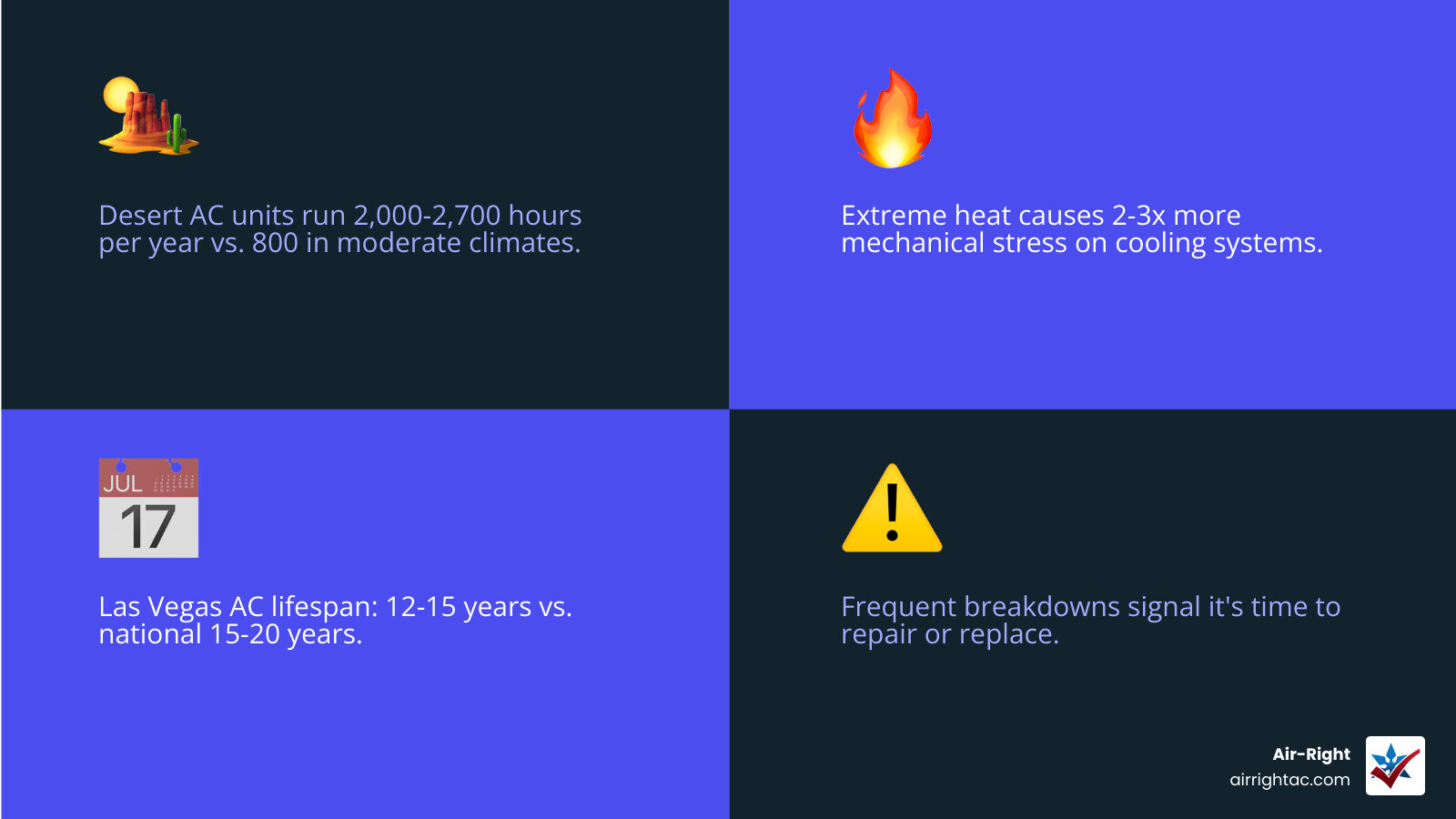
In Las Vegas and across the Mojave Desert, your air conditioner is not a seasonal appliance — it is a round-the-clock lifeline. Desert AC units run 2,000 to 2,700 hours per year, compared to just 800 hours in moderate climates. That is two to three times the mechanical stress, compressed into a system that was never designed to operate at those extremes indefinitely.
The national average AC lifespan is 15 to 20 years. In Las Vegas, Henderson, and surrounding desert communities, that number drops to 12 to 15 years — and for systems pushed hard through extreme summers without consistent maintenance, it can fall even shorter. When your unit starts showing signs of strain, the question of whether to repair or replace it carries real consequences: not just for your wallet, but for your health and comfort when temperatures climb past 110°F.
This guide will walk you through exactly how to make that call — clearly, without pressure, and with the desert math that actually applies to your home.
Understanding the lifespan of cooling systems in extreme heat
When we talk about the lifespan of an air conditioner in Las Vegas or Henderson, we have to throw out the “national averages” you see on big-box home improvement websites. The Mojave Desert is a beautiful but brutal environment for machinery. While a unit in a moderate climate might cruise through a summer with only 800 hours of operation, our local systems are often grinding through 2,000 to 2,700 hours per year.
This near-continuous operation for eight or more months of the year creates immense mechanical stress. Think of it like a car: a vehicle driven only on weekends will last decades, but a taxi driven 20 hours a day reaches its limit much faster. In our region, an AC unit reaching its 12th birthday is often at the same mechanical wear-and-tear level as a 20-year-old unit in the Midwest.
Beyond the heat, we have to contend with our “favorite” desert element: dust. Pervasive desert dust and caliche particles act like sandpaper on moving parts and blankets on cooling coils. When dust accumulates on your condenser coils, it prevents the system from releasing heat efficiently. This forces the compressor to work harder and run longer, which significantly accelerates component wear.
We’ve seen how How Desert Dust And Heat Change Your Ac Service Schedule—it isn’t just about cleaning; it’s about survival. By the time a system hits that 12-15 year window, the internal components have endured thousands of high-heat cycles that eventually lead to metal fatigue and electrical degradation.
Key indicators: Should I repair or replace my AC in the desert?
Deciding should I repair or replace my AC in the desert often comes down to listening to what your system is telling you. It rarely quits all at once without sending a few “warning shots” first.
One of the most obvious signs is the frequency of breakdowns. If you’ve had to call us out twice in a single summer for different issues, your system is likely entering its “domino effect” phase. Once one aging component fails, the strain it puts on the rest of the system often triggers a chain reaction of failures.
Keep an eye on your utility bills as well. If your energy consumption is climbing even though you haven’t changed your cooling habits, your system’s efficiency is likely plummeting. An old, tired motor or a struggling compressor has to draw significantly more power to achieve the same cooling effect as a healthy unit.
Other red flags include:
- Weak Airflow: Even if the air is cold, if it’s barely trickling out of the vents, your blower motor or ductwork may be failing.
- The “Ghosting” Phenomenon: If you find that My Ac Is Ghosting Me Why Your Unit Blows Air But No Coldness, it could be a sign of a dying compressor or a major refrigerant leak.
- Strange Noises: Squealing, grinding, or banging sounds are never “normal.” They usually indicate a mechanical failure that could soon lead to a total shutdown.
- R-22 Refrigerant: If your system was manufactured before 2010, it likely uses R-22 (Freon). Because this refrigerant has been phased out, repairing leaks in these units has become prohibitively expensive and difficult.
For a deeper dive into these symptoms, check out our guide on Signs Your Ac Needs Replacing Not Just Fixing.
Using the $5,000 rule to decide: Should I repair or replace my AC in the desert?
When emotions are high because your house is 90 degrees, it helps to have objective math to guide you. We often recommend the $5,000 Rule.
The calculation is simple: Multiply the age of your unit by the cost of the repair.
- If the total is under $5,000, a repair is usually a safe bet.
- If the total is over $5,000, you are likely throwing good money after bad, and a replacement is the smarter long-term investment.
For example, if you have a 12-year-old unit that needs a $600 repair, that’s $7,200. In this case, the math strongly suggests replacement. However, an 8-year-old unit needing a $400 repair ($3,200 total) is a great candidate for a second chance. You can learn more about this in our article on How To Decide If Your Ac Deserves A Second Chance.
Another popular metric is the 50% Rule: If a single repair cost exceeds 50% of the price of a brand-new system, it’s time to retire the old one. In the desert, we also use a “Point System” where we tally up factors like age, repair frequency, and noise levels. If your system scores too high, it’s a sign that its reliability has vanished.
How efficiency ratings help you decide: Should I repair or replace my AC in the desert?
Efficiency isn’t just a buzzword; in Southern Nevada, it’s a major part of your monthly budget. Modern systems are now rated using SEER2 (Seasonal Energy Efficiency Ratio 2) standards, which are more rigorous and realistic for hot climates.
If you are currently running an old 10 SEER system, upgrading to a modern 18 SEER2 unit can reduce your cooling-related electricity consumption by 40% to 60%. Over the course of a long Las Vegas summer, that translates to hundreds of dollars back in your pocket.
| System Rating | Relative Energy Usage | Potential Savings |
|---|---|---|
| 10 SEER (Old Standard) | 100% | Baseline |
| 14.3 SEER2 (Current Minimum) | ~70% | 30% Savings |
| 18 SEER2 (High Efficiency) | ~55% | 45% Savings |
| 20+ SEER2 (Ultra Efficiency) | ~40% | 60% Savings |
Beyond monthly savings, there are financial incentives to help you Save On Your Energy Bill. Local utility rebates from providers like NV Energy can range from $300 to $2,000 for qualifying high-efficiency equipment. Additionally, federal tax credits are often available for systems that meet specific efficiency thresholds, making the “net cost” of a new system much more attractive.
When to choose repair for short-term relief
Replacement isn’t always the answer. There are many scenarios where a professional repair is the most sensible choice, especially if the system is relatively young (under 10 years) and has been well-maintained.
Many common AC failures are actually minor electrical issues. A failed capacitor, for instance, is a very frequent occurrence in the desert because high heat puts immense strain on electrical components. Replacing a capacitor or a faulty thermostat is a quick, affordable fix that can get your system back up and running for several more years.
We also look at the warranty status. If your system is still under a manufacturer’s parts warranty, the cost of repair is significantly lower, making it much easier to justify fixing the unit. Other repair-friendly issues include:
- Thermostat Calibration: Sometimes the AC is fine, but the “brain” is confused.
- Frozen Coils: Often caused by a simple dirty filter or a minor airflow restriction.
- Minor Refrigerant Leaks: If the leak is small and the system uses modern R-410A refrigerant, a repair can be very effective.
Knowing How To Tell When Your Air Conditioner Needs Repair early on can prevent a small capacitor issue from turning into a blown compressor.
Strategic timing for your HVAC upgrade
Timing is everything when it comes to HVAC. Most homeowners wait until their system dies in the middle of a 115-degree July afternoon to think about replacement. This is the “panic zone,” and it’s the worst time to make a major financial decision.
The best time to replace your AC is during the “off-season”—typically late fall or early spring. During these months, scheduling is much more flexible, and you won’t be waiting in a long queue of emergency calls. Plus, replacing your unit before the heat hits ensures you have a reliable system ready for the first triple-digit day.
Proactive Maintenance Secrets To Keep Your Ac From Quitting On You include scheduling a checkup in February or March. This gives us a chance to identify if your unit is nearing retirement before you’re in an emergency situation. It’s also important to note that the HVAC industry is currently transitioning to A2L refrigerants, which are expected to increase the cost of new equipment by 20-25% in the coming year. Upgrading now could save you significantly compared to waiting until next year.
Understanding Why Your Ac Needs A Checkup Before The Next Heatwave can be the difference between a comfortable summer and a very expensive emergency.
Why you shouldn’t wait to replace your unit during a heatwave
Waiting for a total failure during a heatwave is risky for several reasons. First, there’s the “Peak Season Delay.” When every AC in Las Vegas is running at 100% capacity, breakdown rates skyrocket across the city. You might find yourself waiting days for a replacement unit to be delivered or for an installation crew to become available.
Second, and more importantly, are the health risks. In our climate, AC failure is a genuine emergency. Indoor temperatures can soar to dangerous levels within hours, posing a severe threat to pets, the elderly, and small children.
A proactive replacement allows you to:
- Research your options: You can compare different SEER2 ratings and features without the pressure of a boiling house.
- Improve Air Quality: Modern systems have much better filtration capabilities, which is vital for managing desert dust and allergens.
- Ensure Reliability: You get peace of mind knowing your system won’t quit when you need it most.
If you do find yourself in a crisis, refer to The Ultimate Survival Guide For When Your Ac Quits During A Heatwave for immediate steps to stay safe.
Frequently Asked Questions about Desert AC Units
How long do AC units last in Las Vegas?
While the national average is 15-20 years, the extreme heat and high run-times in Las Vegas typically limit an AC’s lifespan to 12-15 years. Systems that aren’t regularly maintained may even fail closer to the 10-year mark.
What are the most common AC problems in the desert?
The most frequent issues we see are failed capacitors (due to heat stress), clogged condenser coils (from desert dust), refrigerant leaks, and worn-out fan motors. Frozen evaporator coils are also common, often caused by restricted airflow from dusty filters.
Are there rebates for high-efficiency systems in Nevada?
Yes! Through programs like NV Energy’s PowerShift, homeowners can often receive rebates ranging from $300 to $2,000 for installing high-efficiency cooling equipment. Federal tax credits under the Inflation Reduction Act can also provide additional savings for qualifying systems.
Conclusion
Deciding whether to keep repairing an aging system or to invest in a new one is one of the biggest decisions you’ll make for your home. In the Las Vegas Valley, the stakes are high, but the math is clear. Whether you’re in Henderson, Boulder City, or Las Vegas, our goal at Air-Right is to provide you with a professional diagnostic and the honest information you need to make the right choice for your family.
We believe in no-pressure recommendations. If a simple repair will safely get you through another few seasons, we’ll tell you. If your system is a “money pit” that’s likely to fail when the mercury hits 115, we’ll show you why.
Consider joining one of our Hvac Maintenance Plans Pros Cons And Peace Of Mind to keep your current system in top shape, or contact our licensed experts today for a full system evaluation. Don’t wait for the next heatwave to find out if your AC is ready for retirement.
Schedule your professional AC system services with Air-Right today and stay cool with confidence.
Need Help?
Contact us today to discuss your needs. Our team is ready to help.
Related Articles
- Is It a True Emergency? A Triage Guide for 24-Hour Air Conditioning Service in Las Vegas, NV
- Is That Burning Smell an Emergency? Fall Triage Guide for 24 Hour Air Conditioning Service in Las Vegas, NV
- Beyond 24-Hour Air Conditioning Service in Las Vegas: Heat Pump vs. Gas Furnace Options for Fall Upgrades
Related articles


Ready to Get Started?
Whether you need a repair, maintenance, or a new installation, our expert team is here to help.