Why Your Attic and Ducts Need to Stop Fighting and Start Working Together
Air-Right

<p>Discover: do you need duct insulation or attic insulation first for peak energy efficiency in your hot Las Vegas attic? Stop heat loss now!</p>
Why Your Attic and Ducts Are Fighting Over Your Energy Bill in Las Vegas
Do you need duct insulation or attic insulation first is one of the most common questions Las Vegas homeowners ask when trying to cut sky-high energy bills — and the short answer is: seal and insulate your ducts first, then address attic floor insulation.
Here’s a quick breakdown:
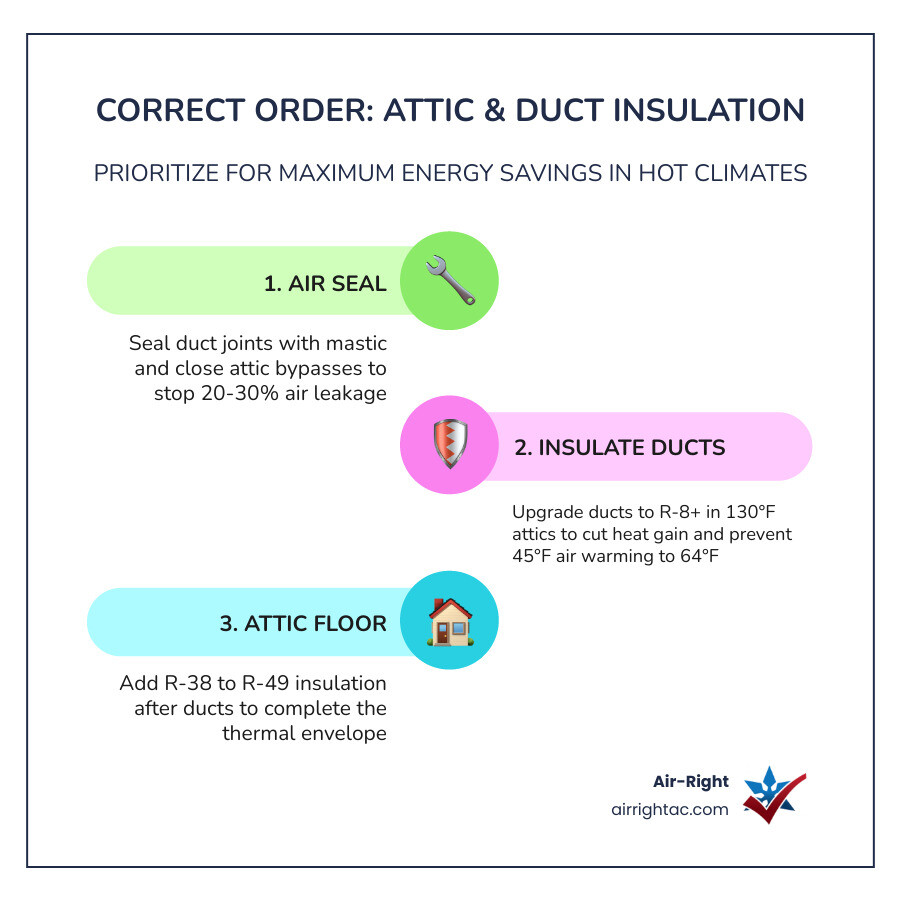
- Step 1 — Air seal everything: Before touching any insulation, seal air leaks at duct joints with mastic, and close attic bypasses like top plates and penetrations.
- Step 2 — Insulate your attic ducts: Ducts in an unconditioned Las Vegas attic face temperatures above 130°F. Upgrading duct insulation from R-6 to R-8 or higher directly reduces the heat your system has to fight.
- Step 3 — Add or upgrade attic floor insulation: Once ducts are sealed and insulated, bring your attic floor up to R-38 to R-49 to reduce overall heat transfer into your living space.
Most homeowners assume more attic insulation is always the first move. But in a Las Vegas home, your ductwork is sitting in one of the hottest unconditioned spaces imaginable — and no amount of attic floor insulation fully protects poorly insulated ducts from that extreme heat. According to energy efficiency research, ducts in unconditioned spaces can lose 20–30% of your conditioned air through a combination of leakage and inadequate insulation. In a 130°F Las Vegas attic, that means the 45°F air your AC produces can warm to 64°F or more before it ever reaches your vents.
The frustrating part? Most homes have duct insulation rated at only R-6 or R-8 — while the same attic floor is code-required to hit R-38. Ducts actually face a higher temperature difference than the ceiling below them, yet they receive a fraction of the thermal protection. That imbalance is exactly what this guide untangles.
Do You Need Duct Insulation or Attic Insulation First for Energy Efficiency?
When we look at the physics of a Southern Nevada home in April 2026, we have to talk about “Delta T”—the difference in temperature between two spaces. In a typical Las Vegas summer, your attic can easily hit 130°F. Inside your ducts, the air is roughly 50°F. That is an 80-degree difference trying to force heat into your cooling system. Meanwhile, the temperature difference between that same attic and your 75°F living room is only 55 degrees.
Logic dictates that the area with the highest temperature stress needs the most protection. However, most builders historically prioritized the attic floor. If you are wondering whether Duct Work Replacement In Boulder City A Survival Guide For Summer is more urgent than blowing in more fiberglass, consider the energy waste. Uninsulated or poorly insulated R-4 trunk ducts in a 105°F attic lose approximately 1,500 BTU/hr. Simply upgrading those ducts to R-8 can cut that loss in half to 750 BTU/hr.
The Delta T Double Standard
There is a massive “double standard” in modern building codes. We require attic floors to be insulated to R-38 or even R-49, yet we allow air ducts—the very veins of our comfort system—to sit in that same scorching heat with only R-6 or R-8 insulation. This R-value gap is why your AC might run constantly without ever making the house feel truly “crisp.” The heat absorption happening inside those thin-skinned ducts is fighting your air conditioner every second it runs.
Prioritizing the Thermal Envelope
To win the war against the heat, we recommend a “Phase 1” approach that focuses on the distribution system first. If your ducts are leaking or under-insulated, adding a foot of insulation to the attic floor won’t stop the 130-degree air from seeping into your duct joints. By following The Ultimate Guide To Attic Insulation In Henderson NV, you’ll see that sealing the thermal envelope starts with the most vulnerable point: the unconditioned space where your ducts live. So, if you’re asking do you need duct insulation or attic insulation first, the answer is to fix the delivery system (ducts) before you thicken the floor (attic).
| Feature | Typical Attic Floor | Typical Attic Ducts |
|---|---|---|
| Recommended R-Value | R-38 to R-49 | R-8 to R-12+ |
| Common Current R-Value | R-19 to R-30 | R-4 to R-6 |
| Delta T (Temp Difference) | ~55°F | ~80°F |
| Energy Loss Impact | High (Radiant/Convective) | Critical (Conductive/Leakage) |
The Critical Role of Air Sealing Before Adding Insulation
Adding insulation over leaky ducts is like putting a sweater on over a wound—it might look better, but it doesn’t fix the underlying problem. Before we ever blow in cellulose or roll out batts, we must address air leakage.
Mastic Sealing vs. Duct Tape
Many homeowners in Henderson and Boulder City find that their old ducts were “sealed” with standard silver duct tape. In the extreme heat of a Nevada attic, the adhesive on that tape dries out and fails within a few years. We use mastic—a thick, gooey paste that hardens into a flexible, airtight seal. When applied “nickel-thick” over joints and reinforced with mechanical fasteners, mastic creates a 30-year bond that prevents your expensive cold air from blowing into the attic. This step is critical because duct leakage alone accounts for about 30% of energy loss in poorly maintained systems.
Identifying Attic Bypasses
Air sealing isn’t just for the ducts. Our Henderson Attic Insulation Guide emphasizes finding “bypasses”—hidden holes that let conditioned air escape from your rooms into the attic. Common culprits include:
- Recessed Lighting: Older “can” lights act like chimneys, sucking cold air out of your kitchen.
- Plumbing Penetrations: The gaps around pipes heading into the walls.
- Top Plates: The space where the wall framing meets the attic floor.
- Attic Hatches: Often the most overlooked “hole” in the ceiling.
By utilizing Affordable Attic Insulation Services In Boulder City NV, you ensure these bypasses are sealed with foam or caulk before the insulation goes down, preventing “dusty” insulation streaks that indicate air has been bypassing your thermal barrier for years.
Why Duct Performance Matters More in the Las Vegas Heat
In the Mojave Desert, our attics aren’t just warm; they are industrial-strength ovens. When attic temperatures soar to 130°F or 140°F, the physics of heat transfer accelerates. If you’ve ever noticed that your bedrooms feel stuffy despite the AC running, you are likely experiencing significant BTU loss through your duct walls.
Heat Gain in Unconditioned Spaces
The “sensible heat” gain in a duct system is a math problem we solve every day. If you have R-4 ducts (common in older Las Vegas homes), the surface area of those ducts acts like a giant radiator in reverse. It absorbs the attic’s heat and transfers it directly into the air stream. Upgrading to R-8 or higher significantly slows this process, allowing your home to reach its target temperature much faster. This isn’t just about comfort; it’s about reducing the “runtime” of your HVAC unit, which extends its lifespan.
Improving Supply Vent Temperatures
A healthy AC unit might output air at 45°F at the coil. If your ducts are poorly insulated, that air might be 64°F by the time it reaches the master bedroom. This 19-degree jump is a sign of “thermal bridging.” By Finding The Right Duct Work Company In Henderson Without Breaking A Sweat, you can ensure your ducts are wrapped and sealed to keep that 45-degree air as cold as possible. To Stop Baking Your Brain With Better Las Vegas Attic Insulation, you need a system where the attic floor and the ducts work in harmony to block out the desert sun.
Strategies for Burying or Elevating Attic Ductwork
One of the most debated topics in home efficiency is whether to “bury” ducts under attic insulation or keep them elevated. In our dry Las Vegas climate, the strategies differ slightly from humid coastal regions, but the goal remains the same: maximum R-value.
Condensation Risks in Humid Environments
While Las Vegas is generally dry, we do have “monsoon” periods where humidity rises. The risk of burying a duct is that if the duct surface gets cold enough to reach the “dew point,” moisture can condense on the outside of the duct. If that duct is buried under fiberglass, the moisture gets trapped, leading to mold and matted insulation. To prevent this, we often recommend encapsulating ducts in closed-cell spray foam before burying them. This creates a vapor barrier that prevents “sweating.”
Effective R-Values for Buried Ducts
Burying ducts (the BEDs method—Buried and Encapsulated Ducts) can effectively bring your ducts into the “conditioned space” of the home. When an R-8 duct is buried under 12 inches of blown-in insulation, its “effective” R-value can skyrocket to R-25 or higher.
Benefits of properly buried ducts include:
- Dramatic Heat Gain Reduction: The temperature around the duct stays much closer to the house temperature.
- Reduced Noise: Thick insulation dampens the sound of air moving through the system.
- Code Compliance: Meets the highest standards for Energy Star and DOE Zero Energy Ready homes.
- Lower Utility Bills: Some studies show a 15% reduction in cooling costs just from addressing attic duct heat gain.
Always refer back to our Henderson Attic Insulation Guide to see which burial depth is right for your specific roof pitch and truss design.
When to Call a Professional for Your Attic Upgrade
While many homeowners consider attic insulation a DIY weekend project, the reality is that the attic is a complex ecosystem. Mistakes can lead to fire hazards, mold, or even structural damage. At Air-Right, our NATE-certified technicians look at the “big picture” of your home’s health.
Expert Diagnostics and Safety
Before we add a single inch of insulation, we perform a safety sweep. In older Las Vegas homes, we check for:
- Knob and Tube Wiring: Covering this old wiring with insulation can cause a fire.
- Rodent Contamination: We never want to bury pest issues under new material.
- Ventilation Baffles: We ensure your “soffit” vents aren’t blocked, which is essential for letting the attic “breathe.”
- Combustion Safety: If you have a gas furnace in the attic, we must ensure it has enough air to burn safely after we’ve sealed the space.
Finding A Reliable Attic Insulation Contractor In Henderson NV means choosing a team that understands airflow balance. If you seal the house too tight without checking the furnace, you could create backdrafting issues.
Long-Term Energy Savings
The return on investment (ROI) for professional duct sealing and attic insulation is among the highest of any home improvement. You aren’t just saving money on your monthly bill; you are protecting your HVAC system. A unit that doesn’t have to fight 130-degree attic air lasts years longer than one that’s constantly overworked.
Our professional inspection includes:
- Duct Blaster Testing: Measuring exactly how much air is leaking.
- Thermal Imaging: Finding the “hot spots” where insulation is missing or thin.
- Static Pressure Check: Ensuring your ducts are sized correctly for your AC unit.
- Moisture Assessment: Checking for roof leaks or condensation before they become mold.
Frequently Asked Questions
Do you need duct insulation or attic insulation first in humid climates?
Even in humid climates, sealing and insulating the ducts remains the priority. However, in humid areas, you must be extremely careful to use a continuous vapor barrier (like mastic or closed-cell foam) to prevent condensation from forming on the cold duct surfaces when they are surrounded by humid attic air.
Do you need duct insulation or attic insulation first to stop uneven room temperatures?
Duct insulation and sealing are usually the “magic bullet” for uneven temperatures. If one room is hotter than the others, it’s often because the air is warming up in a long, poorly insulated duct run before it gets to that room. Attic insulation helps the whole house, but ductwork fixes specific “hot spots.”
What R-value is recommended for attic ducts in 2026?
As of April 2026, we recommend a minimum of R-8 for all attic ductwork in the Las Vegas area. However, for maximum efficiency and to meet the latest high-performance home standards, aiming for R-12 or burying ducts to achieve an effective R-value of R-25 is the gold standard.
Conclusion
The battle between your attic and your ducts doesn’t have to end in a high energy bill. By prioritizing the sealing and insulation of your ductwork first, you ensure that the cold air you pay for actually makes it into your living room. Once your distribution system is protected, adding high-quality attic floor insulation creates a secondary shield that keeps the desert heat at bay.
At Air-Right, we specialize in making Southern Nevada homes more comfortable and efficient. Whether you are in Las Vegas, Henderson, or Boulder City, our team provides clear, no-pressure recommendations to help you save energy and stay cool.
Need Help?
Contact us today to discuss your needs. Our team is ready to help.
Related Articles
- Is It a True Emergency? A Triage Guide for 24-Hour Air Conditioning Service in Las Vegas, NV
- Is That Burning Smell an Emergency? Fall Triage Guide for 24 Hour Air Conditioning Service in Las Vegas, NV
- Beyond 24-Hour Air Conditioning Service in Las Vegas: Heat Pump vs. Gas Furnace Options for Fall Upgrades
Related articles


Ready to Get Started?
Whether you need a repair, maintenance, or a new installation, our expert team is here to help.