Triple Digit Trouble: Why Your Air Conditioner Is Quitting on You
Air-Right

<p>Discover common reasons ac stops cooling in triple digit weather. Learn fixes for Las Vegas heatwaves & boost AC performance now!</p>
Why Your AC Stops Cooling When Las Vegas Temperatures Hit Triple Digits
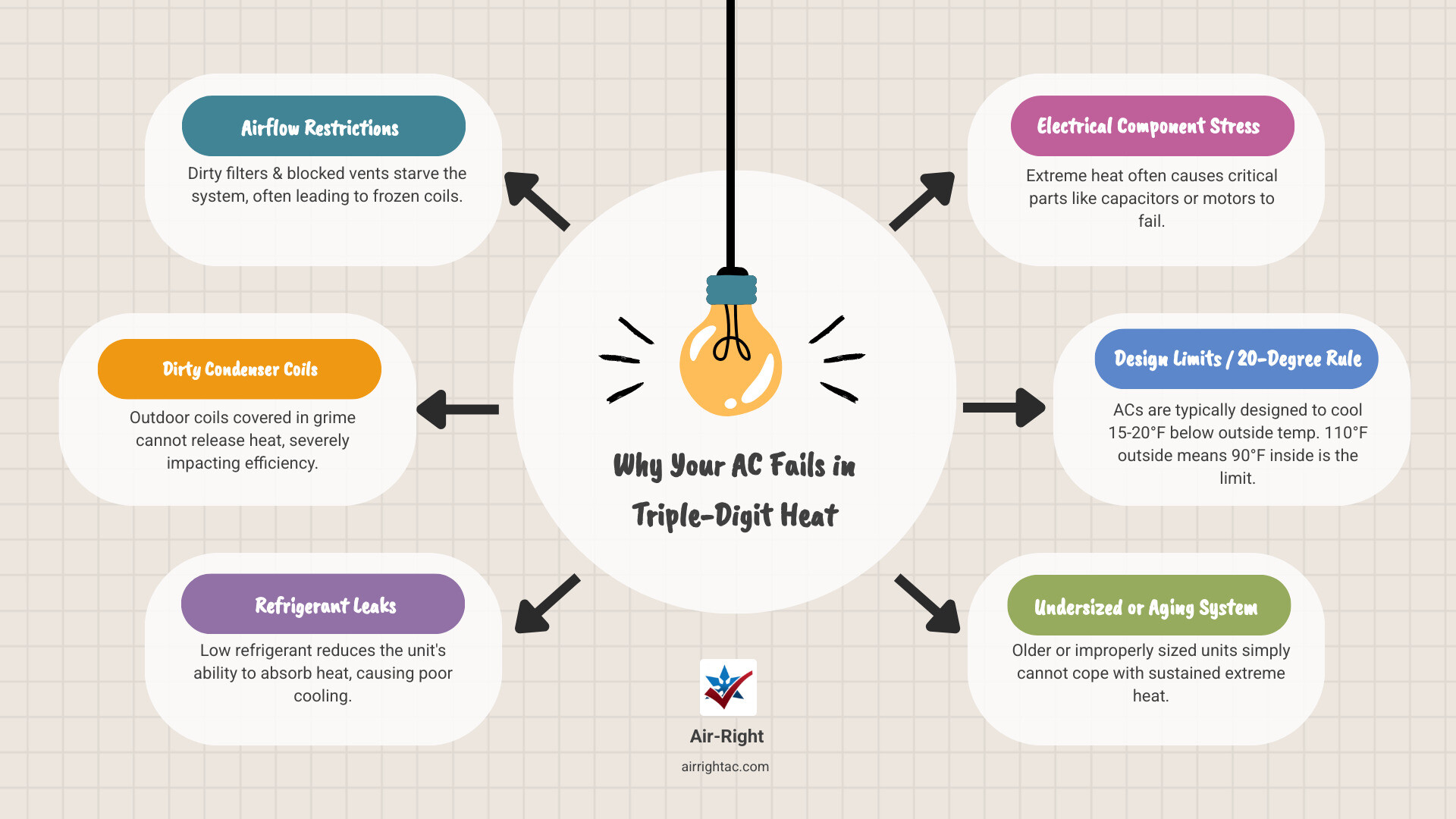
The common reasons ac stops cooling in triple digit weather are something every Las Vegas homeowner needs to understand — especially when summer temperatures routinely push past 110°F and your home starts feeling like an oven.
Here is a quick breakdown of the most common culprits:
- Dirty or clogged air filter — restricts airflow and can cause the evaporator coil to freeze
- Dirty outdoor condenser coils — prevents heat from escaping, killing cooling capacity
- Low refrigerant from a leak — reduces the system’s ability to absorb and transfer heat
- Failed run capacitor — one of the most common part failures, especially in extreme heat
- Frozen evaporator coil — responsible for roughly 30% of “AC not cooling” service calls
- Thermostat set incorrectly or malfunctioning — sometimes the fix is simpler than you think
- System hitting its design limit — most AC units are only built to cool about 15–20°F below the outdoor temperature
- Undersized or aging system — older and underpowered units struggle to keep up when heat is relentless
- Blocked or tripped electrical components — tripped breakers, worn contactors, or burned fan motors
When outdoor temperatures soar into triple digits across Las Vegas, Henderson, and Boulder City, your air conditioner is not just running — it is fighting for its life. The same heat that makes your home unbearable also puts every component inside your AC system under intense mechanical and electrical stress. Small problems that are easy to ignore in mild weather become full breakdowns when the mercury refuses to drop.
Understanding why this happens — and what to watch for — can mean the difference between a quick fix and a week of sweating it out waiting for emergency service.
The Physics of Extreme Heat: Why AC Systems Struggle
As we move through April 2026, we are already preparing for the inevitable Southern Nevada heatwaves. To understand why your unit might fail, we first have to look at the “20-degree rule.” Most residential air conditioners are engineered to maintain an indoor temperature that is roughly 15 to 20 degrees cooler than the outside air.
When it is a manageable 95°F in Henderson, your AC can easily keep the living room at a crisp 75°F. However, when the Las Vegas Strip hits 115°F, that same math suggests your home might struggle to get below 90°F or 95°F. This isn’t necessarily a sign of a broken unit; it is simply the physics of heat rejection. The hotter it is outside, the harder it is for your system to “dump” the heat it gathered from inside your home.
When a system is pushed to these design limits for hours on end, it experiences thermal overload. This constant “marathon sprinting” leads to How to Tell When Your Air Conditioner Needs Repair because the mechanical parts simply cannot dissipate heat fast enough to stay lubricated and cool.
Common reasons ac stops cooling in triple digit weather
In our experience serving Boulder City and the surrounding valley, the common reasons ac stops cooling in triple digit weather usually involve a combination of environmental factors and neglected maintenance. The desert is a harsh environment; dust, high winds, and extreme UV rays degrade components faster here than almost anywhere else.
One of the most frequent issues we see is the failure of the outdoor condenser. If the coils are caked in fine Vegas dust, the heat transfer process is smothered. Additionally, refrigerant leaks are a major culprit. Refrigerant is the “lifeblood” of your system, and even a tiny pinhole leak can drop the pressure enough to stop the cooling process entirely. When the pressure drops, the temperature of the remaining refrigerant actually plummets, which leads to a counter-intuitive problem: a frozen system in the middle of a 110-degree day. You can learn more about these indicators by Getting to Know Common Signs of a Faulty HVAC Unit.
Airflow issues as common reasons ac stops cooling in triple digit weather
Airflow is the “breath” of your HVAC system. If your AC can’t breathe, it can’t cool. A dirty air filter is the #1 reason for service calls during a heatwave. In the summer, we recommend checking your filters every single month. A clogged filter creates a vacuum effect that starves the evaporator coil of warm air. Without that warm air to absorb, the coil gets too cold and the condensation on it turns to ice.
Beyond filters, blocked return vents (often by furniture or rugs) and leaky ductwork are major contributors. If your ducts are pulling in 130-degree air from your attic because of a tear, your AC will never win that battle. This is why we emphasize Duct Work Replacement in Boulder City: A Survival Guide for Summer as a critical long-term comfort strategy.
Electrical strain and other common reasons ac stops cooling in triple digit weather
The electrical components of your AC are under massive stress during a heatwave. The “run capacitor” is the most common part to fail in Southern Nevada. Think of it like a high-powered battery that helps the motors start and stay running. Intense heat causes these to bulge and eventually “pop,” leaving you with a fan that won’t spin or a compressor that won’t hum.
Contactors — the switches that tell the unit to turn on — can also become “pitted” or burnt from constant cycling. When the unit turns on and off 50 times a day to keep up with the heat, these electrical points wear down. If you notice a buzzing sound or the outdoor unit isn’t kicking on at all, you likely need Expert AC Repair in Henderson, NV to swap out these stressed components before they cause a more expensive motor burnout.
The Critical Role of the Outdoor Condenser Unit
The outdoor unit is the “exhaust” of your home. Its job is to take the heat collected from your bedrooms and blow it into the outside air. In triple-digit weather, that “outside air” is already boiling, making the job incredibly difficult.
For the condenser to work, it needs at least two feet of clear space around it. We often find units tucked behind bushes or blocked by storage sheds, which traps a “heat bubble” around the machine. Cleaning a dirty condenser coil alone solves the problem about 80% of the time when a unit is underperforming. We recommend gently rinsing the fins with a garden hose (never a pressure washer!) to remove the buildup of caliche dust and debris. For a deeper look at keeping this unit alive, check out The Ultimate Las Vegas AC Repair Survival Guide.
Home Efficiency Factors: Insulation and System Sizing
Sometimes the AC isn’t the only problem; the house itself might be working against you. In Las Vegas, attic temperatures can reach 140°F or higher. If your insulation is thin or settled, that heat radiates directly through your ceiling.
| Factor | Insulated Attic (R-49+) | Poorly Insulated Attic |
|---|---|---|
| Attic Temp | 125°F (Vented) | 150°F+ |
| Heat Transfer to Home | Minimal | Significant |
| AC Run Time | Cycles normally | Runs 24/7 |
| Energy Bill | Moderate | Sky-high |
If your system was installed 15 years ago, it might also be “undersized” for our modern, hotter summers. An undersized unit will run constantly but never reach the set point on the thermostat. Improving your home’s envelope by Finding the Right Duct Work Company in Henderson Without Breaking a Sweat can take a massive load off an aging AC unit.
Preventative Measures to Survive a Southern Nevada Heatwave
We always say that an ounce of prevention is worth a gallon of sweat. To keep your system from becoming part of the “30% of calls” involving frozen coils, follow these steps:
- Change filters monthly: Don’t wait for the three-month mark during a Vegas July.
- Set it and forget it: Avoid “cranking” the thermostat down to 65°F. It won’t cool the house faster; it will just ensure the compressor never gets a break, leading to a blowout. 78°F is the gold standard for efficiency and system longevity.
- Shade the unit: If possible, provide shade for your outdoor unit during the hottest part of the day, but ensure you don’t block the airflow.
- Close the blinds: Use thermal curtains or blackout blinds on south and west-facing windows to block solar heat gain.
The best way to ensure you aren’t left stranded is a seasonal tune-up. Our AC Maintenance Contract is designed to catch weak capacitors and low refrigerant levels in the spring, before the triple digits arrive.
When to Call a Professional for Heatwave Repairs
While we encourage homeowners to check their breakers and filters, some things require a licensed expert. Handling refrigerant is hazardous and requires EPA certification. If you see ice on your lines, hear a loud screeching (fan motor failure), or smell something burning (electrical short), turn the system off immediately at the breaker and call us.
Running a failing system “just one more hour” can turn a simple repair into a total system replacement. There are many Reasons to Keep Your HVAC Unit Maintained by Experts, but the most important one is safety. High-voltage electricity and pressurized chemicals are not DIY-friendly.
Frequently Asked Questions about AC Performance
Is it normal for my AC to stay at 78°F when it is 110°F outside?
Yes. If your unit is maintaining a 20-30 degree difference from the outdoor temperature, it is likely performing exactly as designed. If it is 115°F outside and your home is 78°F, your AC is actually doing a fantastic job.
How often should I change my air filters during a Las Vegas summer?
Every 30 days. The high volume of air moving through your system during 100+ degree days means the filter collects dust and pet dander three times faster than it does in the winter.
What are the warning signs of a refrigerant leak in extreme heat?
Look for “hissing” or “bubbling” sounds near the indoor or outdoor coils. Other signs include the AC running 24/7 without the house getting cooler, or ice forming on the copper “line set” that connects the indoor and outdoor units.
Conclusion
Surviving a Southern Nevada summer requires a partnership between you and your HVAC system. By understanding the common reasons ac stops cooling in triple digit weather, you can take proactive steps to keep your home comfortable. At Air-Right, we pride ourselves on being licensed, bonded, and insured experts who provide clear, no-pressure recommendations to our neighbors in Las Vegas, Henderson, and Boulder City.
Whether you need a quick capacitor swap, a deep coil cleaning, or a high-efficiency system upgrade, we are here to help. Don’t let the desert heat win this summer. For comprehensive care, explore our full range of AC System Services and let us keep your home the sanctuary it should be.
Need Help?
Contact us today to discuss your needs. Our team is ready to help.
Related Articles
- Is It a True Emergency? A Triage Guide for 24-Hour Air Conditioning Service in Las Vegas, NV
- Is That Burning Smell an Emergency? Fall Triage Guide for 24 Hour Air Conditioning Service in Las Vegas, NV
- Beyond 24-Hour Air Conditioning Service in Las Vegas: Heat Pump vs. Gas Furnace Options for Fall Upgrades
Related articles


Ready to Get Started?
Whether you need a repair, maintenance, or a new installation, our expert team is here to help.