The Ultimate Desert Dweller Guide to HVAC Maintenance
Air-Right

<p>Discover crucial hvac maintenance tips for las vegas homeowners. Beat the heat, dust & hard water for system longevity.</p>
Why HVAC Maintenance Tips for Las Vegas Homeowners Are Different From Everywhere Else
HVAC maintenance tips for Las Vegas homeowners aren’t the same as the generic advice you’ll find on a national home improvement blog — and following that generic advice here can cost you a compressor, or worse, a full system replacement years ahead of schedule.
Here’s the short version of what Las Vegas homeowners need to know:
- Change air filters monthly (June–August) and every 30–60 days the rest of the year — not the national 90-day standard
- Schedule a professional AC tune-up in March or April, before triple-digit temperatures arrive
- Schedule a heating inspection in October, before desert nights dip into the 30s
- Keep 2 feet of clearance around your outdoor condenser unit at all times
- Set your thermostat to 76–78°F when home and 82–85°F when away during summer
- Watch for warning signs like short cycling, unusual noises, ice on refrigerant lines, or a sudden spike in your energy bill
- Consider a maintenance membership for priority scheduling and system longevity
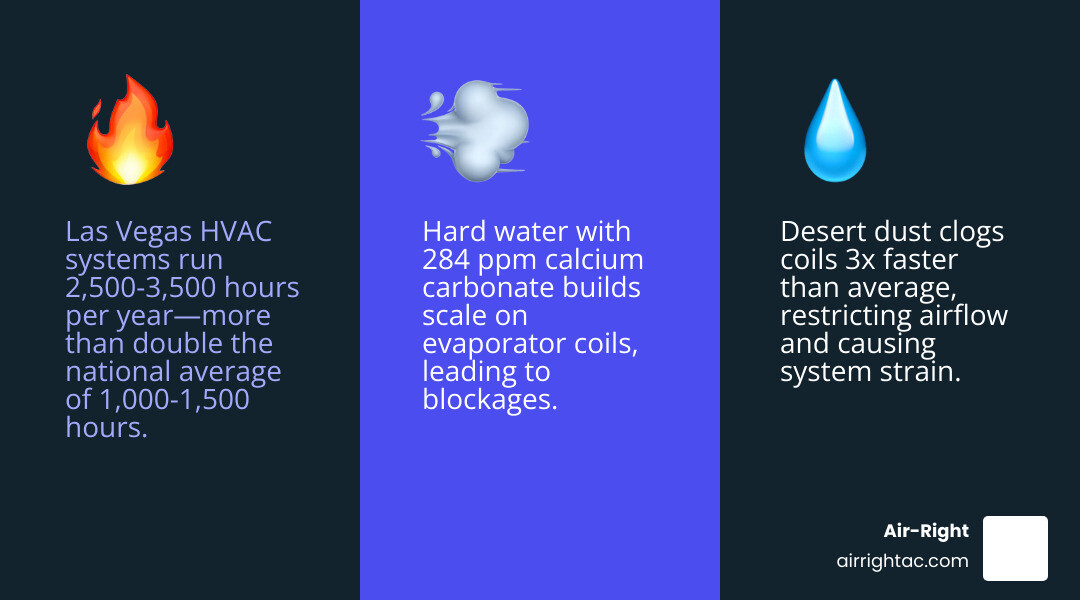
Las Vegas HVAC systems run 2,500 to 3,500 hours per year — more than double the national average of 1,000 to 1,500 hours. That’s not a small difference. It means your equipment ages faster, filters clog faster, and small problems that might stay small in a milder climate can become catastrophic failures by the time June rolls around.
Add 115°F design-day temperatures, desert dust that clogs coils 3x faster than average, and some of the hardest water in the country (284 ppm calcium carbonate), and you have one of the most demanding HVAC environments in the United States.
A well-maintained system in Las Vegas can last 15 to 20 years. A neglected one? It often fails in 8 to 12 years. The difference comes down to a handful of consistent habits and two professional visits per year.
This guide walks you through everything — season by season, task by task — so your system stays reliable no matter what the Mojave throws at it.
Why the Mojave Climate Demands Specialized HVAC Care
Living in Southern Nevada means our homes are essentially life-support pods during the summer. When the “design day” temperature in Las Vegas is 115°F, your air conditioner isn’t just a luxury; it’s a necessity. Because our systems run between 2,500 and 3,500 hours annually—more than double the national average—the mechanical wear and tear is immense.
Think of it like driving a car 30,000 miles a year versus 10,000. You wouldn’t skip an oil change in that scenario, and you shouldn’t skip a tune-up here. There are several Reasons to Keep Your HVAC Unit Maintained by Experts in this climate, ranging from preventing mid-July breakdowns to keeping your manufacturer’s warranty valid.
The Impact of Desert Dust and Haboobs
In Las Vegas, we don’t just deal with heat; we deal with particulates. Desert dust loads clog air filters and coat condenser coils up to three times faster than in other regions. When a haboob or heavy wind storm rolls through Henderson or Boulder City, it deposits a fine layer of silt on your outdoor unit. This “blanket” of dust acts as an insulator, preventing your system from releasing heat. This causes the compressor to run hotter and longer, leading to “liquid slugging” or total motor burnout. Staying on top of our HVAC Maintenance Category tips can help you navigate these environmental hazards.
Hard Water and Your Evaporator Coil
Many homeowners don’t realize that plumbing and HVAC are interconnected in the desert. Las Vegas has exceptionally hard water, averaging 284 parts per million (ppm) of calcium carbonate. This mineral-heavy water creates unique problems for HVAC systems. As your AC removes humidity from the air (especially during the monsoon season), that moisture collects on the evaporator coil. The minerals in the air and water can lead to scale buildup and, more commonly, clogged condensate drain lines. A blocked drain line can cause water to back up into your home, leading to thousands of dollars in ceiling and floor damage.
Essential HVAC maintenance tips for Las Vegas homeowners

Taking care of your system doesn’t always require a toolbox and a service truck. There are several monthly DIY tasks that every desert dweller should master. By being proactive, you can catch small issues before they become emergency repairs. If you are looking for the right supplies, check out our HVAC Products page for recommendations on high-quality components.
HVAC maintenance tips for Las Vegas homeowners: The Filter Factor
If there is one rule to live by in Las Vegas, it is this: Change your air filter every 30 days during the summer. While national brands might suggest 90 days, our dust levels make that impossible. A clogged filter restricts airflow, which forces the blower motor to work harder and can actually cause your indoor coils to freeze over.
We recommend using filters with a MERV rating between 8 and 11. These are efficient enough to catch desert dust and construction debris without being so restrictive that they “suffocate” your system. If you have pets or severe allergies, you might even need to check them every three weeks during high-wind months.
Maintaining the Outdoor Condenser Unit
Your outdoor unit needs to “breathe” to work efficiently. We often see homeowners in Henderson or Boulder City try to hide their units behind thick bushes or decorative screens. While we understand the aesthetic appeal, your unit requires at least 2 feet of clear space on all sides.
- Clear Debris: Regularly remove tumbleweeds, plastic bags, and fallen leaves that get sucked against the fins.
- Gently Rinse: Once a month, use a garden hose (low pressure only!) to rinse the dust off the exterior coils. Never use a pressure washer, as it will flatten the delicate aluminum fins.
- Check for Level: Las Vegas soil can shift. Ensure your unit’s pad hasn’t tilted, which can cause oil to settle unevenly in the compressor.
Professional Seasonal Tune-Ups and Maintenance Plans
While DIY care is vital, there are technical aspects of your system that require a professional touch. Specialized tools are needed to check refrigerant pressures, test capacitor strength, and inspect heat exchangers for dangerous cracks. Our AC System Services ensure that every component is calibrated for peak performance.
| Task | DIY Homeowner | Professional Technician |
|---|---|---|
| Change Air Filters | Yes | Yes |
| Clear Debris Around Unit | Yes | Yes |
| Flush Condensate Drain | Yes | Yes |
| Check Refrigerant Levels | No (Requires EPA Cert) | Yes |
| Test Capacitor Strength | No (High Voltage Risk) | Yes |
| Clean Evaporator Coils | No | Yes |
| Inspect Heat Exchanger | No | Yes |
| Tighten Electrical Connections | No | Yes |
HVAC maintenance tips for Las Vegas homeowners: Professional Timing
In the Mojave, timing is everything. You do not want to be the person calling for a repair on the first 110°F day in June. By then, every reputable company in the valley will have a waiting list.
- Spring (March-April): This is the “Goldilocks” window for an AC tune-up. It allows us to catch weak capacitors (the #1 failure item in Vegas) before the heat stresses them to the breaking point.
- Fall (October): This is the time for a heating inspection. Even though our winters are mild, desert nights drop into the 30s. We check for carbon monoxide leaks and ensure your furnace or heat pump is ready for the switch.
The Benefits of Maintenance Memberships
Many of our neighbors choose to join the Club Members program. These memberships take the guesswork out of maintenance. Instead of trying to remember when you last had a service, we handle the scheduling for you. Benefits usually include:
- Priority Scheduling: You go to the front of the line during heatwaves.
- Extended Lifespan: Regular professional care can help a system reach that 20-year mark.
- Warranty Protection: Most manufacturers require proof of annual maintenance to honor parts warranties.
Optimizing Efficiency During Triple-Digit Summers
Energy bills in Las Vegas can be staggering during July and August. However, with a smart strategy, you can stay cool without breaking the bank. A well-structured AC Maintenance Contract ensures your system is efficient enough to follow these energy-saving schedules.
- Occupied Home: Set your thermostat to 76–78°F.
- Away from Home: Set it to 82–85°F. Do not turn the system completely off; it is much harder for an AC to “recover” a house from 95°F to 75°F than it is to maintain a steady temperature.
- Ceiling Fans: Ensure they are rotating counter-clockwise. This creates a wind-chill effect that makes you feel about 4 degrees cooler.
Managing Attic Heat and Duct Integrity
In the height of summer, Las Vegas attics can reach a blistering 150°F to 160°F. If your ductwork has even minor leaks or poor insulation, you are losing 20% to 30% of your cooling before it ever reaches your living room. We often find that “hot spots” in a home aren’t caused by a failing AC, but by disconnected or crushed ducts in the attic. Proper attic insulation and sealed ductwork act as a barrier against that extreme overhead heat.
Smart Thermostat Strategies
Modern smart thermostats are a game-changer for desert living. They allow you to:
- Monitor Remotely: Check your home temperature from work to ensure the system hasn’t failed while your pets are home.
- Humidity Control: During the monsoon season (July–September), use the “AUTO” fan setting. If the fan stays “ON” constantly, it can blow moisture back into the house, making it feel muggy.
- Early Start: Program the system to start cooling the house down at 4:00 PM so it’s comfortable when you arrive at 5:00 PM, avoiding the peak-load “crank down” that stresses the compressor.
Recognizing Warning Signs of System Failure
Your HVAC system usually tries to tell you it’s struggling before it quits entirely. Knowing How to Tell When Your Air Conditioner Needs Repair can save you from a total system meltdown.
- Short Cycling: If your unit turns on and off every few minutes, it could be overheating or have a failing sensor.
- Ice on the Lines: If you see ice on the copper refrigerant lines or the indoor unit, stop! Turn the system off and call for service. This is usually caused by a severely dirty filter or a refrigerant leak.
- Unusual Noises: Grinding, squealing, or loud “thumping” sounds indicate mechanical failure in the blower or compressor.
- Warm Air: If the air coming from the vents isn’t at least 16–22°F cooler than the air going into the intake, your system isn’t performing correctly.
Identifying Faulty Components Early
In our experience, Getting to Know Common Signs of a Faulty HVAC Unit helps homeowners act quickly.
- Weak Capacitors: These act like a “battery” to start your motors. The extreme heat in Las Vegas attics and outdoor units causes them to degrade. Replacing a weak one during a tune-up is much cheaper than replacing a motor that burned out because of a bad capacitor.
- Refrigerant Leaks: A system that is just 10% low on refrigerant can lose 20% of its efficiency.
Lifespan Expectations in the Desert
While the national average for an HVAC system is about 15 years, Las Vegas systems live a “hard” life. A neglected unit in our valley might only last 8 to 10 years. However, with consistent hvac maintenance tips for las vegas homeowners—like monthly filter changes and bi-annual professional tune-ups—you can realistically expect 15 to 20 years of service. When the time does come for a replacement, we focus on properly sizing the new unit so it doesn’t overwork itself in the 115°F heat.
Frequently Asked Questions about Las Vegas HVAC Care
How often should I change my air filter in Las Vegas?
During the peak summer months (June through August), you should change your air filter every 30 days. During the spring and fall, every 60 days is usually sufficient, unless there has been a significant dust storm or nearby construction.
When is the best time to schedule an AC tune-up?
The best time is March or April. Scheduling before the heat arrives ensures your system is clean and mechanically sound. It also means you won’t have to wait days for an appointment during the summer rush.
Why is my energy bill so high during a Las Vegas summer?
Beyond the extreme heat, high bills are often caused by dirty condenser coils, a clogged air filter, or leaky ductwork in a 150°F attic. Even a slightly low refrigerant charge can cause your system to run hours longer than necessary to reach your thermostat setting.
Conclusion: Protecting Your Desert Investment
Your HVAC system is one of the most significant investments in your home. In the Mojave Desert, it is also the most hardworking. By following these hvac maintenance tips for las vegas homeowners, you aren’t just saving money on your monthly power bill—you are ensuring your family stays safe and comfortable through the most extreme weather Nevada has to offer.
At Air-Right, we pride ourselves on being licensed, bonded, and insured experts who provide clear, no-pressure recommendations. Whether you need a quick repair, a seasonal tune-up, or an energy-efficiency upgrade, we are here to help our neighbors in Las Vegas, Henderson, and Boulder City.
Ready to ensure your home is ready for the next heatwave? Explore our full range of Services or contact us today to schedule your next maintenance visit. Your comfort is our priority, year-round.
Need Help?
Contact us today to discuss your needs. Our team is ready to help.
Related Articles
- Is It a True Emergency? A Triage Guide for 24-Hour Air Conditioning Service in Las Vegas, NV
- Is That Burning Smell an Emergency? Fall Triage Guide for 24 Hour Air Conditioning Service in Las Vegas, NV
- Beyond 24-Hour Air Conditioning Service in Las Vegas: Heat Pump vs. Gas Furnace Options for Fall Upgrades
Related articles


Ready to Get Started?
Whether you need a repair, maintenance, or a new installation, our expert team is here to help.