The Hot Truth About Attic Insulation Upgrades for Energy Savings
Air-Right

<p>Discover how insulation keeps your home cooler in the desert. Save energy, lower bills, and boost comfort in Southern Nevada.</p>
Why Knowing How Insulation Keeps Your Home Cooler in the Desert Could Save You Hundreds This Summer
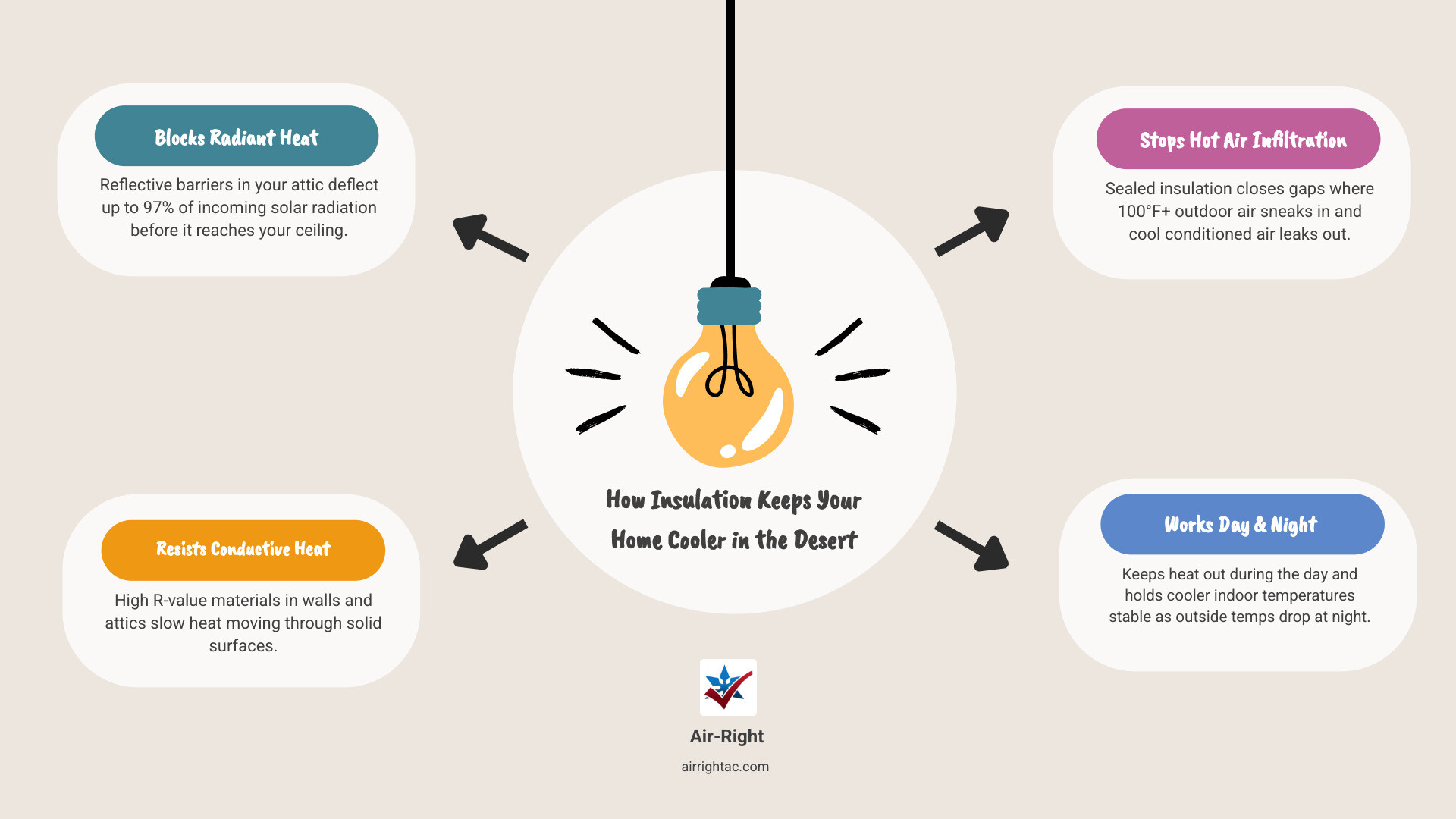
How insulation keeps your home cooler in the desert comes down to one core job: slowing the relentless transfer of heat from outside into your living space. Here’s a quick breakdown:
- It blocks radiant heat – Reflective barriers in your attic can deflect up to 97% of incoming solar radiation before it ever reaches your ceiling
- It resists conductive heat – High R-value materials in walls and attics slow heat moving through solid surfaces
- It stops hot air infiltration – Sealed insulation closes gaps where 100°F+ outdoor air sneaks in and cool conditioned air leaks out
- It works day and night – During the day it keeps heat out; at night it holds cooler indoor temperatures stable as outside temps drop
If you live in Las Vegas, Henderson, or Boulder City, this matters more than almost anywhere else in the country. Arizona homeowners already pay more than triple the national average for summer cooling — and Southern Nevada homeowners face the same brutal reality. Attic temperatures in the Mojave Desert routinely climb past 150°F in summer. Without proper insulation, that superheated air radiates straight down into your home, forcing your AC to run constantly just to keep up.
The result? Sky-high energy bills, an overworked HVAC system, and rooms that never quite feel comfortable no matter how low you set the thermostat. Proper insulation is the fix that works around the clock — even when your AC is off.
Why Proper Insulation is Essential for Desert Climates
Living in the Mojave Desert is a unique experience. We enjoy stunning sunsets and wide-open landscapes, but we also deal with some of the most extreme temperature fluctuations on the planet. This is known as a “diurnal temperature swing.” In the peak of July, we might see 115°F during the afternoon, only for the temperature to drop significantly once the sun goes down.
In a poorly insulated home, your walls and attic act like a giant battery, soaking up that 115°F heat all day long. This is what we call “heat ingress.” By the time the sun sets and you’re ready to relax, your home is still “discharging” that stored heat into your living room. Without a proper thermal barrier, your air conditioner is essentially fighting a losing battle against the very structure of your house.
Proper insulation is essential because it manages this thermal mass. It prevents the heat from entering in the first place, ensuring that the cool air your AC works so hard to produce actually stays inside. In our experience serving the Las Vegas area, many older homes — especially those built before the mid-80s — are essentially “under-dressed” for the desert. They lack the necessary R-value to handle modern climate demands. For a deeper look at local requirements, check out our Henderson Attic Insulation Guide.
How insulation keeps your home cooler in the desert
To truly understand how insulation keeps your home cooler in the desert, we have to look at the three ways heat moves: conduction, convection, and radiation.
- Radiation: This is the sun’s energy hitting your roof. In Las Vegas, the sun is relentless. Radiant heat is responsible for the bulk of the heat gain in your attic.
- Conduction: This is heat moving through solid objects. Think of a metal spoon in a hot cup of coffee. Your roof shingles get hot, which heats the plywood, which heats the wooden joists, which eventually heats your ceiling.
- Convection: This is heat moving through the air. If you have gaps in your attic or around your windows, hot air literally “flows” into your home, while your expensive cool air escapes.
Insulation works by providing “R-value,” or thermal resistance. The higher the R-value, the better the material is at resisting that conductive heat flow. In the desert, we want the highest R-value practical to ensure that 150°F attic air doesn’t turn your bedroom ceiling into a giant radiator. If you feel like your house is fighting you, it might be time to Stop Baking Your Brain with Better Las Vegas Attic Insulation.
Insulation Material Comparison Table
| Material Type | R-Value per Inch | Best Use Case in NV | Key Desert Benefit |
|---|---|---|---|
| Fiberglass Batts | 2.9 – 3.8 | New construction walls | Low cost, easy to install |
| Blown-In Cellulose | 3.2 – 3.8 | Attic floors (retrofits) | Dense, recycled, fire-resistant |
| Spray Foam (Closed-Cell) | 6.0 – 7.0 | Roof decks & tight spaces | Superior air sealing & R-value |
| Mineral Wool | 3.0 – 4.0 | Soundproofing & fire zones | High heat resistance, no sagging |
Best Materials and Strategies for Southern Nevada Homes
In Southern Nevada, we can’t just use the same insulation strategies they use in the Midwest. While they focus on keeping heat in during the winter, our primary goal is keeping heat out during the summer. This requires a specialized approach that often involves layering different types of protection.
For instance, a standard fiberglass batt might work fine in a temperate climate, but in the Las Vegas valley, it often isn’t enough to stop the sheer volume of radiant heat coming off the roof. We recommend a comprehensive strategy that includes high-performance materials and professional sealing. For more details on the best approach for our region, see The Ultimate Guide to Attic Insulation in Henderson, NV.
Understanding how insulation keeps your home cooler in the desert using radiant barriers
One of the most effective tools in our desert arsenal is the radiant barrier. Unlike traditional insulation that absorbs and slows heat, a radiant barrier reflects it. These are typically made of highly reflective aluminum foil applied to a substrate.
When installed on the underside of your roof rafters, a radiant barrier can reflect up to 97% of the radiant heat from the sun. This can drop your attic temperature by as much as 30°F to 40°F. Think about that: instead of your AC trying to cool a house sitting under a 160°F oven, it’s now sitting under a 120°F space. That difference is massive for your comfort and your wallet. If you’re looking for an expert to install these systems, we can help you with Finding a Reliable Attic Insulation Contractor in Henderson, NV.
How insulation keeps your home cooler in the desert with spray foam and cellulose
While radiant barriers handle the sun’s rays, blown-in materials and spray foam handle the air and the structure.
- Blown-In Cellulose: Made from recycled paper treated with fire retardants, cellulose is much denser than fiberglass. It does a fantastic job of filling in all the nooks and crannies on your attic floor, creating a seamless blanket that stops air from moving through your ceiling.
- Spray Foam: This is the “gold standard” for desert homes. Closed-cell spray foam expands to fill every single gap, creating an airtight “thermal envelope.” It essentially turns your home into a giant Yeti cooler. It’s particularly effective for flat roofs or homes with 2×6 wall construction.
When we combine these materials, we create a multi-layered defense. Cellulose is an excellent, eco-friendly choice for many residents. If you’re in the market for these upgrades, check out our Affordable Attic Insulation Services in Boulder City, NV.
Key Benefits: Energy Savings and HVAC Longevity
The most immediate benefit of upgrading your insulation is, of course, the money you’ll save. Statistics show that effective insulation can cut energy consumption by up to 50% in desert climates where AC systems otherwise run non-stop. Some homeowners in the Southwest have reported saving upwards of $1,000 annually on their utility bills just by addressing their attic insulation and air sealing.
But the benefits go beyond the monthly bill:
- HVAC Longevity: When your home is well-insulated, your AC doesn’t have to work as hard. It cycles less frequently and runs for shorter periods. This reduces wear and tear on the compressor and fan motor, potentially adding years to the life of your system. To keep your current system running while you plan your upgrades, you might need to Keep Your Cool with Expert AC Repair in Henderson, NV.
- Carbon Footprint: Using less electricity means less demand on the grid, which is a win for the environment and sustainability.
- Indoor Air Quality: Proper insulation and air sealing keep out desert dust, pollen, and allergens. This is a huge plus during our windy spring seasons.
- Home Value: Energy-efficient homes are increasingly in demand. According to the National Association of Realtors, energy-efficient features often lead to faster sales and higher closing prices.
For more tips on putting money back in your pocket, read our guide on how to Save on Your Energy Bill.
Installation Best Practices for Maximum Effectiveness
Even the best insulation material will fail if it’s installed poorly. At Air-Right, we’ve seen plenty of “DIY disasters” where homeowners added more insulation but ignored the underlying issues. Here are the best practices we follow:
- Air Sealing First: You wouldn’t put a sweater on over a shirt full of holes and expect to stay warm. The same logic applies here. Before we blow in new insulation, we must seal the “bypass” leaks — gaps around light fixtures, plumbing stacks, and top plates where air leaks between your attic and your living space.
- Don’t Forget the Ducts: In many desert homes, the ductwork runs through the attic. If those ducts are leaky or poorly insulated, you’re essentially paying to cool your attic before the air ever reaches your vents. We often recommend a full assessment of your air delivery system. For those in the outlying areas, check out our Duct Work Replacement in Boulder City: A Survival Guide for Summer.
- Ventilation is Key: It sounds counterintuitive, but your attic needs to “breathe.” Proper ventilation (like soffit and ridge vents) allows moisture to escape and prevents heat from becoming trapped. If you seal your attic but block your vents, you could end up with mold issues or a roof that ages prematurely.
- Uniform Coverage: “Gaps” are thermal bridges. If you have 15 inches of insulation in one spot and only 2 inches in another, heat will pour through that thin spot like water through a hole in a bucket.
Frequently Asked Questions about Desert Insulation
How long does insulation last in harsh desert conditions?
Quality insulation like blown-in fiberglass or cellulose can last 20 to 30 years or more. However, in the desert, we have to watch out for “settling” (where the material packs down over time and loses R-value) and dust accumulation. Intense heat doesn’t necessarily “melt” insulation, but it can cause certain spray foams to degrade if the attic isn’t properly ventilated. We recommend an inspection every 5 to 10 years to ensure everything is still performing at peak levels.
What is the recommended R-value for Las Vegas attics?
The Department of Energy generally recommends R-30 to R-60 for our region (Climate Zone 2). For the best balance of cost and performance in Las Vegas and Henderson, we usually aim for R-38 to R-49. This typically requires about 14 to 18 inches of blown-in fiberglass. If you have less than 10 inches of “the fluffy stuff” up there, you are definitely losing money every month.
Can insulation help with noise reduction in busy neighborhoods?
Absolutely! If you live near the Strip, a busy highway, or under a flight path, insulation is your best friend. Materials like mineral wool and dense-pack cellulose are fantastic at dampening sound. They turn your home into a quiet sanctuary, blocking out the hustle and bustle of the city along with the heat.
Conclusion
Understanding how insulation keeps your home cooler in the desert is the first step toward a more comfortable, sustainable, and affordable lifestyle in Southern Nevada. Whether you’re in a historic home in Boulder City or a new build in Henderson, the “Hot Truth” is that your attic is the frontline in the battle against the sun.
At Air-Right, we don’t believe in high-pressure sales. We believe in providing our neighbors in Las Vegas, Henderson, and Boulder City with clear, honest recommendations based on the latest 2026 energy standards. We are licensed, bonded, and insured, and our team is ready to help you transform your home into a cool oasis.
Don’t spend another summer watching your thermostat climb while your bank account drops. Let us help you take control of your home’s efficiency. Schedule your efficiency upgrade with Air-Right today and start feeling the difference tonight!
Need Help?
Contact us today to discuss your needs. Our team is ready to help.
Related Articles
- Is It a True Emergency? A Triage Guide for 24-Hour Air Conditioning Service in Las Vegas, NV
- Is That Burning Smell an Emergency? Fall Triage Guide for 24 Hour Air Conditioning Service in Las Vegas, NV
- Beyond 24-Hour Air Conditioning Service in Las Vegas: Heat Pump vs. Gas Furnace Options for Fall Upgrades
Related articles


Ready to Get Started?
Whether you need a repair, maintenance, or a new installation, our expert team is here to help.