The Definitive Guide to How Dust and Dry Air Affect Your Health Indoors
Air-Right

<p>Discover how dust and dry air affect your health indoors in Las Vegas homes and learn practical solutions to improve indoor air quality today.</p>
Why Understanding How Dust and Dry Air Affect Your Health Indoors Matters in Las Vegas
How dust and dry air affect your health indoors is a serious concern — especially in Southern Nevada, where the desert climate pushes indoor air quality challenges to the extreme.
Here is a quick summary of the key health risks:
| Health Area | Effects of Dust and Dry Air |
|---|---|
| Respiratory system | Dried mucous membranes, increased risk of sinus infections, bronchitis, and asthma flares |
| Immune defense | Weakened nasal mucus makes it easier for viruses and bacteria to reach your lungs |
| Skin and eyes | Dryness, cracking, eczema flares, and corneal irritation |
| Sleep and stress | Low humidity is linked to higher heart rates, poorer sleep, and dehydration |
| Infection risk | Viruses survive longer in dry air, raising the risk of colds, flu, and pneumonia |
Americans already spend roughly 90% of their time indoors — and indoor air can be two to five times more polluted than the air outside. In Las Vegas, Henderson, and Boulder City, that problem is compounded by desert dust, low outdoor humidity, and HVAC systems that constantly recirculate dry, particle-laden air through your home.
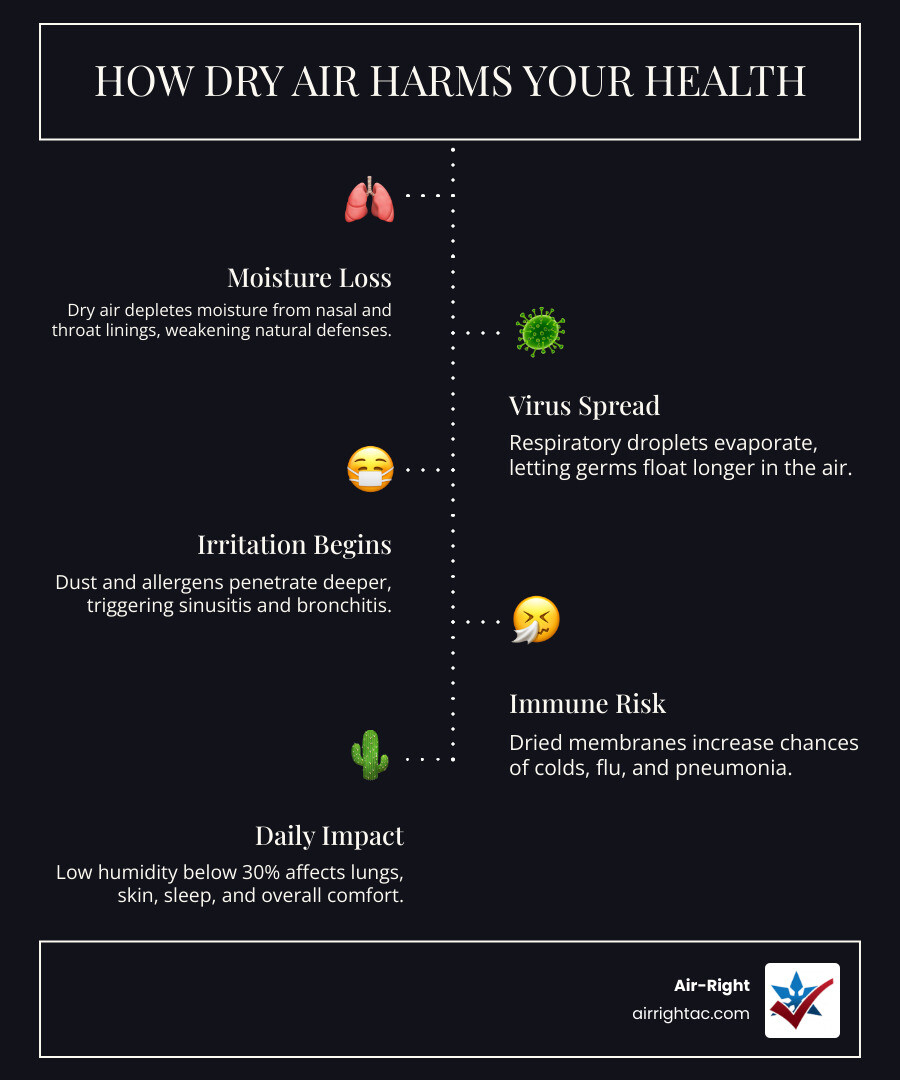
When humidity drops below 30%, your body’s first line of defense — the moist lining inside your nose and throat — begins to dry out and crack. That means germs that would normally get trapped and expelled can travel deeper into your airways. Add fine desert dust, dust mites, and allergens stirred up by your heating and cooling system, and you have a combination that can affect every member of your household, from young children to older adults.
This guide covers everything you need to know: the health effects, the hidden risks unique to the Mojave Desert climate, and the practical steps you can take to protect your family’s comfort and wellbeing year-round.
The Respiratory Impact: How Dust and Dry Air Affect Your Health Indoors
Living in an arid climate like Southern Nevada means our respiratory systems are under constant siege. The primary way how dust and dry air affect your health indoors is by compromising your body’s biological filters. Your nose and throat are lined with mucous membranes designed to trap dirt, dust, and pathogens. In a dry environment, these membranes lose moisture and become less effective, allowing irritants to bypass your primary defenses.
This lack of moisture doesn’t just make you feel “stuffed up”; it significantly increases the survival time of viruses. When the air is dry, respiratory droplets from a cough or sneeze evaporate quickly, leaving behind tiny infectious particles that float in the air longer. This is why we often see a spike in illnesses like sinusitis and bronchitis during the drier months.
For those with pre-existing conditions, the impact is even more severe. Dust and dry air are notorious asthma triggers. Fine particles can cause bronchoconstriction, making it difficult to breathe. Furthermore, How Desert Dust and Heat Change Your AC Service Schedule is a critical consideration for locals, as a neglected HVAC system can become a primary source of recirculated dust and germs.
Understanding How Dust and Dry Air Affect Your Health Indoors
Your nasal defenses are your first line of protection against the flu and pneumonia. When indoor humidity levels drop below 30%, these defenses weaken. Research shows that low humidity environments allow flu viruses to survive longer and spread more easily.
Hidden issues in your home’s infrastructure can worsen this. For instance, Stop the Bleed: How Leaky Ducts Waste Cooled Air in the Attic explains how gaps in your ductwork can pull in unfiltered, dusty air from your attic and push it directly into your living spaces. This not only makes your home dustier but also introduces pollutants that can irritate your lungs and increase the risk of respiratory infections.
Protecting Your Family: How Dust and Dry Air Affect Your Health Indoors
In Henderson and the surrounding areas, air quality fluctuates wildly with the wind. When desert dust infiltrates your home, it doesn’t just sit on the shelves; it gets recirculated every time your AC or heater kicks on. This constant movement of allergens can lead to chronic respiratory membrane irritation. By maintaining proper humidity and ensuring your filtration is up to par, you can stop the cycle of particle redistribution that leads to “winter itch” and seasonal breathing struggles.
Beyond Breathing: Skin, Eyes, and the Stress of Arid Air
While we often focus on our lungs, how dust and dry air affect your health indoors extends to our largest organ: the skin. In Las Vegas, the air is frequently thirsty, and if it can’t find moisture in the environment, it pulls it from your body.

Low humidity is a leading cause of eczema flares and dermatitis. When the skin’s barrier is compromised by dryness, it becomes itchy, red, and prone to cracking. Your eyes are equally vulnerable. Dry air can cause the tear film on your eyes to evaporate too quickly, leading to “dry eye” symptoms, redness, and even painful corneal patches.
Beyond these physical symptoms, dry air has a measurable impact on your internal stress levels. Studies have shown that workers in buildings with low humidity exhibit elevated heart rates and higher cortisol levels, indicating a physical stress response to the environment. This often leads to poorer sleep quality and a general feeling of fatigue.
The Hidden Link Between Dry Air and Indoor Stress
It might sound strange, but the air in your home could be making you stressed. Dehydration is a common side effect of living in an arid environment, even if you aren’t sweating. As your body loses moisture to the dry air, your electrolyte balance can shift, leading to headaches and decreased workplace productivity.
Maintaining a healthy hydration level (aiming for roughly half your body weight in ounces of water daily) is essential, but it’s only half the battle. If your indoor environment is constantly stripping moisture away, your body remains in a state of high alert. This is why many Boulder City and Las Vegas residents find they sleep better and feel more relaxed once they implement proper humidity controls.
The Role of Dust and Allergens in Desert Homes
Dust in a desert home is more than just “dirt.” It is a complex cocktail of dead skin cells, textile particles, pet dander, mold spores, and—most significantly—dust mites. While dust mites usually prefer higher humidity, they can still thrive in mattresses and carpets where human sweat provides a localized moisture source. When these particles are stirred up, they release Volatile Organic Compounds (VOCs) and allergens that can trigger immediate allergic reactions.
Effective filtration is the key to managing this. Using HEPA (High-Efficiency Particulate Air) filters can remove 99.97% of airborne particles, but these filters only work if your home is properly sealed. We often find that The Hot Truth About Attic Insulation Upgrades for Energy Savings is a game-changer for air quality. Proper insulation doesn’t just keep you cool; it acts as a barrier against the fine silt and outdoor pollutants that try to seep into your home.
How Heating Systems Exacerbate Winter Air Quality
During the winter months in Southern Nevada, we rely heavily on our furnaces. However, furnace operation can actually worsen the problem of how dust and dry air affect your health indoors. Forced-air heating systems are notorious for stirring up settled dust and redistributing it throughout every room.
Furthermore, the process of heating the air naturally lowers its relative humidity. This leads to the buildup of static electricity—that annoying “zap” you get when touching a doorknob. This static can actually help dust particles cling to surfaces or stay suspended in the air. If you are noticing a sudden increase in dust during the winter, Stop the Heat Leak: Is Your Attic or Your Ductwork the Real Culprit? can help you identify if your system is pulling in extra debris from unconditioned spaces.
Practical Solutions for Maintaining Optimal Indoor Air Quality
To combat the effects of the desert, you need a multi-pronged approach. The goal is to keep your indoor humidity between 30% and 50%. Anything lower triggers the health issues we’ve discussed; anything higher than 50% can actually encourage mold growth and dust mite populations.
| Feature | Portable Humidifier | Whole-Home Humidifier |
|---|---|---|
| Coverage | Single Room | Entire House |
| Maintenance | Daily filling/cleaning | Annual service |
| Control | Manual | Automatic via Thermostat |
| Noise | Can be audible | Silent (installed in HVAC) |
| Consistency | Fluctuates | Very Stable |
Beyond humidification, ventilation is key. While it’s tempting to seal the house up tight, you need fresh air to dilute indoor pollutants. Using high-quality MERV filters (typically MERV 11-13 for residential homes) in your HVAC system is a great start. We also recommend using a hygrometer—an inexpensive device that measures humidity—so you can monitor your air in real-time.
For cleaning, skip the feather duster. Dry dusting just sends particles back into the air. Instead, use a damp microfiber cloth to trap the dust. Pair this with a HEPA-filtered vacuum to ensure you aren’t just blowing fine dust out the back of the machine. If you’re looking for more ways to manage the desert’s impact, check out our guide on How to Keep Your Desert Home from Turning into a Giant Oven, which offers tips on maintaining a balanced indoor climate.
Frequently Asked Questions about Indoor Air Quality
What is the ideal humidity level for a Las Vegas home?
The EPA recommends keeping indoor relative humidity between 30% and 50%. In the Las Vegas Valley, our outdoor humidity often drops into the single digits. Maintaining at least 30% indoors is crucial for protecting your respiratory health and preventing your wooden furniture or floors from cracking. However, be careful not to exceed 50%, as this can lead to mold growth in “hidden” areas like behind furniture or in closets.
Can dry air cause nosebleeds and headaches?
Yes, absolutely. Dry air strips the moisture from your nasal passages, causing the delicate skin inside to crack and bleed. This sinus irritation often leads to pressure and “dry air headaches.” In the Boulder City climate, where the air can be particularly punishing, staying hydrated and using a saline nasal spray can help, but addressing the humidity in your home is the most effective long-term solution.
How often should I change my filters in a dusty environment?
In a standard environment, every three months is fine. However, in Las Vegas, we recommend checking your filters every month. After a major dust storm or high-wind event, you might find your filter is completely caked with silt. Using a higher MERV-rated filter will trap more particles, but it will also clog faster. Keeping a clean filter is essential for both your health and your HVAC system’s efficiency.
Conclusion
At Air-Right, we believe that your home should be a sanctuary from the harsh Southern Nevada elements. Understanding how dust and dry air affect your health indoors is the first step toward creating a healthier, more comfortable living space. Whether you are in Las Vegas, Henderson, or Boulder City, our team is dedicated to providing the energy-efficiency and air quality solutions you need to breathe easy.
From advanced filtration and whole-home humidification to sealing leaky ducts and upgrading insulation, we offer clear, no-pressure recommendations to improve your home’s “lungs.” Don’t let the desert air dictate your comfort or your health.
Schedule Professional Indoor Air Quality Services with us today and experience the difference that clean, balanced air can make for your family.
Need Help?
Contact us today to discuss your needs. Our team is ready to help.
Related Articles
- Is It a True Emergency? A Triage Guide for 24-Hour Air Conditioning Service in Las Vegas, NV
- Is That Burning Smell an Emergency? Fall Triage Guide for 24 Hour Air Conditioning Service in Las Vegas, NV
- Beyond 24-Hour Air Conditioning Service in Las Vegas: Heat Pump vs. Gas Furnace Options for Fall Upgrades
Related articles


Ready to Get Started?
Whether you need a repair, maintenance, or a new installation, our expert team is here to help.