The Definitive Guide to Choosing the Right AC System for Desert Homes
Air-Right

<p>Learn how to choose the right ac system for desert homes in Las Vegas with expert sizing, efficiency, and desert-ready performance tips.</p>
I’m looking to upgrade my home’s cooling. Who in Las Vegas specializes in energy-efficient systems for desert heat?
Knowing how to choose the right AC system for desert homes in Las Vegas, Henderson, and Boulder City is one of the most important decisions you’ll make as a homeowner. Temperatures here regularly climb past 110°F. Your AC doesn’t get a summer break — it runs almost non-stop for six or more months a year. In fact, air conditioning accounts for roughly 70% of residential electricity use in Arizona during summer months, and Southern Nevada tells a similar story. The wrong system doesn’t just mean discomfort. It means higher energy bills, faster equipment wear, and a unit that gives out when you need it most.
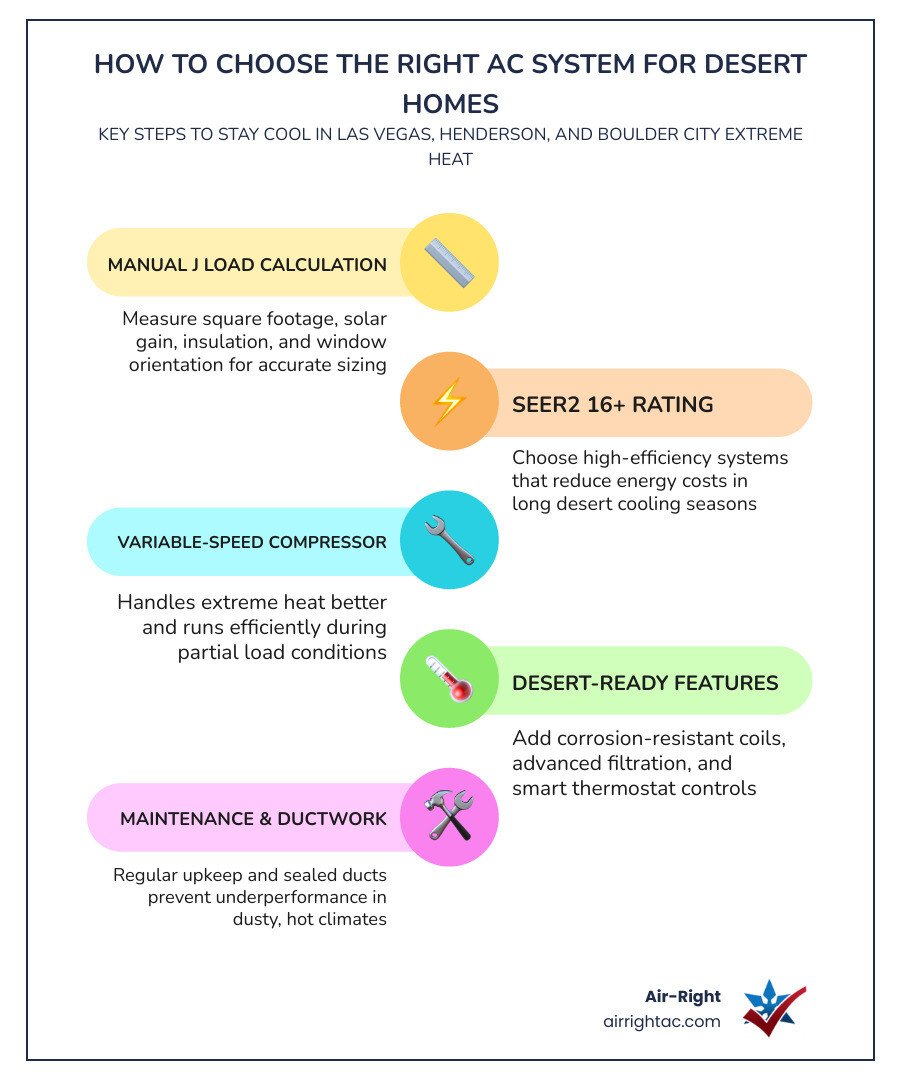
Here’s a quick overview of how to choose the right AC system for a desert home:
- Get a proper load calculation (Manual J) — square footage alone isn’t enough; solar gain, insulation, and window orientation all matter
- Prioritize SEER2 16 or higher — high-efficiency systems deliver real savings over a long cooling season
- Choose variable-speed or two-stage compressors — they handle extreme heat better and run more efficiently at partial load
- Look for desert-ready features — corrosion-resistant coils, advanced filtration, and smart thermostat compatibility
- Decide between central AC and a heat pump — both work in desert climates, but each has trade-offs worth understanding
- Don’t overlook ductwork and insulation — a great unit on a leaky duct system still underperforms
- Plan for regular maintenance — desert dust and extreme operating hours shorten equipment life without consistent upkeep
This guide walks through each of these steps in detail so you can make a confident, informed choice for your home.
Why Desert Climates Demand Specialized HVAC Solutions

Desert cooling is not the same as cooling in a mild climate. In Las Vegas, Henderson, and Boulder City, your system has to deal with a rough combination of:
- Long stretches of extreme heat
- Intense sun exposure and solar gain
- Hot attics that can become much hotter than outdoor air
- Dust, pollen, and debris
- Monsoon-season humidity swings
- Extended daily run times
That last point matters a lot. In Southern Nevada, your equipment is often asked to perform at or near peak load for months. That is why desert homes need systems built and installed for endurance, not just basic cooling.
Dust is another major factor. Fine desert dust clogs filters faster, coats coils, and makes your system work harder. Monsoon weather adds a different challenge: humidity spikes. Even though our climate is dry most of the year, those humid stretches can make homes feel sticky and can strain systems that are poorly sized or poorly configured.
This is also why we always remind homeowners that the house itself is part of the HVAC system. West-facing glass, poor attic insulation, leaky ducts, and air leakage all add to the cooling load. If your home tends to trap heat, start with this guide on how to keep your desert home from turning into a giant oven.
How to Choose the Right AC System for Desert Homes: The Sizing Factor
If there is one place homeowners get misled, it is sizing. Bigger is not automatically better. In desert homes, proper sizing is critical.
A correctly sized system can reduce energy consumption by about 20% to 30% compared with an oversized unit in hot, dry climates. A professional Manual J load calculation can also prevent up to 40% of common comfort and efficiency problems.
What happens if the unit is too big?
- It cools the thermostat area too quickly
- It turns on and off too often, called short cycling
- It wastes energy during repeated starts
- It creates uneven temperatures from room to room
- It increases wear on parts
What happens if the unit is too small?
- It runs for very long periods
- It may struggle to maintain temperature during late afternoon heat
- Indoor temperatures can slowly creep upward on the hottest days
- Parts wear out faster because the system rarely gets a break
In other words, an oversized system acts like a sprinter running laps in flip-flops, and an undersized system acts like a marathoner carrying furniture. Neither one is happy.
Leaky ducts and attic heat also affect sizing. If your ducts run through a superheated attic, the system may lose a surprising amount of cooling before that air ever reaches your rooms. If that sounds familiar, read Stop the Heat Leak Is Your Attic or Your Ductwork the Real Culprit.
How to choose the right ac system for desert homes using Manual J calculations
A Manual J calculation goes far beyond square footage. It looks at the real cooling load of your home, including:
- Home orientation
- Window size, type, and direction
- Insulation levels
- Ceiling height
- Duct location and condition
- Air leakage
- Number of occupants
- Lighting, appliances, and internal heat sources
- Shading from trees, patios, or overhangs
This is why “one ton per X square feet” is not reliable in Southern Nevada. Two homes with the same square footage can have very different cooling needs if one has west-facing windows, vaulted ceilings, poor insulation, or a scorching attic.
Manual J helps determine the right BTU capacity for your home. It should then be matched with proper equipment selection and duct performance. If your current system has constant comfort issues, it may not just be old – it may be wrong for the home. Our article on Signs Your AC Needs Replacing Not Just Fixing can help you spot the difference.
Prioritizing Efficiency: SEER2 Ratings and Compressor Technology
In a desert climate, efficiency matters because your AC runs so much. High-efficiency equipment is not just a nice bonus here – it has real impact over a long cooling season.
As a general target, we recommend looking closely at systems rated SEER2 16 or higher for desert homes. Research for hot climates consistently points to that range as a strong balance between performance and long-term savings. Homes with high-efficiency systems in hot regions can often see significant reductions in energy usage compared with lower-efficiency equipment.
Why SEER2 ratings matter when you choose the right ac system for desert homes
SEER2 measures cooling efficiency under updated testing conditions that better reflect real-world performance. Higher ratings mean the system delivers more cooling for the electricity used.
Here is a simple way to think about it:
| SEER2 range | Best fit for desert homes | What to expect |
|---|---|---|
| 14.3-15.2 | Minimum efficiency options | Better than older units, but may be less ideal for long desert cooling seasons |
| 16-18 | Strong target for many homes | Good balance of efficiency, performance, and durability |
| 18+ | High-efficiency upgrade | Lower energy use, better comfort control, and strong long-term value in extreme heat |
SEER2 is important, but it is not the only rating worth asking about. In very hot climates, performance during high outdoor temperatures matters too. That is why we also look at overall system design, airflow, and compressor type instead of chasing a single number.
If you are deciding whether your current equipment is worth keeping, How to Decide If Your AC Deserves a Second Chance is a good next read.
Variable-speed and two-stage compressors are especially valuable in desert homes:
- Variable-speed systems can ramp output up or down as conditions change
- Two-stage systems can run at a lower level most of the time and higher output when needed
- Both improve comfort during long run times
- Both are usually quieter than single-stage systems
- Both reduce harsh on-off cycling
During monsoon humidity, these systems can also help with better moisture removal because they run longer and more steadily. That steadier performance is one of the biggest reasons they work so well here.
Essential Features for Harsh Desert Environments
Once sizing and efficiency are covered, it is time to look at features that matter specifically in our environment.
Start with filtration. Desert dust is relentless. A better filter setup helps protect both your indoor air and your equipment. Depending on the system, many homeowners benefit from:
- High-quality pleated filters
- Properly matched MERV-rated filtration
- Sealed filter cabinets that reduce bypass air
- Whole-home air cleaners for added particle capture
Indoor air quality add-ons can also make sense, especially for households with allergies, pets, or sensitivity to dust. UV purifiers may help support cleaner coils and air handling components in systems designed for them.
Corrosion resistance is another underrated feature. Monsoon conditions can expose outdoor equipment to moisture, and coil durability matters. Corrosion-resistant coil coatings or protective finishes can support longer-term reliability.
Then there are comfort and control upgrades:
- Smart thermostat compatibility
- Zoning options for multi-story or larger homes
- Variable-speed indoor blowers
- Quiet operation features
- Alerts for maintenance or filter changes
Smart thermostats help homeowners fine-tune schedules, reduce unnecessary runtime, and monitor performance. Zoning can be a game changer for homes with hot upstairs rooms, additions, or rooms that are rarely used.
If dust has been taking a toll on your system, this article on How to Save Your AC from a Dusty Desert Death is worth bookmarking.
Comparing System Types: Central AC vs. Heat Pump Systems
For most desert homeowners, the main choice is between a traditional central AC system and a heat pump system.
Central AC systems:
- Excellent for cooling
- Common in homes with existing ductwork
- Usually paired with a separate heating system
- Familiar option for many homeowners
Heat pump systems:
- Provide both cooling and heating
- Work well in Southern Nevada’s hot summers and generally mild winters
- Can be highly efficient year-round
- May qualify for rebates or incentives depending on current programs
A common question is whether heat pumps can handle extreme heat. Modern systems designed for desert conditions can perform very well in high outdoor temperatures when properly sized and installed. The key is selecting the right equipment and making sure the rest of the home supports it.
Ductless mini-split heat pumps can also be excellent in desert homes when:
- The home has no existing ductwork
- You are conditioning a garage conversion, casita, or addition
- One room is always too hot
- You want zoning without reworking the entire duct system
If your current system fails during peak summer, our The Ultimate Survival Guide for When Your AC Quits During a Heatwave can help you stay safe while you plan next steps.
Improving Whole-Home Performance Beyond the Equipment
This is the part many articles skip, but it matters a lot: the equipment is only one piece of the comfort puzzle.
A high-efficiency AC installed on a home with leaky ducts, low attic insulation, or major air leaks will not perform the way it should. In desert climates, attic temperatures can become extreme, and that punishes both ducts and ceiling insulation.
Before or during replacement, we recommend evaluating:
- Duct leakage
- Duct insulation
- Attic insulation levels
- Return air performance
- Air sealing around penetrations and gaps
- Window heat gain and shading
- Thermostat placement
In many homes, envelope improvements can reduce the cooling load enough to support better performance without oversizing the equipment. That is one reason square footage alone is such a poor guide.
If certain rooms are always hotter than others, the issue may be in the attic or duct system rather than the outdoor unit. Read The Cold Hard Truth Signs Your Home Needs Better Insulation and Beating the Heat with a Desert Proof Maintenance Plan for a fuller picture.
Smart thermostats and zoning tie into whole-home performance too. These upgrades can:
- Reduce overcooling in unused spaces
- Improve comfort in occupied zones
- Support better scheduling during peak heat
- Help identify usage patterns
- Integrate with smart home systems for easier control
For larger homes or homes with difficult sun exposure, zoning can be especially helpful.
Maintaining Your Investment for Peak Performance
Desert HVAC systems work hard, and that shortens lifespan if maintenance is neglected. In harsh desert regions, AC systems often last around 10 to 15 years because of extreme heat, dust exposure, and long operating seasons.
Regular maintenance helps protect efficiency, comfort, and reliability. It also helps catch small issues before they become midsummer emergencies.
A solid desert maintenance routine includes:
- Replacing filters every 1 to 3 months, sometimes more often in dusty periods
- Cleaning outdoor coils
- Checking refrigerant charge
- Inspecting electrical components
- Clearing condensate drains
- Verifying airflow
- Inspecting duct condition and insulation
- Confirming thermostat operation
Spring tune-ups are especially important before the hottest weather arrives. If the system is already limping into summer, it usually does not get stronger by being ignored. It gets dramatic.
For more help, explore Beating the Heat with a Desert Proof Maintenance Plan and Maintenance Secrets to Keep Your AC from Quitting on You.
Homeowners should also ask about available rebates, incentives, and financing when replacing a system. High-efficiency systems and heat pumps may qualify for utility or federal programs depending on current rules, and financing options can make major upgrades easier to plan. We always recommend checking current program availability at the time of purchase since offerings can change.
Frequently Asked Questions about Desert AC Systems
What is a good SEER2 rating for a home in Las Vegas?
For many homes in Las Vegas, a good target is SEER2 16 or higher. That range usually makes sense for our long, intense cooling season. If you plan to stay in the home for years or want better comfort features, higher-efficiency options may be worth considering.
Do heat pump systems work effectively in 115°F desert heat?
Yes, modern heat pump systems can work effectively in extreme desert heat when they are properly sized, matched to the home, and installed correctly. The system quality, airflow, duct performance, and load calculation all matter. A good heat pump is not automatically bothered by triple-digit weather just because the thermometer looks offended.
How often should I change my AC filters during a dusty desert summer?
Check them monthly. In dusty desert conditions, many homeowners need filter changes every 1 to 3 months, and sometimes more often during especially dusty periods or if there are pets, construction nearby, or allergy concerns. A clogged filter reduces airflow and forces the system to work harder.
Conclusion
Choosing the right AC system for a desert home is about more than brand or tonnage. It is about matching the equipment to the home, the climate, and the way you live. In Las Vegas, Henderson, and Boulder City, that means proper sizing, strong efficiency, desert-ready features, and a close look at ducts, insulation, and indoor air quality.
Air-Right is a licensed, bonded, and insured HVAC contractor serving Southern Nevada with clear, no-pressure recommendations. Whether you need help comparing central AC and heat pump options, improving attic and duct performance, or planning a replacement, our team is here to help.
If you are ready to talk through your options, contact us today for expert AC system services.
Need Help?
Contact us today to discuss your needs. Our team is ready to help.
Related Articles
- Is It a True Emergency? A Triage Guide for 24-Hour Air Conditioning Service in Las Vegas, NV
- Is That Burning Smell an Emergency? Fall Triage Guide for 24 Hour Air Conditioning Service in Las Vegas, NV
- Beyond 24-Hour Air Conditioning Service in Las Vegas: Heat Pump vs. Gas Furnace Options for Fall Upgrades
Related articles


Ready to Get Started?
Whether you need a repair, maintenance, or a new installation, our expert team is here to help.