The Definitive Guide to Attic Insulation Savings
Air-Right

<p>Discover how much does attic insulation save on cooling bills in hot climates like Las Vegas, with realistic savings, key factors, and proven upgrades.</p>
Why Your Attic Is Silently Driving Up Your Summer Cooling Bills
If you’ve ever wondered how much does attic insulation save on cooling bills, here’s a quick answer before we dig deeper:
Quick Answer: Attic Insulation Cooling Bill Savings
| Starting Condition | Estimated Cooling Bill Savings |
|---|---|
| No insulation → R-38 or R-49 | 20–35% reduction on cooling costs |
| Under-insulated (R-11) → R-49 | 15–25% reduction |
| Partially insulated (R-19) → R-49 | 10–20% reduction |
| Combined with air sealing | Up to 15% on total HVAC costs (EPA average) |
| Hot climates (like Las Vegas) | Up to 35% savings on cooling alone |
These figures reflect real-world ranges backed by EPA and DOE data. Your actual savings depend on your home’s current insulation level, climate, and how well your attic is air-sealed — all of which we cover in this guide.
Here in Las Vegas and Henderson, Nevada, the summer heat is relentless. Your AC runs almost nonstop from May through September, and your utility bills show it. But here’s what most homeowners don’t realize: the problem often isn’t your air conditioner — it’s what’s happening directly above your living space.
On a hot summer day, an uninsulated or under-insulated attic can reach 130 to 150°F. That superheated air doesn’t stay put. It radiates downward through your ceiling, turning your upper floor into an oven and forcing your AC to work twice as hard just to keep up. Homeowners with poor attic insulation often notice their second floor running 10 to 15 degrees warmer than the rest of the house — a classic sign that the attic is the weak link.
The good news? Attic insulation is consistently one of the most cost-effective home improvements you can make. According to the EPA, proper insulation and air sealing can cut heating and cooling costs by an average of 15% — and in hot climates with long cooling seasons like Southern Nevada, the cooling-specific savings can push even higher.
This guide breaks down exactly what you can realistically expect to save, what factors drive those savings, and how to get the most out of your investment.
How Much Does Attic Insulation Save on Cooling Bills?
When we talk about energy efficiency, the attic is usually the first place we look. It is the “hat” of your home, and in the desert, that hat is sitting under a magnifying glass all day. Realistically, homeowners can expect to see a significant drop in their monthly expenses after a proper upgrade. While the EPA estimates a national average of 15% savings on heating and cooling costs, those of us in the Las Vegas Valley often see higher returns because our cooling season is so intense.
Realistic cooling savings for most homes
For a typical home in our area that hasn’t been updated in a decade or two, the savings are often immediate. If your attic is currently under-insulated—meaning you can see the wooden floor joists peeking through the fluff—you are likely losing a massive amount of cooled air. By bringing that insulation up to modern standards, a 15% to 25% reduction in cooling costs is a very realistic expectation.
Beyond the money, the comfort gains are huge. If you’ve ever felt like your AC just couldn’t keep up during a 110-degree July afternoon, it’s often because the attic is winning the tug-of-war. Better insulation allows your home to hold onto the “cool” longer, leading to fewer AC cycles and a much more consistent temperature between the first and second floors.
How much does attic insulation save on cooling bills in hot climates?
In hot-dry climates like Boulder City and Las Vegas, the “radiant oven effect” is our biggest enemy. Because our attic temperatures can soar to 150°F, the delta (the temperature difference) between your attic and your 72-degree living room is nearly 80 degrees. Heat naturally wants to move toward cool areas, and without a thick barrier, it pours through your ceiling.
In these extreme conditions, many homeowners report savings of up to 35% on their cooling-specific bills. Because we spend so much more on cooling than heating, the total annual percentage might look different than someone in a colder state, but the actual dollar-for-dollar impact on summer utility bills is often much higher here.
Why published savings estimates and real-world results can differ
You might see a study saying attic insulation saves 11% on total energy, while another says 20%. Why the gap? These estimates often use “modeled homes” that assume everything else is perfect. In the real world, factors like duct leakage, how often you leave the back door open for the dog, and the efficiency of your actual AC unit play a role.
If your ducts are leaking 20% of your cold air into the attic before it even reaches your vents, even the best insulation won’t show its full potential on your bill. We always recommend looking at the “whole-home envelope” rather than just one piece of the puzzle.

The Biggest Factors That Change Your Savings
Not every insulation job is created equal. Several variables determine whether you’ll see a modest dip or a massive plunge in your energy spending.
Existing attic insulation level matters more than homeowners think
The law of diminishing returns applies here. If you currently have zero insulation, the first few inches you add will provide the most dramatic savings. Moving from R-0 (nothing) to R-38 is life-changing. However, if you already have R-30 and you’re moving to R-49, the savings will be noticeable but less “night and day.” Most older homes in Henderson were built with R-11 or R-19, which is far below what we recommend for peak desert performance today.
Air sealing plus insulation usually beats insulation alone
This is a secret many big-box installers won’t tell you: insulation blocks heat flow (conduction), but it doesn’t stop air flow (convection). Most attics have dozens of tiny holes where wires, pipes, and light fixtures go through the ceiling. These gaps act like little chimneys, sucking the cold air out of your house.
By performing professional air sealing before laying down new insulation, we can reduce total air infiltration by up to 25%. This “one-two punch” ensures the insulation can actually do its job. For a deeper dive into how this works, check out our guide on how to Beat the Heat and the Bills with Better Attic Insulation.
Duct losses in the attic can erase expected cooling savings
In many Southern Nevada homes, the HVAC ductwork runs through the attic. If those ducts are leaky, you are essentially paying to air condition your attic. This is a huge waste of energy. If you insulate the attic floor but leave leaky ducts exposed to 140-degree heat, your AC will still run constantly. We often find that fixing “bleeding” ducts is just as important as adding fluff to the floor. Learn more about this in our article Stop the Bleed: How Leaky Ducts Waste Cooled Air in the Attic.
Which Insulation Type Delivers the Best Cooling Savings?
Choosing the right material is about more than just the R-value per inch; it’s about how that material performs in a 150-degree desert attic.
Batt vs blown-in vs cellulose for cooling performance
- Fiberglass Batts: These are the classic “blankets.” They are DIY-friendly but often leave gaps around wires and joists. In an attic, even small gaps can lead to significant heat gain.
- Blown-in Fiberglass: This is excellent for retrofitting. It creates a seamless “cloud” of protection that fills in all the nooks and crannies.
- Blown Cellulose: Made from recycled paper treated for fire resistance, cellulose is denser than fiberglass. It is fantastic at stopping air movement and generally has a higher R-value per inch, making it a favorite for high-performance cooling upgrades.
| Insulation Type | R-Value per Inch | Best For | Cooling Effectiveness |
|---|---|---|---|
| Fiberglass Batt | 2.9 – 3.8 | Standard joist spacing | Moderate (if gaps exist) |
| Blown Fiberglass | 2.2 – 2.9 | Retrofits / Odd spaces | High (seamless coverage) |
| Blown Cellulose | 3.2 – 3.8 | Maximum heat block | Very High (dense) |
| Spray Foam | 3.6 – 7.0 | Total air sealing | Excellent (conditioned attics) |
When spray foam can improve cooling bills more than other options
Spray foam is the “premium” choice. It doesn’t just insulate; it creates a total air barrier. In complex attics or homes where the ductwork is located in the attic, applying spray foam to the underside of the roof deck can turn the attic into a “conditioned” space. This means your attic stays within 10 degrees of your living room temperature, which drastically reduces the strain on your HVAC system.
How much does attic insulation save on cooling bills by insulation type?
While all types will save you money, the quality of the installation matters more than the material. A perfectly installed layer of blown-in fiberglass will outperform a sloppy installation of expensive spray foam every time. However, because cellulose and spray foam do a better job of stopping air movement, they often edge out traditional batts by 5% to 10% in total cooling savings.
Best R-Values, Ventilation, and Moisture Control for Maximum Summer Savings
In the Las Vegas area, we fall into Department of Energy (DOE) Climate Zone 3. This means we have specific targets to hit if we want to maximize our ROI.
Recommended attic R-values for hot and hot-humid climates
For our zone, the “sweet spot” is typically R-38 to R-49.
- R-38 is roughly 12-14 inches of insulation.
- R-49 is roughly 15-18 inches.
Going beyond R-60 in the desert often provides “diminishing returns”—meaning the extra money you spend on the material might take 20 years to pay back in energy savings. We find that R-49 is the perfect balance for most Henderson and Las Vegas homes.
Why attic ventilation still matters after adding insulation
You might think that if you have great insulation, you should seal the attic completely. Not so! Unless you are using a specific “unvented” spray foam design, your attic needs to breathe. Proper ventilation (soffit and ridge vents) allows the superheated air to escape. If you block your vents with insulation, the heat builds up until it eventually forces its way through the insulation and into your home. It can also cook your roof shingles, shortening their lifespan.
Moisture and ventilation mistakes that can hurt results
Even in the desert, moisture can be an issue—usually from bathroom fans venting directly into the attic instead of outside. If your insulation gets wet, it loses its effectiveness and can lead to mold. We always check for these “hidden” issues before adding new material. If you’re seeing signs of trouble, read up on The Cold Hard Truth: Signs Your Home Needs Better Insulation.
Payback, Incentives, and When Attic Insulation Stops Being the Best Next Upgrade
One of the best things about attic insulation is that it’s one of the few home upgrades that actually pays for itself.
Typical payback periods based on starting insulation and climate
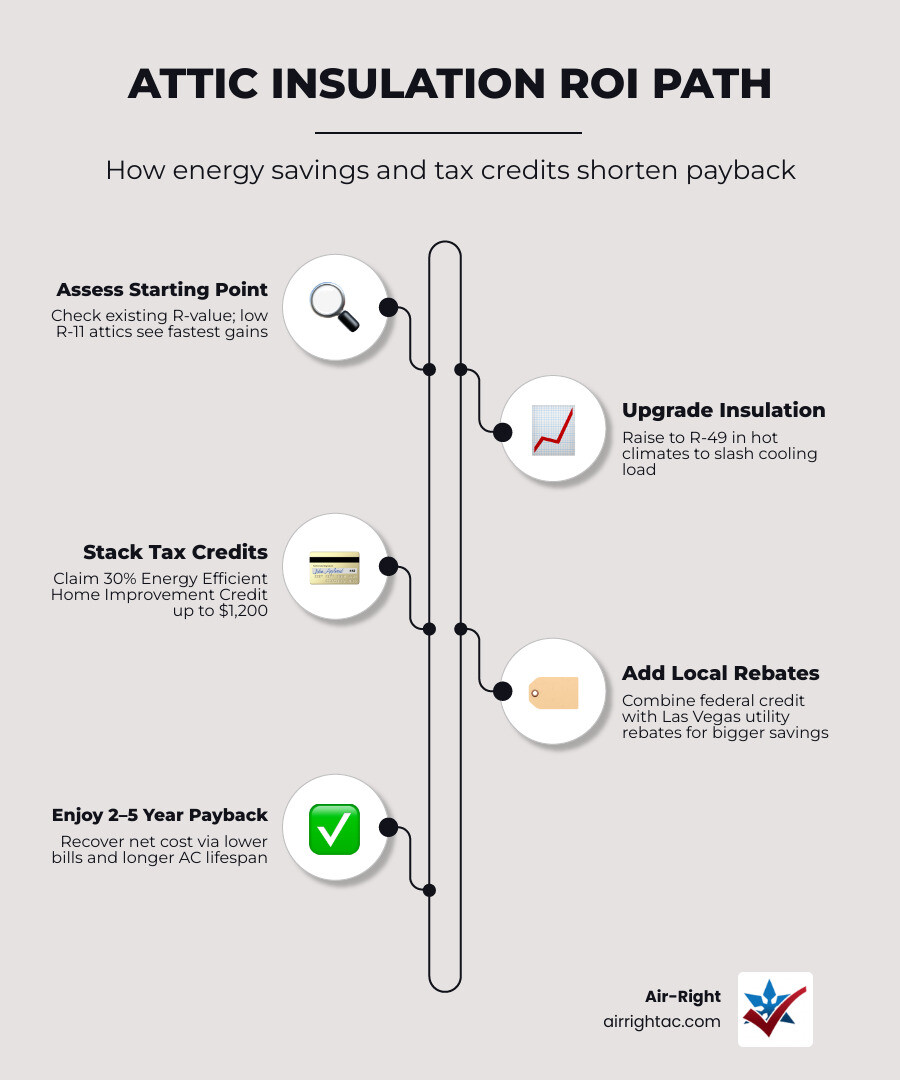
In a cooling-dominant climate like ours, the payback period is remarkably short. If you are upgrading from a very poorly insulated state (R-11 or less) to R-49, you can often recoup your investment through lower utility bills in just 2 to 5 years. When you factor in the increased lifespan of your AC unit (because it isn’t running 24/7), the ROI is even better.
How federal tax credits and utility rebates improve ROI in 2026
As of May 2026, homeowners can still take advantage of the Energy Efficient Home Improvement Credit. This federal tax credit can cover 30% of the material costs for attic insulation and air sealing, up to an annual cap (typically $1,200). When you stack these federal credits with local utility rebates available in the Las Vegas area, the net investment drops significantly, often slashing your payback time by a year or more.
When added attic insulation has diminishing returns
If your attic is already at R-49 and it’s properly air-sealed, adding another 6 inches of insulation probably won’t change your life. At that point, your “heat leak” is likely coming from somewhere else—like your windows, your doors, or an aging HVAC system.
Upgrades that may beat more attic insulation for cooling savings
If your attic is already in good shape, we might recommend:
- Duct Sealing: Often has a faster ROI than “over-insulating” the attic.
- High-Efficiency Inverter HVAC Systems: These units can be 30-50% more efficient than older models.
- Window Shading: Solar screens are huge in the desert.
For more on where to put your money first, check out Stop Burning Cash with the Best Insulation ROI Upgrades or our guide on Choosing Between Duct and Attic Insulation for a Cooler Home.
Frequently Asked Questions About How Much Does Attic Insulation Save on Cooling Bills
Is attic insulation worth it if my AC is already efficient?
Absolutely. A high-efficiency AC is great, but why make it work harder than it has to? Think of it like a high-end refrigerator; even the best fridge in the world will run constantly if you leave the door cracked open. Proper insulation keeps the “cool” inside so your efficient AC can take long breaks, which extends its life even further.
Will attic insulation lower upstairs temperatures even if my bills do not drop dramatically?
Yes! This is the “comfort” factor. Even if your bill only drops by a modest percentage, the reduction in radiant heat means your upstairs bedrooms won’t feel like a sauna in the evenings. This is often the biggest “win” for homeowners—being able to actually sleep comfortably in their own homes.
Should I upgrade attic insulation or fix ductwork first?
This is a tough one, but we usually recommend an inspection first. If your ducts are in the attic and they are leaking, fixing them is priority number one. You don’t want to bury leaky ducts under 15 inches of new insulation where they can’t be reached. Often, the best approach is to seal the ducts and then blow in the insulation. See our comparison: Stop the Heat Leak: Is Your Attic or Your Ductwork the Real Culprit?.
Conclusion: The Smartest Way to Cut Summer Cooling Costs Starts at the Attic
When people ask us how much does attic insulation save on cooling bills, they are usually looking for a way to fight back against the desert sun. The truth is, your attic is the first line of defense. By investing in proper insulation and air sealing, you aren’t just lowering a bill; you’re protecting your HVAC system, increasing your home’s value, and finally making that second floor livable again.
At Air-Right, we don’t believe in high-pressure sales. We believe in clear, honest recommendations that make sense for your specific home and budget. Whether you’re in Las Vegas, Henderson, or Boulder City, our team is here to help you find the “sweet spot” for your home’s efficiency.
Ready to stop the heat and start saving? Explore our full range of services or contact us today for an attic evaluation. Let’s get your home ready for the next Nevada summer!
Need Help?
Contact us today to discuss your needs. Our team is ready to help.
Related Articles
- Is It a True Emergency? A Triage Guide for 24-Hour Air Conditioning Service in Las Vegas, NV
- Is That Burning Smell an Emergency? Fall Triage Guide for 24 Hour Air Conditioning Service in Las Vegas, NV
- Beyond 24-Hour Air Conditioning Service in Las Vegas: Heat Pump vs. Gas Furnace Options for Fall Upgrades
Related articles


Ready to Get Started?
Whether you need a repair, maintenance, or a new installation, our expert team is here to help.