The Definitive Guide to Attic Insulation R-Value for Desert Homes
Air-Right

<p>Discover how attic insulation r value explained for desert homes helps you beat extreme heat, lower energy bills, and choose the right materials for Southern Nevada comfort.</p>
Why Attic Insulation R-Value Explained for Desert Homes Is More Important Than You Think
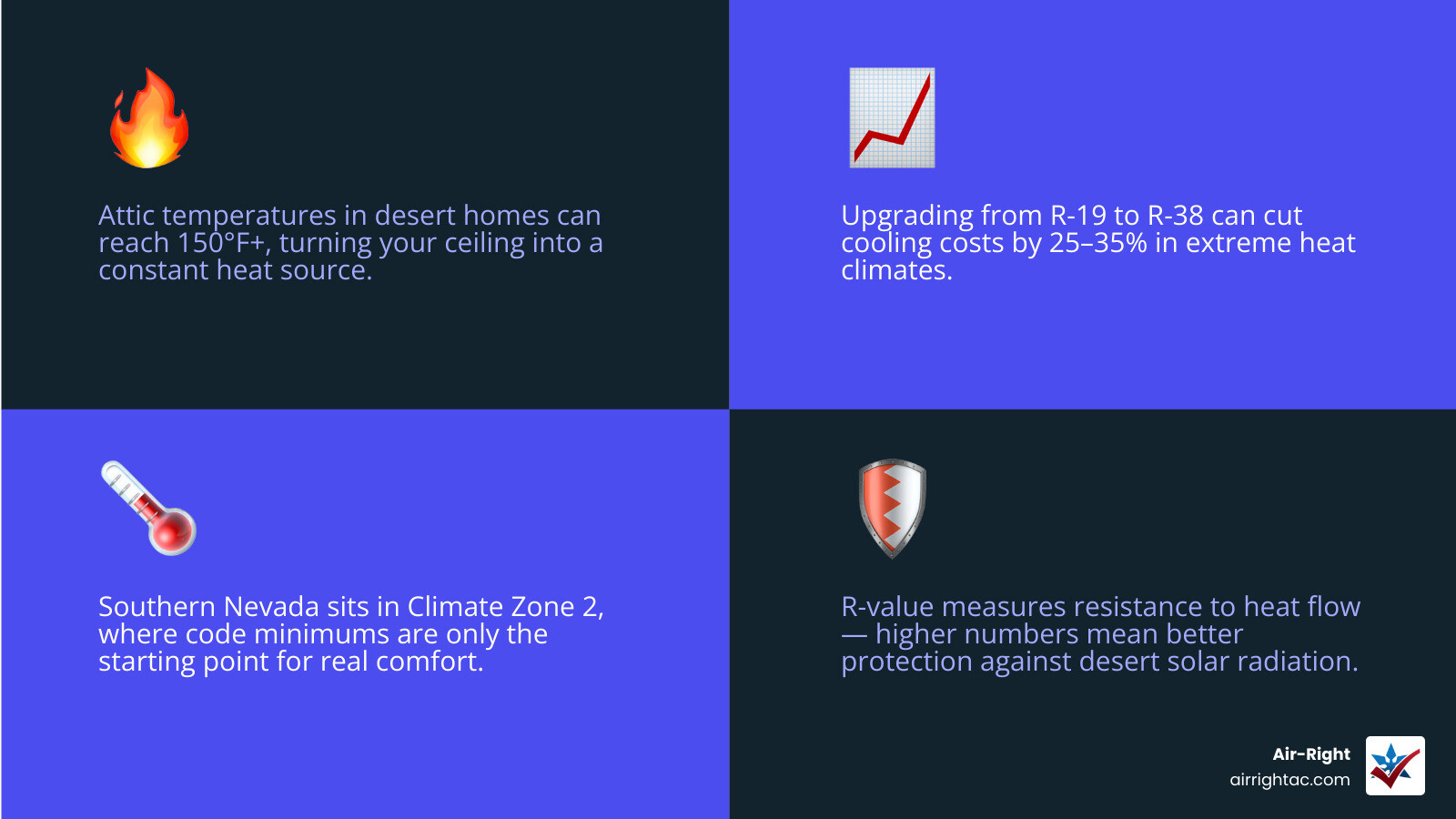
Understanding attic insulation r-value explained for desert homes starts with one simple fact: your attic is the enemy in Las Vegas, Henderson, and Boulder City summers. When outdoor temperatures push past 110°F, attic temperatures can soar to 150°F or higher — turning the space above your living room into a heat reservoir that your AC fights against all day, every day.
Quick Answer: Attic Insulation R-Values for Desert Homes (Las Vegas / Southern Nevada)
| Location in Home | Minimum R-Value | Recommended R-Value | Optimal R-Value |
|---|---|---|---|
| Attic | R-30 (code) | R-38 to R-49 | R-60 |
| Walls | R-13 | R-13 to R-19 | R-21+ |
| Floor / Crawl Space | R-19 | R-19 to R-25 | R-30 |
Key points to know:
- R-value measures how well insulation resists heat flow — the higher the number, the better
- Code minimums in Nevada are a starting point, not a comfort target
- Most Las Vegas-area homes built before the early 2000s have R-19 or less in the attic — far below what the extreme desert climate demands
- Upgrading from R-19 to R-38 can reduce cooling costs by 25–35%
- Air sealing alongside insulation can account for an additional 20–30% energy savings
R-value is not just a number on a bag of insulation. In a desert climate like Southern Nevada, it is the difference between an AC system that keeps up and one that runs nonstop without ever catching a break. Homes here face a unique challenge: six-plus months of relentless heat, intense solar radiation hammering the roof all day, and attic temperatures that would be dangerous to stand in. Insulation that works fine in a mild climate is simply not enough here.
The sections below break down exactly what R-value means, what levels make sense for your home, which materials perform best in extreme heat, and how to know if your current insulation is costing you money every single month.
Attic Insulation R-Value Explained for Desert Homes
To understand how insulation protects your home, we have to look at the basic physics of heat transfer. Heat naturally moves from warmer areas to cooler areas. In the middle of a Southern Nevada summer, the blistering outdoor air and intense solar radiation warm your roof tiles, which then radiate heat down into your attic space. Without a strong thermal barrier, this heat will easily migrate through your drywall ceiling and raise the temperature of your living spaces.
The International Energy Conservation Code (IECC) places the Las Vegas valley, Henderson, and Boulder City in Climate Zone 2 (a hot-dry region). While Zone 2 building codes historically required lower insulation levels than freezing northern climates, energy experts now recognize that keeping extreme heat out requires just as much thermal resistance as keeping winter warmth in. Upgrading your attic insulation is one of the most effective ways to lower your energy consumption because it directly targets the largest area of heat gain in your home. To understand why this upgrade is so critical for your comfort, read about The Hot Truth About Attic Insulation Upgrades for Energy Savings.
What is R-Value and Why Does It Matter in Southern Nevada?
R-value is a measure of thermal resistance. Put simply, it tells you how well a material can resist heat flowing through it. The “R” stands for resistance. A higher R-value means better insulating power, thicker protection, and less heat entering your home.
In Southern Nevada, our homes face a massive temperature differential. If you like to keep your thermostat at a comfortable 75°F while the attic above your ceiling is baking at 150°F, you are dealing with a 75-degree temperature difference across a sheet of drywall. Without proper insulation acting as a shield, heat will pour into your home, forcing your air conditioner to run continuously.
This constant operation of your HVAC system not only drives up your monthly utility bills but also accelerates wear and tear on your equipment, leading to premature breakdowns. To keep your cooling system running efficiently, it helps to understand how to protect your home from the top down. You can learn more about how to stop this heat transfer by reading our guide on how to Stop Baking Your Brain with Better Las Vegas Attic Insulation.
Recommended R-Values for Extreme Desert Climates
While Nevada building codes historically allowed a minimum of R-30 for residential attics, this minimum standard is designed for basic compliance rather than maximum efficiency or comfort. For true relief from the desert heat, we recommend aiming higher:
- R-38 (approximately 12 to 14 inches of traditional loose-fill insulation): This is the baseline recommendation for modern desert homes. It provides a solid defense against thermal transfer and helps stabilize indoor temperatures.
- R-49 (approximately 15 to 18 inches of loose-fill insulation): This is our highly recommended target for homeowners looking to maximize their energy savings. At R-49, you establish a heavy-duty thermal barrier that significantly reduces the workload on your air conditioner.
- R-60 (approximately 19 to 22 inches of loose-fill insulation): This is the optimal level for maximum performance, particularly in older homes with high ceilings or homes with ductwork running through unconditioned attic spaces.
If you are a Henderson resident looking to optimize your home’s setup, we have put together a localized resource to help you navigate these choices. Check out our Henderson Attic Insulation Guide for specific regional recommendations.
Comparing Insulation Materials and Their R-Values Per Inch
Different insulation materials have different physical properties, which means they require different thicknesses to achieve the same overall R-value. When planning an upgrade, it is important to compare how these materials perform under extreme thermal stress and how much space they will occupy in your attic.

To help you visualize your options, here is a side-by-side comparison of the most common insulation materials used in Southern Nevada attics:
| Insulation Material | R-Value Per Inch | Standard Thickness for R-38 | Settling Rate | Best Use Case |
|---|---|---|---|---|
| Blown-In Fiberglass | R-2.2 to R-2.7 | 14 to 17 inches | Low (5% to 10%) | Standard, easy-access attics looking for great value |
| Blown-In Cellulose | R-3.2 to R-3.8 | 10 to 12 inches | High (15% to 20%) | Filling irregular framing gaps and tight corners |
| Closed-Cell Spray Foam | R-6.0 to R-7.0 | 6 to 7 inches | None | Low-clearance attics or unvented roofline applications |
| Fiberglass Batts | R-2.9 to R-3.8 | 10 to 13 inches | Low | Unobstructed attic floors with uniform joist spacing |
| Mineral Wool (Rock Wool) | R-3.0 to R-4.0 | 10 to 12 inches | Extremely Low | Homes requiring high fire resistance and soundproofing |
Choosing the right material depends on your attic’s layout, your budget, and whether you have HVAC ductwork located in the attic space. For a deeper look into how your attic insulation interacts with your heating and cooling system, read our article on Choosing Between Duct and Attic Insulation for a Cooler Home.
Blown-In Fiberglass vs. Cellulose in Desert Heat
Blown-in (or loose-fill) insulation is the most popular choice for retrofitting existing desert homes. It is applied using a blowing machine that distributes the material evenly across the attic floor, filling in gaps around joists, wiring, and pipes. However, fiberglass and cellulose behave differently in the dry desert heat.
Blown-in fiberglass is highly resistant to moisture, does not burn, and does not settle significantly over time. It typically loses only 5% to 10% of its thickness over its entire lifespan, meaning your R-value remains stable for decades. On the other hand, blown-in cellulose—made from recycled paper treated with fire retardants—has a higher R-value per inch, but it is prone to settling. In dry desert climates, cellulose can settle by 15% to 20% in the first few years, which decreases its effective R-value unless the installer accounts for this by adding extra depth initially.
Additionally, cellulose can create more dust during installation, which is a consideration for homeowners sensitive to indoor air quality. For a closer look at installing loose-fill materials in Henderson, see The Ultimate Guide to Attic Insulation in Henderson NV.
Spray Foam and Radiant Barriers for Maximum Heat Rejection
For premium thermal protection, spray foam insulation and radiant barriers offer advanced ways to tackle extreme desert heat.
Unlike traditional insulation that sits on the attic floor, spray foam is often applied directly to the underside of the roof deck. This moves the thermal boundary of your home from the ceiling to the roofline, creating a “conditioned” attic space. Closed-cell spray foam delivers an impressive R-6.0 to R-7.0 per inch and acts as a complete air barrier. By keeping the attic space within a few degrees of your living space, spray foam protects any HVAC equipment and ductwork located in the attic from operating in a 150°F environment.
Radiant barriers work on a different principle. Instead of slowing down conductive heat transfer, they reflect radiant heat. A radiant barrier is a highly reflective foil material installed on the underside of the roof rafters. In the intense Southern Nevada sun, a properly installed radiant barrier can reflect up to 97% of radiant heat, lowering attic temperatures by 20°F to 30°F. When combined with traditional blown-in insulation, a radiant barrier acts as a powerful first line of defense. To explore how to create the ultimate thermal shield for your property, read our guide on the Best HVAC and Insulation Setup for Desert Weather.
Balancing R-Value with Air Sealing and Attic Ventilation
Simply piling more insulation into your attic will not solve your energy efficiency problems if your attic is drafty or poorly ventilated. Insulation is designed to slow down conductive heat transfer, but it cannot stop convective heat transfer (air movement) or replace the need for proper airflow.
To get the most out of your investment, you must treat your attic as a complete system. This involves combining a high R-value with professional air sealing and balanced ventilation. To learn how these elements work together to lower your utility bills, read about how to Beat the Heat and the Bills with Better Attic Insulation.
Why Air Sealing is Crucial Alongside Attic Insulation R-Value Explained for Desert Homes
Many homeowners do not realize that traditional insulation materials like fiberglass and cellulose are porous. They do not stop air from moving. If your ceiling has gaps, cracks, or holes, hot attic air will seep down into your living spaces, and your expensive air-conditioned air will escape upward.
Air sealing is the process of finding and closing these hidden pathways before laying down new insulation. Common culprits include:
- Gaps around recessed “can” lights
- Cracks along top plates (where wall framing meets the ceiling drywall)
- Openings around plumbing stacks, electrical wiring, and ductwork penetrations
- Leaky attic access hatches
By sealing these areas with expanding foam and caulk, we prevent hot attic air from bypassing your insulation. If you live in Boulder City and want to ensure your home is sealed tight, consider exploring Affordable Attic Insulation Services in Boulder City NV.
The Law of Diminishing Returns on Attic Insulation R-Value Explained for Desert Homes
When it comes to attic insulation, more is not always better. Insulation performance follows the law of diminishing returns. This means that each additional inch of insulation you add saves progressively less energy than the inch before it.
For example, upgrading an under-insulated attic from R-11 to R-38 will result in a massive drop in your cooling costs and a highly noticeable improvement in comfort. However, upgrading that same attic from R-49 to R-80 will yield only tiny, incremental energy savings that may take decades to pay for themselves.
Instead of spending your budget on excessive insulation thickness, it is far more cost-effective to invest in thorough air sealing, duct repair, or improved attic ventilation. A professional contractor can help you find this perfect balance. For advice on choosing the right partner for your project, check out our tips on Finding a Reliable Attic Insulation Contractor in Henderson NV.
Signs Your Desert Home Has Inadequate Attic Insulation
How do you know if your attic is currently falling short? Because attic spaces are usually out of sight, many homeowners tolerate uncomfortable conditions for years without realizing their insulation is to blame.
Here are the most common warning signs that your Southern Nevada home is under-insulated:
- High Utility Bills: If your summer energy bills keep climbing despite regular AC maintenance, your home is likely losing its cool air through the ceiling.
- Uneven Room Temperatures: If some rooms feel like a refrigerator while others feel like an oven, your attic insulation may be thin, uneven, or missing in certain areas.
- Constant HVAC Runtime: If your air conditioner runs continuously during the heat of the day without ever cycling off, it is fighting a losing battle against the heat radiating from your ceiling.
- Hot Ceilings and Walls: If you touch your ceiling on a July afternoon and it feels warm or hot to the touch, your insulation is failing to block the thermal energy radiating from your attic.
- Excessive Dust Indoors: If you find yourself constantly dusting, a lack of air sealing in the attic may be allowing insulation particles, dust, and outdoor pollutants to pull down into your living spaces through ceiling gaps.
If any of these signs sound familiar, your home is likely ready for an upgrade. For a detailed breakdown of what to look for, read The Cold Hard Truth: Signs Your Home Needs Better Insulation.
Frequently Asked Questions About Desert Attic Insulation
Can a desert home have too much attic insulation?
Yes, a home can experience diminishing returns if insulation is piled too high without considering other factors. Additionally, over-insulating can be counterproductive if the material blocks your soffit vents or restricts attic airflow. Vented attics rely on a continuous flow of air from intake vents to exhaust vents to flush out extreme heat. If insulation blocks this path, heat will build up, reducing the overall efficiency of your thermal barrier.
How does extreme attic heat (150°F+) affect insulation performance?
Extreme temperatures can accelerate the physical degradation of certain insulation materials. For instance, loose-fill cellulose can settle faster under extreme heat cycles, and wet or damp insulation from summer monsoons can lose up to 50% of its thermal resistance. Furthermore, thermal bridging—where heat bypasses insulation through wooden ceiling joists—becomes much more pronounced when attic temperatures reach extreme highs.
How do pre-1984 homes differ from newer constructions in insulation needs?
Homes built before 1984 in Southern Nevada were constructed under much older, less stringent building codes. These older properties often have shallow ceiling joists (which limit the depth of insulation you can easily install) and may only have R-11 or R-19 insulation. Newer constructions typically feature modern framing that accommodates deeper insulation levels and complies with modern energy codes, though they can still benefit from upgrades to reach optimal R-49 or R-60 performance.
Conclusion
Managing the heat in Southern Nevada requires a comprehensive approach to home efficiency. Your attic insulation is your home’s primary shield against the brutal desert sun, and ensuring you have the correct R-value is essential for keeping your home comfortable and your utility bills manageable.
At Air-Right, we specialize in helping homeowners in Las Vegas, Henderson, and Boulder City optimize their home comfort. As a licensed, bonded, and insured HVAC contractor, we provide clear, no-pressure recommendations tailored to your home’s unique needs. Whether you need to seal air leaks, top off your existing blown-in insulation, or optimize your entire HVAC and ductwork setup, our team is here to help.
Ready to take control of your home’s energy efficiency? Schedule professional attic insulation services with us today and keep your home cool all summer long.
Need Help?
Contact us today to discuss your needs. Our team is ready to help.
Related Articles
- Is It a True Emergency? A Triage Guide for 24-Hour Air Conditioning Service in Las Vegas, NV
- Is That Burning Smell an Emergency? Fall Triage Guide for 24 Hour Air Conditioning Service in Las Vegas, NV
- Beyond 24-Hour Air Conditioning Service in Las Vegas: Heat Pump vs. Gas Furnace Options for Fall Upgrades
Related articles


Ready to Get Started?
Whether you need a repair, maintenance, or a new installation, our expert team is here to help.