The Cold Hard Truth: Signs Your Home Needs Better Insulation
Air-Right

<p>Spot the signs your home needs better insulation. Cut energy bills, boost comfort, and prevent issues in your Las Vegas home.</p>
Is Your Las Vegas Home Trying to Tell You Something About Its Insulation?
Signs your home needs better insulation are often hiding in plain sight — and for Las Vegas homeowners, ignoring them can mean sky-high energy bills, an overworked AC, and a home that never quite feels comfortable no matter how low you set the thermostat.
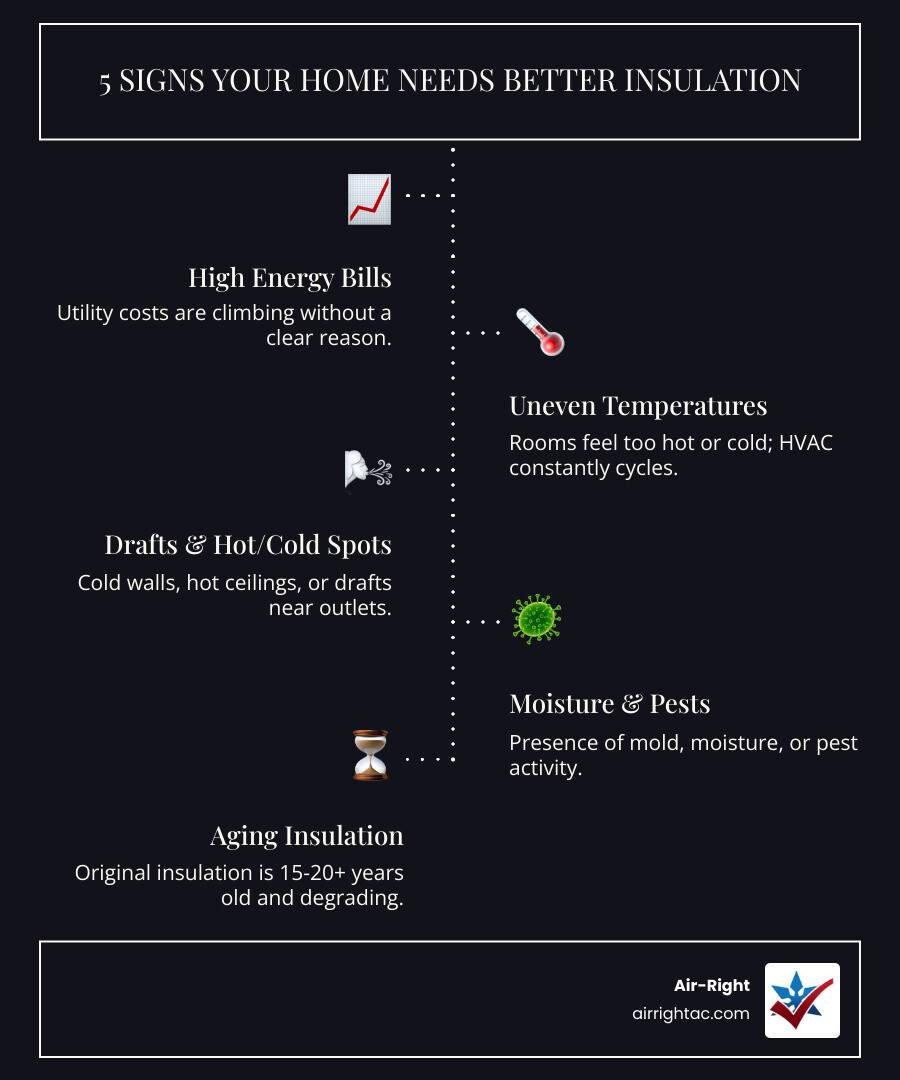
Here are the most common signs to watch for:
- Unusually high energy bills that keep climbing without a clear reason
- Uneven temperatures between rooms, floors, or areas of your home
- Hot ceilings or cold walls to the touch
- Drafts near outlets, baseboards, or recessed lights even with windows and doors shut
- Your HVAC runs almost constantly to maintain the set temperature
- More outside noise than you’d expect inside your home
- Moisture, mold, or musty smells in the attic or along walls
- Pest activity in your attic or walls (rodents nest in insulation)
- Insulation that’s 15–20+ years old and has never been upgraded
Most homeowners don’t think much about insulation until something goes wrong. It’s tucked behind drywall, buried under attic floors, and completely out of sight. But insulation is quietly doing one of the most important jobs in your home — controlling how heat moves in and out.
Here’s the basic science: heat always moves toward cooler areas. In Las Vegas summers, that means relentless heat is constantly trying to push its way into your home through your walls, ceiling, and attic. Insulation slows that process using three principles — convection (air movement), conduction (heat transfer through materials), and radiation (heat traveling through space). The better your insulation’s R-value (its resistance to heat flow), the harder it works to keep that desert heat where it belongs — outside.
When your home’s thermal envelope has gaps, weak spots, or aging materials, your AC has to fight much harder to compensate. The Department of Energy estimates that proper insulation can reduce heating and cooling costs by up to 20% — which in a Las Vegas home running the AC for most of the year, adds up fast.
The good news? Most of the signs are ones you can spot yourself, before the problem gets expensive.
Energy Bills and HVAC Performance
One of the most immediate signs your home needs better insulation shows up in your mailbox every month. If you notice your utility costs are creeping up—or sprinting up—compared to the same month last year, your insulation might be failing. In the Mojave Desert, our air conditioners are the marathon runners of the appliance world. However, even the best AC unit can’t win the race if the “coolness” it produces is leaking out of the attic like water through a sieve.
The Department of Energy suggests that homeowners can save between 10% and 20% on energy-use costs simply by upgrading their air sealing and insulation. When your home is under-insulated, your HVAC system enters a state of “constant cycling.” This means it turns on, runs for a long time, shuts off briefly, and then kicks right back in because the home can’t hold the temperature.
This constant strain doesn’t just hit your wallet today; it shortens the lifespan of your expensive cooling equipment. If your system is working overtime to compensate for thin attic batts, you’re essentially paying for a cooling bill and a future repair bill at the same time. To keep your system in top shape while you address insulation gaps, regular HVAC Maintenance is essential. Taking steps to Save on Your Energy Bill often starts with ensuring your home can actually keep the air you’ve paid to cool.
Physical Signs Your Home Needs Better Insulation
You don’t need a degree in engineering to diagnose a poorly insulated home; you just need your hands. A simple “touch test” can reveal a lot. During a blistering July afternoon in Henderson or Boulder City, go into your hallway and touch the ceiling. If it feels hot to the touch, your attic insulation is failing to block the radiant heat from your roof. Conversely, in the winter, if your interior walls feel icy, the heat you’re paying for is conducting straight through the drywall to the outside.
Another physical indicator is the presence of “phantom drafts.” We often blame old windows or doors for drafts, but research shows that sealing windows and doors only addresses about 15-20% of air leakage. The real culprits are often hidden:
- Electrical Outlets: If you feel a breeze coming from an outlet on an exterior wall, there’s a gap in the wall cavity insulation.
- Recessed Lighting: These “can lights” often act as chimneys, sucking cool air up into the hot attic.
- Baseboards: Gaps here indicate air is moving between the floor and the walls.
Checking these areas is part of getting Better Las Vegas Attic Insulation, as a complete thermal envelope requires more than just a few fiberglass batts tossed in a corner.
Common signs your home needs better insulation in Las Vegas
Our local climate presents unique challenges. In Las Vegas, the sun beats down on roofs with incredible intensity. This creates a “heat battery” in your attic that can reach 150°F or more. If your insulation is insufficient, this heat radiates downward into your living space.
A classic sign of this in Southern Nevada is the “Second-Floor Swelter.” If your upstairs bedrooms are consistently 5 to 10 degrees hotter than the downstairs, despite your AC running full blast, your attic insulation is likely below the recommended R-value. You might also notice dramatic temperature fluctuations throughout the day—the house feels fine at 8:00 AM but becomes an oven by 2:00 PM because the insulation can’t keep up with the rising solar load. For a deeper dive into local requirements, check out The Ultimate Guide to Attic Insulation in Henderson, NV.
Identifying signs your home needs better insulation through noise
Believe it or not, your ears can tell you as much as your thermostat. Many people forget that insulation is also a powerful acoustic barrier. If you can hear your neighbor’s car idling, the neighborhood kids playing three houses down, or the wind whistling as if you were standing outside, your walls and attic are likely under-insulated.
High-quality insulation—like mineral wool or dense-pack cellulose—dampens sound waves. If your home has suddenly become “noisier” over the years, it could be a sign that your insulation has settled or degraded, leaving gaps that allow sound (and heat) to pass through freely. Seeking Affordable Attic Insulation Services in Boulder City, NV can bring back the peace and quiet you deserve.
Structural and Pest Warnings
Sometimes the signs your home needs better insulation are a bit more… biological. Pests like mice, rats, and even pigeons love fiberglass insulation. It’s warm, soft, and easy to tunnel through. If you find droppings, nesting materials, or “tunnels” in your attic insulation, the material is likely compromised. Pests compress insulation, and compressed insulation loses its R-value because it relies on trapped air pockets to work.
Moisture is another major red flag. While we live in a dry climate, the “dew point” still matters. When hot attic air meets a cool ceiling (cooled by your AC), condensation can form. If you see water spots on your ceiling that aren’t caused by a roof leak, or if you notice a musty smell in the attic, your insulation may be damp. Once fiberglass or cellulose gets wet, it can grow mold and lose its effectiveness permanently.
In the rare winter cold snaps we get in the Vegas valley, poorly insulated pipes in crawl spaces or attics can freeze. If your pipes are shivering, it’s a sign that the “blanket” protecting your home’s vitals is too thin.
Evaluating Insulation Quality
How do you know if what you have is “good enough”? Age is the biggest factor.
- Fiberglass Batts: These typically last 15–20 years. Over time, they can sag or pull away from the studs.
- Blown-in Cellulose: This is great for filling nooks, but it settles significantly over 20–25 years, losing its “fluff” and its R-value.
- Spray Foam: This is the gold standard, often lasting 80+ years, but it must be installed correctly to avoid gaps.
A quick visual check is the “Joist Test.” Peek into your attic; if you can see the wooden floor joists, you almost certainly don’t have enough insulation. In Nevada, we should be aiming for a depth that completely covers those joists and then some (usually 10-18 inches depending on the material).
If you’re unsure where to start, consulting a Henderson Attic Insulation Guide can help you visualize what a healthy attic should look like. And when you’re ready for an upgrade, Finding a Reliable Attic Insulation Contractor in Henderson, NV is the best way to ensure the job is done to modern building codes.
Frequently Asked Questions about Home Insulation
How long does home insulation typically last?
While many materials are rated for decades, real-world conditions in the desert—like extreme heat and dust—can accelerate degradation. Fiberglass batts often start to lose their effectiveness after 15 years as they settle or accumulate dust. Cellulose can settle by as much as 20% in just a few years. If your home was built before 2005 and hasn’t been touched, it’s likely time for a top-off.
Can poor insulation cause mold or moisture issues?
Yes. When there is a large temperature difference between two sides of a surface (like your ceiling), moisture in the air can condense. In a poorly insulated home, this “dew point” happens right on your drywall or inside your walls, leading to hidden mold growth and musty odors.
Does insulation help with summer heat in Nevada?
Absolutely. This is the biggest misconception! People think insulation is for “keeping warm,” but in Las Vegas, its primary job is “keeping cool.” By resisting radiant heat from the sun and preventing hot air from infiltrating your living space, proper insulation is the best friend your air conditioner ever had.
Conclusion
Recognizing the signs your home needs better insulation is the first step toward a more comfortable, affordable life in the Las Vegas valley. Whether it’s the frustration of a hot second floor, the sting of a high energy bill, or the annoyance of hearing every car that passes by, these symptoms shouldn’t be ignored.
At Air-Right, we specialize in helping homeowners in Las Vegas, Henderson, and Boulder City reclaim their comfort. Our licensed and insured technicians provide clear, no-pressure recommendations to help you decide if a simple “top-off” or a full insulation replacement is right for your home. Don’t let the desert heat win—explore Our Services today and find out how we can help you stay cool for less.
Need Help?
Contact us today to discuss your needs. Our team is ready to help.
Related Articles
- Is It a True Emergency? A Triage Guide for 24-Hour Air Conditioning Service in Las Vegas, NV
- Is That Burning Smell an Emergency? Fall Triage Guide for 24 Hour Air Conditioning Service in Las Vegas, NV
- Beyond 24-Hour Air Conditioning Service in Las Vegas: Heat Pump vs. Gas Furnace Options for Fall Upgrades
Related articles


Ready to Get Started?
Whether you need a repair, maintenance, or a new installation, our expert team is here to help.