Stop the Heat Leak: Is Your Attic or Your Ductwork the Real Culprit?
Air-Right

<p>Stop heat leaks! Discover if duct insulation vs attic insulation which matters more for your Las Vegas home. Save energy now!</p>
Why the Answer to “Duct Insulation vs Attic Insulation Which Matters More” Could Cut Your Energy Bills in Half
Duct insulation vs attic insulation which matters more is one of the most common — and most misunderstood — questions Las Vegas homeowners ask when their energy bills spike or their AC struggles to keep up in summer heat. And in Southern Nevada, where attic temperatures routinely climb past 130°F, the stakes are high.
Here’s the short answer before we go deeper:
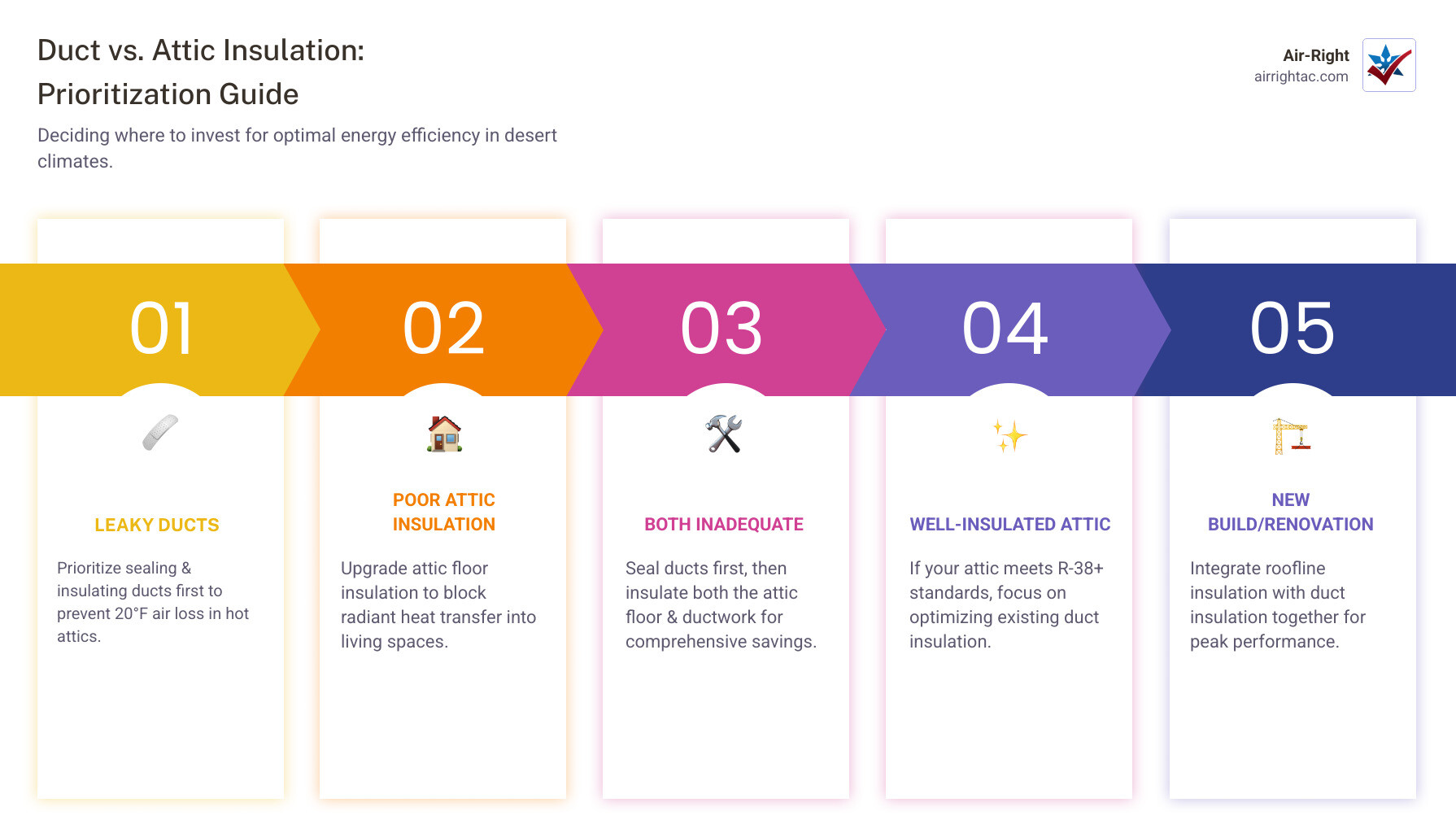
Quick Answer: Which Matters More?
| Situation | Prioritize This |
|---|---|
| Ducts are leaking or poorly sealed | Duct sealing + duct insulation first |
| Attic has little to no insulation | Attic floor insulation first |
| Both are inadequate | Seal ducts, then insulate both |
| Attic is already well insulated (R-38+) | Focus on duct insulation upgrade |
| New construction or full renovation | Insulate attic roofline and ducts together |
The honest truth? Neither one fully works without the other. But which you fix first depends on your home’s specific weak point.
Here’s why this matters so much in Las Vegas, Henderson, and Boulder City: your HVAC system can lose up to 20 degrees of cooled air between the air handler and your ceiling vents — not because your AC unit is failing, but because your ducts are sitting in a 130°F+ attic with inadequate insulation. At the same time, a poorly insulated attic floor lets that same radiant heat pour straight into your living space, forcing your system to work even harder.
Fixing one without the other is like patching one end of a leaking hose. You need to understand both sides to make a smart decision.
Understanding the Roles: Duct Insulation vs Attic Insulation Which Matters More?
When we talk about home efficiency in April 2026, we have to look at the “thermal envelope.” Think of your home as a cooler. The attic floor insulation is the thick foam walls of the cooler that keep the heat out. The duct insulation is the sleeve around your cold drink inside that cooler. If the cooler walls are thin, the inside gets hot. If the drink sleeve is thin, the drink warms up before you can take a sip.
In the debate of duct insulation vs attic insulation which matters more, the answer often lies in the “Delta T” — the temperature difference. Your attic floor might face a 50 to 60-degree difference between the house and the attic. However, your air ducts carry 55°F air through a 135°F attic. That’s an 80-degree difference! This extreme gap makes duct performance critical.
| Feature | Attic Floor Insulation | HVAC Duct Insulation |
|---|---|---|
| Primary Goal | Stop heat from entering living spaces | Keep conditioned air at the target temp |
| Common Materials | Blown-in cellulose, fiberglass batts | Foil-backed fiberglass wrap, R-8 flex |
| Typical R-Value | R-38 to R-60 (Nevada Standard) | R-4 to R-8 |
| Heat Transfer | Mostly conduction and radiation | Conduction and convection |
For more local specifics, check out our Henderson Attic Insulation Guide.
The Primary Purpose of Attic Floor Barriers
The attic floor is your home’s first line of defense. By laying down a thick blanket of blown-in cellulose or fiberglass batts, we create a barrier that slows down radiant heat. In Las Vegas, the sun bakes your roof tiles until the attic space becomes an oven. Without a proper floor barrier, that heat migrates through your drywall ceiling into your bedrooms.
By beefing up this layer, you reduce the overall “cooling load” on your AC. It doesn’t have to work as hard because the house isn’t absorbing as much heat from above. If you’re curious about which material fits your home, The Ultimate Guide to Attic Insulation in Henderson, NV breaks down the best choices for our desert climate.
The Critical Function of HVAC Duct Wrapping
Your ductwork is the delivery system for your comfort. If the attic floor is the “garage” protecting the car, the ducts are the car itself. Even in a well-insulated attic, the air inside the ducts is vulnerable. Most older homes have ducts insulated to R-4 or R-6. Modern standards prefer R-8 or higher.
When cold air travels through undersized or poorly wrapped ducts, it acts like a “heat sponge.” By the time the air reaches your master bath, it might have warmed up by 10 or 15 degrees. This is why finding the right duct work company in Henderson is so important; you need someone who understands that a delivery system is only as good as its insulation.
The Science of Heat Gain: Why Your Ducts Are Under Attack
In Southern Nevada, physics isn’t always on our side. During a typical July afternoon, attic temperatures can easily soar to 150°F. If your AC is producing 55-degree air, but that air has to travel 40 feet through a 150-degree tunnel, the thermal gain is massive. We often see systems losing 20 degrees of cooling capacity before the air even hits the room.
This is a classic case of “convection” and “conduction” working against you. The hot air in the attic heats the surface of the duct (conduction), and the air moving inside picks up that heat. This is why we advocate for homeowners to stop baking their brains with better Las Vegas attic insulation, as lowering the ambient attic temperature gives your ducts a fighting chance.
Why Duct Insulation vs Attic Insulation Which Matters More in Desert Climates
In humid climates, people worry about rot. In Las Vegas, we worry about “thermal bypass” and extreme Delta T. Because our summer air is so dry and hot, the temperature difference between your ductwork and the attic environment is among the highest in the country.
If you have a choice between adding three inches of insulation to an already decent attic floor or upgrading your R-4 ducts to R-8, the duct upgrade often wins. Why? Because the energy waste from “cooking” your cold air is more expensive than the minor heat bleed through a ceiling that is already mostly protected.
Condensation Risks and Vapor Barriers
You might think moisture isn’t an issue in the desert, but inside your HVAC system, it’s a different story. When cold air meets a warm surface, you reach the “dew point.” If your duct insulation is torn or compressed, moisture can condense on the metal.
This is why professional duct wrapping uses a foil-backed vapor barrier. If you try to DIY this by throwing fiberglass batts over your ducts, you might actually trap moisture against the ductwork, leading to mold or rust. We always ensure a tight, sealed vapor barrier to keep the unconditioned attic air away from the cold duct surface.
Prioritizing Your Upgrades: Sealing Before Insulating
Before we even talk about duct insulation vs attic insulation which matters more, we have to talk about sealing. You can wrap a leaky duct in the world’s most expensive insulation, but if 30% of your cold air is blowing out through a loose joint, the insulation won’t save you a dime.
Air leakage is the silent killer of HVAC efficiency. Traditional duct tape (the silver stuff) is notorious for failing in the desert heat. It dries out, becomes brittle, and peels off. We use professional-grade mastic sealant — a thick, peanut-butter-like paste that hardens into a permanent, flexible seal. For more on why your old ducts might be failing you, see our survival guide for summer duct work in Boulder City.
The Impact of Duct Insulation vs Attic Insulation Which Matters More for HVAC Longevity
When your air is warming up in the ducts, your AC has to run longer cycles to reach the temperature set on your thermostat. Longer cycles mean more wear and tear on your compressor and fan motor.
By prioritizing duct insulation and sealing, you reduce the “static pressure” and strain on the system. This leads to fewer breakdowns and a longer lifespan for your equipment. If you’re looking for an expert to evaluate your system’s health, finding a reliable attic insulation contractor in Henderson is a great first step toward long-term savings.
Air Sealing the Attic Floor
Just as we seal ducts, we must seal the attic floor. This prevents the “stack effect,” where conditioned air from your home is sucked into the attic through gaps around recessed lights, plumbing stacks, and wire penetrations.
If your attic floor isn’t air-sealed, adding more insulation is like putting a sweater on over a shirt full of holes. The air still moves right through it. We focus on sealing these “top plates” to ensure the insulation can actually do its job. We offer affordable attic insulation services in Boulder City that include these critical sealing steps.
Choosing the Right Materials for Southern Nevada Homes
Not all insulation is created equal. In Las Vegas, we look for materials that can handle the heat without settling or losing their R-value over time.
- Blown-in Cellulose: Made from recycled paper treated with borates, this is excellent for fire resistance and filling small gaps. It has a higher R-value per inch than loose-fill fiberglass.
- Blown-in Fiberglass: This is a popular, cost-effective choice that doesn’t settle as much as cellulose. It’s great for reaching those R-49 to R-60 standards recommended for Nevada.
- Spray Foam: By applying closed-cell spray foam to the roofline (the underside of the roof deck), we can move the thermal boundary. This turns your attic into a “semi-conditioned” space, meaning your ducts are no longer sitting in 150-degree heat.
Best Materials for Attic Floors
For most Henderson and Las Vegas homes, blown-in cellulose or fiberglass is the gold standard for attic floors. These materials are “gap-filling,” meaning they wrap around wires and joists much better than old-fashioned batts. We also prefer borate-treated materials because they act as a natural pest deterrent — a nice bonus in the desert!
Effective Solutions for Attic Ductwork
For ducts, we typically use R-8 foil-backed duct wrap or high-quality flex ducts with built-in insulation. We also use support strapping to keep ducts off the attic floor, which prevents “thermal bridging” and keeps the airflow balanced. Using mastic sealant on every joint before wrapping is our “secret sauce” for maximum efficiency.
Frequently Asked Questions about Attic Efficiency
Should I insulate my ducts or my attic floor first?
If your ducts are uninsulated or leaking, start there. The energy loss from “cooking” your air is usually more significant than the heat coming through the ceiling. However, if your attic floor is bare, that is a major emergency that needs to be addressed immediately to protect your home’s structure and comfort.
Can attic insulation alone solve duct heat gain?
No. Even if you have R-60 on the floor, the air in the attic space will still be hot (unless you use spray foam on the roofline). Your ducts still need their own “sleeve” of insulation to keep the air inside cold while it travels through the warm attic.
Is DIY duct insulation safe for homeowners?
It can be tricky. Working in a 130-degree attic is dangerous, and improper sealing can lead to condensation and mold issues. Additionally, handling fiberglass requires proper PPE (masks, gloves, eye protection). Most homeowners find that the efficiency gains from a professional, mastic-sealed installation far outweigh the cost of a DIY attempt.
Conclusion
At Air-Right, we’ve seen it all in Las Vegas, Henderson, and Boulder City. We know that the question of duct insulation vs attic insulation which matters more doesn’t have a one-size-fits-all answer. It takes a professional eye to look at your duct design, your current insulation levels, and your system’s performance to give you a clear, no-pressure recommendation.
Whether you need a simple duct sealing or a full attic insulation upgrade to R-60, our licensed, bonded, and insured team is here to help. We focus on home comfort and energy savings that actually make a difference on your monthly bill.
Ready to stop the heat leak? Contact Air-Right today for professional diagnostics and expert insulation services across Southern Nevada. Let’s get your home back to being the cool sanctuary it should be!
Need Help?
Contact us today to discuss your needs. Our team is ready to help.
Related Articles
- Is It a True Emergency? A Triage Guide for 24-Hour Air Conditioning Service in Las Vegas, NV
- Is That Burning Smell an Emergency? Fall Triage Guide for 24 Hour Air Conditioning Service in Las Vegas, NV
- Beyond 24-Hour Air Conditioning Service in Las Vegas: Heat Pump vs. Gas Furnace Options for Fall Upgrades
Related articles


Ready to Get Started?
Whether you need a repair, maintenance, or a new installation, our expert team is here to help.