Stop the Bleed: How Leaky Ducts Waste Cooled Air in the Attic
Air-Right

<p>Stop energy waste! Learn how duct insulation improves AC efficiency in your Las Vegas home. Get cooler and save money.</p>
Your Attic Is Draining Your AC — Here’s Why Duct Insulation Matters
How duct insulation improves AC efficiency comes down to one simple idea: keeping cooled air cold from the moment it leaves your system to the moment it reaches your vents.
Here’s a quick breakdown of how it works:
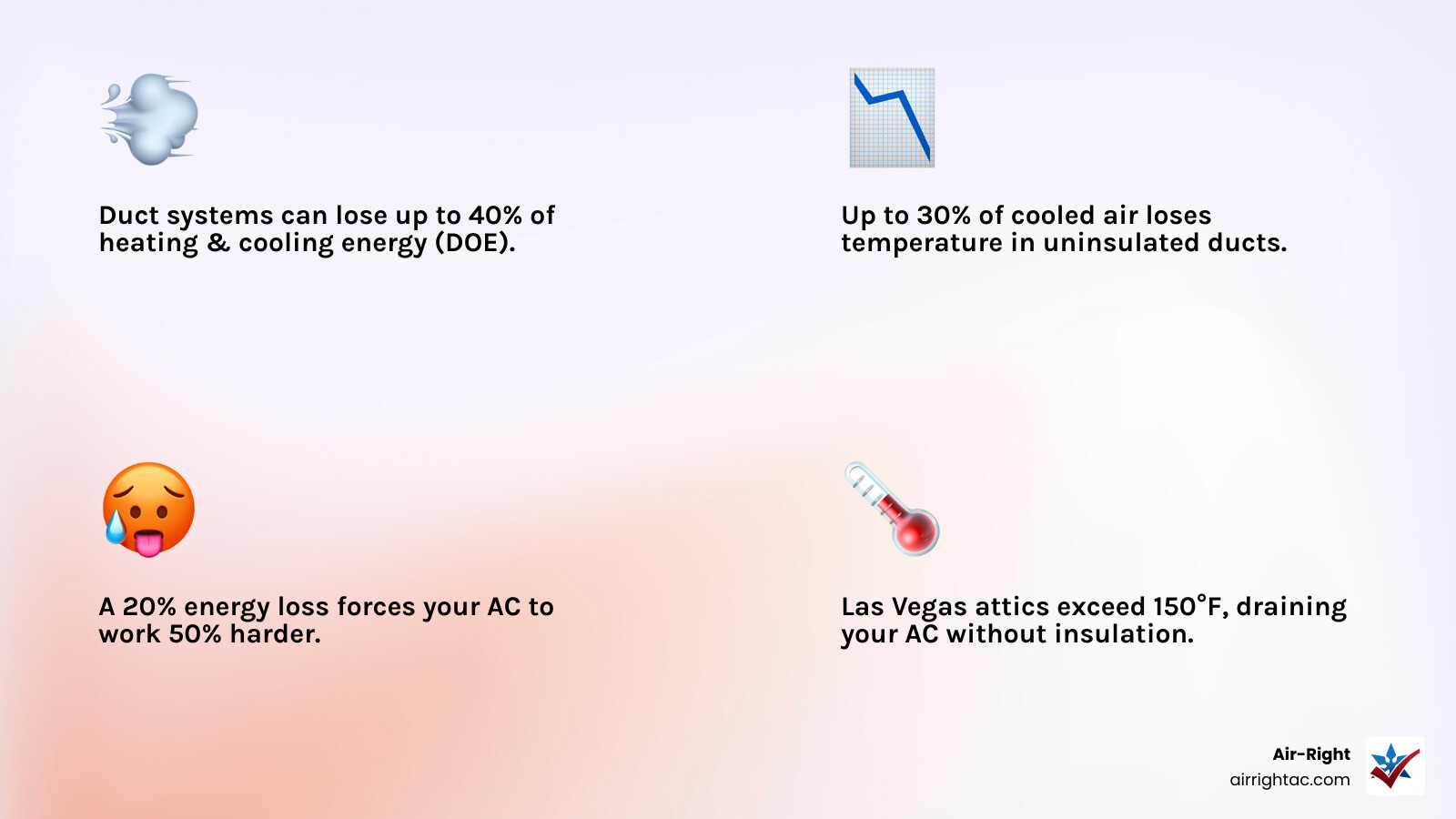
- Prevents heat gain — Insulation acts as a barrier between your cool duct air and the scorching attic heat around it (Las Vegas attics can exceed 150°F in summer).
- Reduces energy waste — Without insulation, up to 30% of cooled air loses its temperature before it ever reaches a room.
- Lowers system strain — When ducts bleed heat, your AC runs longer and works harder to compensate.
- Controls condensation — Insulation prevents moisture buildup on duct surfaces, stopping mold before it starts.
- Improves airflow consistency — Insulated ducts deliver air closer to the temperature your thermostat actually set.
The numbers tell a hard story. According to the U.S. Department of Energy, duct systems can lose up to 40% of heating and cooling energy through a combination of leakage and heat transfer. The North American Insulation Manufacturers Association (NAIMA) puts conditioned air loss through unprotected ducts as high as 30%. And research shows that even a 20% energy loss can force your HVAC system to work up to 50% harder than it should.
In Las Vegas, where summer temperatures push past 110°F and your AC runs nearly non-stop, those numbers aren’t abstract — they show up directly on your utility bill every single month. More than 7 out of 10 buildings across the U.S. have air ducts with inadequate insulation, which means the odds are not in your favor if your home has never had a duct inspection.
Leaky, uninsulated ducts running through an unconditioned attic aren’t just inefficient. They’re actively working against every dollar you spend cooling your home.
Understanding How Duct Insulation Improves AC Efficiency
To understand how duct insulation improves AC efficiency, we first have to look at the physics of your attic. Most air ducts in Southern Nevada are made of thin sheet metal or flexible plastic. These materials are excellent at moving air, but they are terrible at resisting heat.
When your AC kicks on, it sends air chilled to about 55°F through ducts sitting in an attic that might be 130°F or hotter. Without a protective barrier, a process called “thermal bridging” occurs. This is essentially a heat highway where the scorching attic air warms up the metal duct, which then warms up the air inside. By the time that “cooled” air reaches your master bedroom, it might have gained 10 or 15 degrees.
This is where the R-value comes in. R-value measures a material’s thermal resistance—the higher the number, the better it stops heat from moving through it. By wrapping those ducts in high-quality insulation, we break that thermal bridge. You can Save on Your Energy Bill significantly just by ensuring that the cold air you paid for actually stays cold until it leaves the register.
How duct insulation improves ac efficiency by reducing thermal bridging
When we talk about energy conservation in Henderson or Boulder City, we’re really talking about reducing the workload on your equipment. Thermal bridging doesn’t just make your rooms warmer; it forces your AC to run longer cycles.
If your thermostat is set to 75°F, but the air coming out of the vents is lukewarm because of heat gain in the attic, the system will struggle to reach the set point. This constant “cycling” creates immense strain on the compressor and fan motor. Proper insulation ensures temperature consistency throughout the house, meaning the back bedroom stays just as cool as the living room. Our AC System Services often reveal that “broken” air conditioners are actually just healthy systems struggling against poorly insulated ductwork.
How duct insulation improves ac efficiency through condensation control
In the desert, we don’t often think about humidity, but the temperature difference between 55°F duct air and 100°F attic air is a recipe for condensation. When hot air hits a cold, uninsulated surface, water droplets form—much like the “sweat” on a cold soda can in July.
This moisture is a silent killer for HVAC systems. It can lead to:
- Mold and mildew growth inside the attic or even within the duct seams.
- Microbial growth that degrades indoor air quality.
- Corrosion of metal ductwork, leading to holes and further air loss.
Quality duct insulation includes a vapor barrier—a shiny outer layer that prevents moist air from reaching the cold duct surface. This is a critical part of HVAC Maintenance that protects both your health and your home’s structural integrity.
Assessing Your Home: Signs You’re Losing Cooled Air
How do you know if your ducts are the “unsung heroes” or the “secret villains” of your home? Since most ductwork is hidden behind drywall or buried under attic insulation, you have to look for the secondary symptoms of a failing system.
One of the most common signs is uneven temperatures. If the kitchen is freezing but the home office feels like a sauna, you likely have a breach in the duct insulation or a significant leak. Another red flag is high utility bills that seem out of proportion with your actual AC usage. If your bills have spiked but your habits haven’t changed, your ducts might be bleeding air.
You should also keep an eye out for:
- Excessive dust: If you clean your home and a layer of dust returns within 24 hours, your ducts might be pulling in dirty attic air through gaps.
- Whistling sounds: High-pitched noises often indicate air escaping through a small hole under high pressure.
- The “Cold Blow” phenomenon: This happens when the air coming out of the vent feels more like a breeze than a refrigerated blast.
If you’re noticing these issues, it might be time to look into Duct Work Replacement in Boulder City: A Survival Guide for Summer to see if your system is beyond a simple patch job.
The Two-Step Solution: Sealing and Insulating for Maximum Results
Insulation is only half the battle. If you wrap a leaky pipe in a towel, the towel just gets wet. Similarly, if you insulate a leaky duct, you’re just hiding the problem. To truly “stop the bleed,” we use a two-step process: Sealing and Insulating.
First, we use mastic sealant or specialized foil tape (not the “duct tape” you find at the hardware store, which actually fails quickly under heat) to close every gap, seam, and joint. This prevents conditioned air from escaping and keeps unconditioned attic air from being sucked in. Once the system is airtight, we apply the insulation. This combination is the most effective way to Stop Baking Your Brain with Better Las Vegas Attic Insulation.
The impact of duct sealing on system performance
Sealing does more than just save air; it balances the pressure in your home. When ducts leak, it can create a “backdrafting” effect. This is a safety hazard where combustion gases from gas water heaters or furnaces are pulled back into the living space instead of being exhausted outside.
Properly sealed ducts also ensure that the airflow is balanced. Your AC is designed to move a specific volume of air. If 20% of that air is lost in the attic, the “static pressure” of the system is thrown off. This makes the blower motor work significantly harder. When you Get Your HVAC System Installed Efficiently, sealing is the foundation of that efficiency.
Real-world efficiency gains from professional upgrades
The statistics are clear: sealing and insulating your ducts can provide a 20% efficiency boost almost immediately. In some cases, this allows the HVAC system to work with 50% less workload, which directly translates to a longer lifespan for your expensive equipment.
Instead of your AC unit lasting 10 years and dying a premature death from exhaustion, a protected system can easily reach 15 or 20 years with a proper AC Maintenance Contract. You aren’t just saving on your monthly power bill; you’re delaying a multi-thousand-dollar replacement.
Material Selection: What Works Best in the Las Vegas Heat?
Not all insulation is created equal, especially when it has to survive a Southern Nevada summer. Here is how the most common materials stack up:
| Material | Thermal Resistance (R-Value) | Best For… |
|---|---|---|
| Fiberglass Wrap | R-4 to R-8 | Most residential ducted systems; cost-effective. |
| Spray Foam | R-6 to R-7 per inch | Hard-to-reach areas; provides an airtight seal. |
| Reflective Foil | Variable | Reflecting radiant heat in very hot attics. |
| Rigid Foam Board | R-8+ | Exposed ductwork in garages or basements. |
In the Las Vegas area, we often recommend a combination of fiberglass wrap with a high-quality reflective vapor barrier. This addresses both the conductive heat (from the air) and the radiant heat (from the sun hitting your roof). For more details on attic-specific materials, check out The Ultimate Guide to Attic Insulation in Henderson, NV.
Required R-values for Nevada building codes
Building codes in Nevada have become much stricter over the years to combat our extreme climate. The International Energy Conservation Code (IECC) generally requires R-8 insulation for ducts located in unconditioned spaces like attics.
If your home was built more than 15 or 20 years ago, your ducts might only have R-4 or even no insulation at all. Upgrading to modern standards isn’t just about following the law; it’s about basic survival in the desert heat. You can find more local specifics in our Henderson Attic Insulation Guide.
Why Professional Installation is Required for Long-Term Performance
It is tempting to think of duct insulation as a DIY weekend project, but the reality is much more complex. Professional installation is vital for several reasons:
- Sizing and Static Pressure: If you wrap a duct too tightly, you compress the insulation, which kills its R-value. If you use the wrong material, you can restrict airflow, causing the evaporator coil to freeze up.
- UL-181 Standards: Professionals use materials that meet strict fire safety and durability standards. Standard “duct tape” is not UL-rated for permanent duct sealing and will peel off within a single season.
- Complex Calculations: We don’t just guess where the leaks are. We use specialized tools to measure pressure drops and ensure the entire system is balanced.
Finding the Right Duct Work Company in Henderson Without Breaking a Sweat means looking for a team that understands the “whole-home” approach to efficiency, not just someone who throws some fiberglass over a hole.
Frequently Asked Questions About Duct Efficiency
Are there rebates or incentives available for duct insulation in Las Vegas?
Yes! Many local utility providers and federal programs offer incentives for energy-efficiency upgrades. Because duct insulation is recognized by Energy Star as one of the most effective ways to reduce a home’s carbon footprint, there are often rebates or tax credits available that can help offset the cost of the project. We always recommend checking current Nevada utility programs before starting your upgrade.
How does duct insulation reduce noise in my AC system?
If your AC sounds like a jet engine taking off every time it starts, your ducts might be to blame. Fibrous glass insulation acts as an acoustic dampener, absorbing the vibrations of the air moving through the metal. It also prevents the “popping” or “creaking” sounds that occur when metal ducts expand and contract as they heat up and cool down.
How often should I have my duct insulation inspected?
We recommend a professional inspection every 3 to 5 years, or as part of your seasonal maintenance. Duct insulation has a lifespan of about 15 years, but it can be damaged much sooner by pests (like pigeons or rodents), roof leaks, or even other contractors stepping on the ducts while working in the attic. If your insulation looks flattened, torn, or discolored, it’s no longer doing its job.
Conclusion
At Air-Right, we’ve seen how a few simple changes in the attic can transform a home from a “money pit” into a sanctuary of comfort. How duct insulation improves AC efficiency isn’t just a technical theory—it’s a practical necessity for anyone living in the Las Vegas, Henderson, or Boulder City area.
By sealing leaks and adding the right thermal barrier, you stop the bleed of cooled air and start saving money. Whether you’re dealing with uneven room temperatures or just want to lower your monthly power bill, our team is here to provide clear, no-pressure recommendations.
Don’t let your attic steal the comfort you pay for. Explore our full range of Services and let us help you keep your cool all summer long.
Need Help?
Contact us today to discuss your needs. Our team is ready to help.
Related Articles
- Is It a True Emergency? A Triage Guide for 24-Hour Air Conditioning Service in Las Vegas, NV
- Is That Burning Smell an Emergency? Fall Triage Guide for 24 Hour Air Conditioning Service in Las Vegas, NV
- Beyond 24-Hour Air Conditioning Service in Las Vegas: Heat Pump vs. Gas Furnace Options for Fall Upgrades
Related articles


Ready to Get Started?
Whether you need a repair, maintenance, or a new installation, our expert team is here to help.