Stop Burning Cash with the Best Insulation ROI Upgrades
Air-Right

<p>Discover which insulation project gives better roi in Southern Nevada. Maximize savings, boost home value, and stop burning cash!</p>
Which Insulation Project Gives Better ROI: The Quick Answer for Las Vegas Homeowners
Which insulation project gives better roi is the right question to ask before spending a single dollar on home efficiency upgrades — especially in Las Vegas, where summer heat pushes energy bills to painful highs.
Here is the short answer, ranked by return:
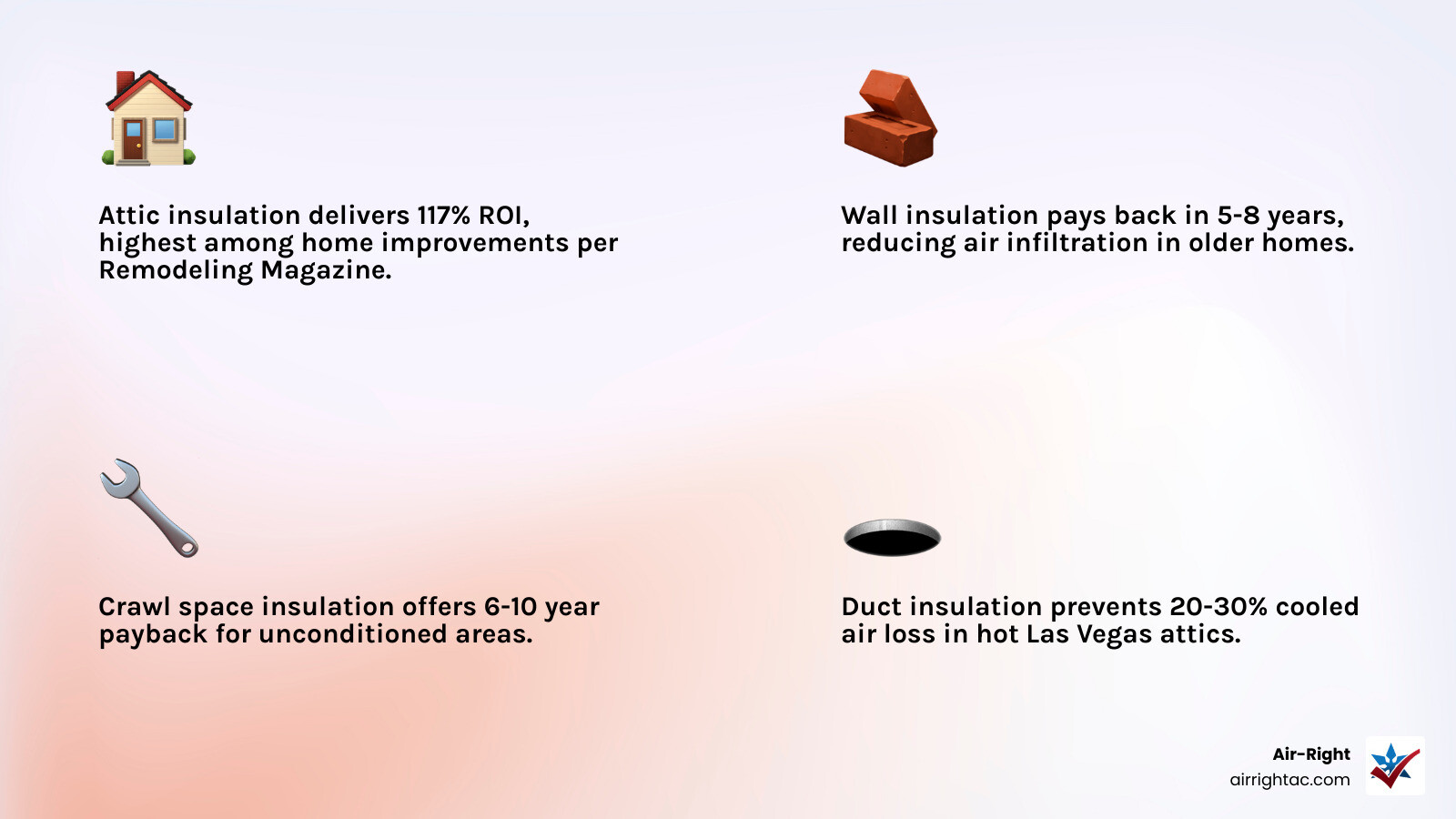
- Attic insulation – Highest ROI, often exceeding 100%. In Southern Nevada, radiant heat gain through the roof is the single biggest driver of cooling costs. Addressing it first delivers the fastest financial return.
- Wall insulation – Fastest energy payback in older homes (5-8 years). Reduces air infiltration and eliminates hot spots room by room.
- Basement / crawl space insulation – Solid mid-range return (6-10 years). Less impactful in Las Vegas than in cold climates, but still worthwhile in homes with unconditioned spaces.
- Duct insulation – Often overlooked, but leaky ducts running through a 150°F Las Vegas attic can waste 20-30% of your cooled air before it reaches the living space.
Most homeowners assume kitchen remodels or new windows are the smart money moves. The data says otherwise. According to Remodeling Magazine’s Cost vs. Value Report, fiberglass attic insulation returns 117% ROI — more than any other tracked home improvement. A minor kitchen remodel, by comparison, returns around 60-70%.
The core reason is simple: insulation keeps working silently for decades. Once installed correctly, it reduces your HVAC load every single day, whether it is July in Las Vegas or a rare January cold snap. And in a market where utility bills rose roughly 7% in 2025 alone, the math gets more favorable every year.
This guide breaks down each insulation project by real costs, expected annual savings, payback timelines, and how Southern Nevada’s desert climate changes the calculus compared to national averages.
Understanding ROI in the Context of Home Efficiency
When we talk about Return on Investment (ROI) for home insulation, we are looking at two distinct financial wins. The first is the “hard value” — how much the project adds to your home’s resale price. The second is the “payback period” — the time it takes for your monthly energy bill savings to fully cover the initial cost of the installation.
In the Southern Nevada market of 2026, energy efficiency has moved from a “nice-to-have” to a major selling point. Data shows that energy-efficient upgrades can deliver a 3% to 7% increase in property value. Perhaps more importantly, these homes often sell up to 20% faster because buyers are increasingly wary of the “hidden cost” of high utility bills in the desert.
Hard Value vs. Perceived Value
Hard value is what an appraiser sees. Perceived value is what a buyer feels. When a buyer walks into a Henderson home that stays a crisp 72 degrees without the AC sounding like a jet engine taking off, that is perceived value. It creates “sales velocity,” making your home the most attractive option on the block.
Maintenance Reduction
Better insulation also offers a “hidden ROI” in the form of maintenance reduction. When your home is properly sealed, your HVAC system doesn’t have to cycle as often. This extends the life of your expensive equipment and reduces the frequency of emergency repairs. To see how these savings stack up over time, you can learn more about how to Save on Your Energy Bill.
Which Insulation Project Gives Better ROI in Southern Nevada?
Not all insulation projects are created equal. In our experience serving Las Vegas and Boulder City, the “envelope” of your home has specific weak points. Below is a comparison of how different projects stack up in terms of typical returns.
| Insulation Project | Estimated ROI (Resale) | Energy Bill Reduction | Typical Payback Period |
|---|---|---|---|
| Attic Upgrade | 100% – 117% | 15% – 30% | 3 – 7 Years |
| Wall Retrofit | 60% – 80% | 10% – 20% | 5 – 8 Years |
| Duct Sealing/Insulation | 70% – 90% | 20% – 30% | 2 – 4 Years |
| Crawl Space/Floor | 50% – 70% | 5% – 10% | 6 – 10 Years |
The Attic: Your First Line of Defense
If you are wondering which insulation project gives better roi, the attic is the undisputed heavyweight champion. In a climate where roof temperatures can hit 160°F, your attic acts like an oven directly above your head. Without proper thermal resistance, that heat migrates into your living space, forcing your AC to work overtime.
We recommend starting with a thorough inspection of your current levels. For a deep dive into local standards, check out The Ultimate Guide to Attic Insulation in Henderson, NV.
Why Attic Upgrades are the Answer to Which Insulation Project Gives Better ROI
The reason the attic wins the ROI battle is twofold: accessibility and impact. Unlike walls, which require drilling or demolition, most attics are easily accessible for “topping off” existing insulation.
Whether using fiberglass batts or blown-in cellulose, increasing your attic’s R-value (a measure of thermal resistance) is the most cost-effective way to slash HVAC load. In fact, many homeowners in the Las Vegas valley see their cooling costs drop by hundreds of dollars annually just by bringing their attic up to modern standards. For more localized advice, our Henderson Attic Insulation Guide provides specific insights for our desert environment.
Determining Which Insulation Project Gives Better ROI for Older Homes
For those living in older ranch-style homes in Las Vegas or historic properties in Boulder City, wall insulation is often the “sleeper hit” for ROI. Many homes built before the 1980s have little to no insulation in the exterior walls.
Retrofitting these walls using “drill-and-fill” methods (where we blow insulation into the wall cavities through small, patchable holes) can drastically reduce air infiltration. This doesn’t just save money; it stops those annoying drafts and makes every room feel consistently comfortable. If you feel like your home is constantly fighting the sun, you should Stop baking your brain with better Las Vegas attic insulation and wall upgrades.
Comparing Material Performance: From Fiberglass to Aerogel
Choosing the right material is just as important as choosing the right project. The R-value per inch determines how much space you need to achieve your energy goals.
- Fiberglass (R-3.2 to R-3.8 per inch): The most common and affordable option. It is fire-resistant and excellent for topping off attics.
- Cellulose (R-3.2 to R-3.8 per inch): Made from recycled paper, it is treated for fire resistance and is excellent at filling small gaps and crevices.
- Spray Foam (R-6 to R-7 per inch): A premium option that acts as both insulation and an air barrier. While it has a higher upfront cost, it can reduce energy bills by 35% to 50% and even allow for smaller HVAC units in new construction.
- Aerogel (R-10 to R-14 per inch): Often called “frozen smoke,” this is the world’s lightest solid. It is 99.8% air and offers three to four times the thermal resistance of fiberglass.
While aerogel is a space-age material with incredible longevity (lasting decades without settling), it is typically reserved for high-end projects or spaces with extreme constraints. For the average homeowner, a combination of air sealing and traditional blown-in insulation usually provides the fastest ROI.
Maximizing Returns with Air Sealing and 2026 Incentives
Insulation is only half the battle. If your home has air leaks, it is like wearing a high-end winter coat but leaving it unzipped. We often find that air leaks account for 25% to 40% of the energy used for heating and cooling in a typical home.
The Power of the Blower Door Test
To maximize your ROI, we recommend starting with a professional energy audit that includes a blower door test. This helps us pinpoint exactly where heat is escaping or entering. By combining air sealing with insulation, you ensure that the materials you pay for can actually do their job.
2026 Tax Credits and Rebates
As of April 2026, the financial incentives for these projects have never been better. Under the Inflation Reduction Act, homeowners can claim a federal tax credit of 30% (up to $1,200 annually) for qualifying insulation and air sealing projects. When you stack these federal credits with local utility rebates, the effective cost of your project can drop by 20% to 50%, drastically shortening your payback period.
We also offer various Discounts and flexible Financing options to help you get these projects started without breaking the bank.
Beyond the Numbers: The Hidden Value of Better Insulation
While the math on which insulation project gives better roi is compelling, there are non-financial benefits that improve your quality of life every day.
- HVAC Longevity: By reducing the load on your air conditioner, you prevent premature wear and tear. A properly insulated home can sometimes even use a smaller, less expensive HVAC unit when it comes time for replacement.
- Indoor Air Quality (IAQ): Proper insulation and air sealing work together to keep out desert dust, pollen, and outdoor pollutants. This is a core part of our clean-air solutions.
- Soundproofing: Tired of hearing the traffic on the 215 or the neighbor’s lawnmower? High-quality insulation, particularly cellulose or mineral wool, is an incredible sound dampener.
- Humidity Control: Even in the desert, managing indoor humidity is key to comfort. Proper sealing prevents moisture from creeping into walls and attics where it can cause structural issues.
To ensure you get the most out of these benefits, it is vital to work with experts who understand the local climate. We suggest Finding a Reliable Attic Insulation Contractor in Henderson, NV who is licensed and insured. For those in our neighboring communities, we also provide Affordable Attic Insulation Services in Boulder City, NV.
Frequently Asked Questions about Insulation ROI
How long does it take for insulation to pay for itself?
Most insulation upgrades in the Las Vegas area pay for themselves in 3 to 7 years. Projects like attic air sealing and duct repair often have the shortest payback periods because they address the most significant sources of energy waste for a relatively low cost.
Does insulation increase my home’s resale value?
Yes. National data consistently shows that attic insulation is one of the few home improvements that can return over 100% of its cost at resale. Buyers in 2026 prioritize “financial resilience” and energy independence, making a well-insulated home much more competitive.
Is spray foam worth the higher upfront cost compared to fiberglass?
It depends on your goals. Spray foam provides a superior air barrier and can reduce HVAC tonnage requirements by up to 25% in new builds. If you plan to stay in your home for more than 5-7 years, the higher energy savings (up to 50% reduction in bills) often make it a smarter long-term investment.
Conclusion
When it comes to deciding which insulation project gives better roi, the attic remains the gold standard for Southern Nevada homeowners. By focusing on the areas where heat gain is most aggressive, you can enjoy immediate comfort and long-term financial gains.
At Air-Right, we specialize in helping our neighbors in Las Vegas, Henderson, and Boulder City navigate these choices. As a licensed, bonded, and insured contractor, we provide clear, no-pressure recommendations tailored to your home’s specific needs. Whether you need a simple attic top-off or a comprehensive air-sealing strategy, we are here to help you stop burning cash and start enjoying a more efficient home.
Ready to see how much you could save? Get Pricing or Get Pricing 2 today, or explore our full range of Professional HVAC and Insulation Services.
Need Help?
Contact us today to discuss your needs. Our team is ready to help.
Related Articles
- Is It a True Emergency? A Triage Guide for 24-Hour Air Conditioning Service in Las Vegas, NV
- Is That Burning Smell an Emergency? Fall Triage Guide for 24 Hour Air Conditioning Service in Las Vegas, NV
- Beyond 24-Hour Air Conditioning Service in Las Vegas: Heat Pump vs. Gas Furnace Options for Fall Upgrades
Related articles


Ready to Get Started?
Whether you need a repair, maintenance, or a new installation, our expert team is here to help.