Single Stage vs Two Stage vs Variable Speed AC: A Comprehensive Guide
Air-Right

<p>Compare single stage vs two stage vs variable speed ac to find the best system for comfort, efficiency, and humidity control in your home.</p>
I want to upgrade my home’s air conditioning. How do I choose between single-stage, two-stage, and variable-speed systems in Las Vegas?
When comparing single stage vs two stage vs variable speed AC systems, here’s what you need to know right away:
| System Type | How It Runs | SEER2 Rating | Best For |
|---|---|---|---|
| Single-Stage | 100% on or fully off | 14-15 | Smaller homes, straightforward cooling needs |
| Two-Stage | 65-70% or 100% capacity | 17-18 | Larger homes, better comfort |
| Variable-Speed | 25-100% in tiny increments | 20+ | Maximum efficiency, precision comfort |
Your air conditioner does more than cool your home. It controls humidity, manages your energy bill, and determines how consistently comfortable every room feels — especially during a Las Vegas summer when temperatures push past 110°F.
The compressor inside your AC unit is what makes all the difference. Think of a single-stage system like a light switch: it’s either fully on or fully off. A two-stage system adds a dimmer with two settings. A variable-speed system acts more like a volume dial — constantly making tiny adjustments to match exactly what your home needs at any given moment.
Each approach comes with real trade-offs in comfort, efficiency, and system design. Understanding those differences helps you make a decision you won’t regret five years from now.
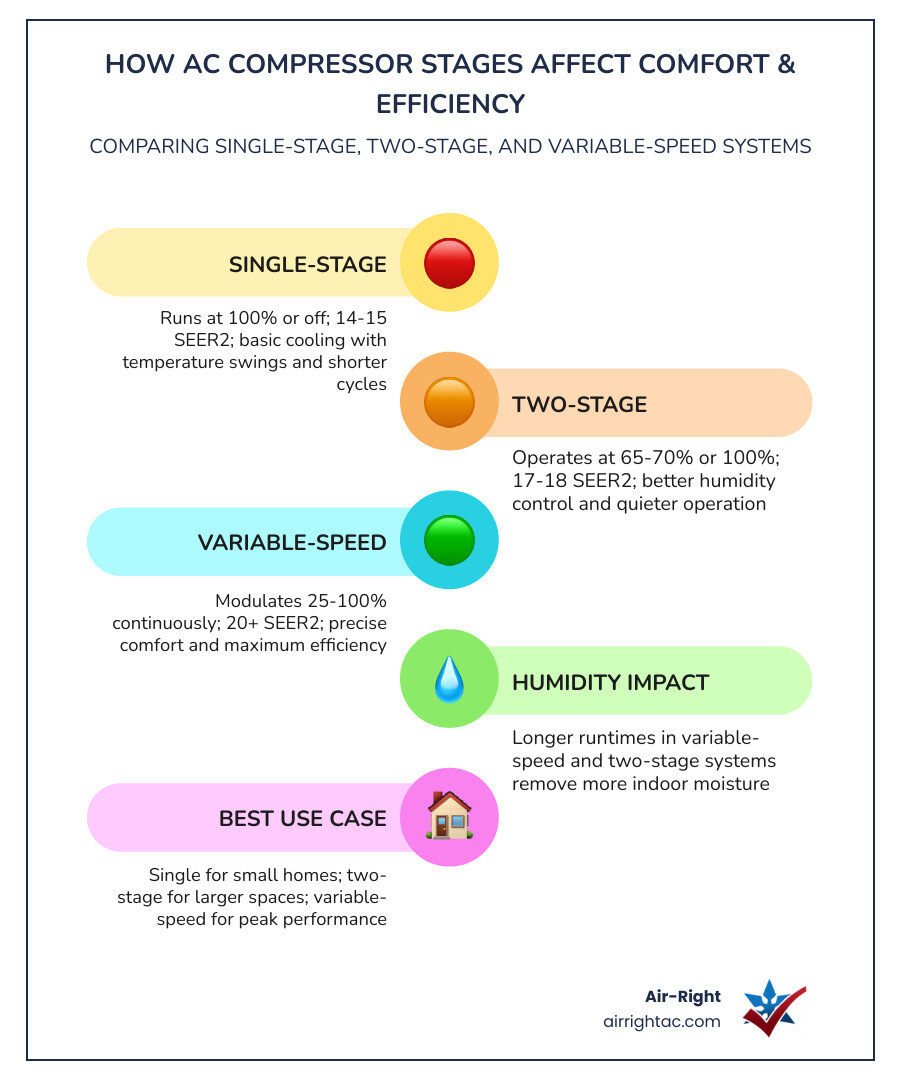
Single Stage vs Two Stage vs Variable Speed AC: Quick Comparison
When we help homeowners in Las Vegas, Henderson, and Boulder City select a new cooling system, we look at how different compressor technologies impact daily life. The compressor is the heart of your air conditioner, responsible for circulating refrigerant and managing the cooling load.
Choosing between a single-stage, two-stage, or variable-speed compressor dictates how long your system runs, how much noise it makes, and how much electricity it draws during our intense desert heatwaves.
More info about AC system services
What “Cooling Stages” Mean
In the HVAC world, “stages” refer to a compressor’s ability to adjust its cooling output. Your home’s cooling demand changes constantly throughout the day. At 6:00 AM, your home might only need a tiny bit of cooling to stay comfortable. By 4:00 PM, under the blazing Southern Nevada sun, your system needs to run at full load to keep up.
- Full Load: The maximum cooling capacity your system can produce (measured in BTUs or tons).
- Partial Load: A lower cooling output used when the outdoor temperature is milder.
- Capacity Control: The compressor’s ability to match its output to the thermostat’s demand.
A system with multiple stages or variable-speed capacity control can run longer, lower-speed cycles. This steady operation is actually much more efficient than turning on and off repeatedly, and it allows the indoor blower and air handler to distribute air evenly throughout your rooms.
How Single Stage vs Two Stage vs Variable Speed AC Systems Differ at a Glance
The core differences lie in how each compressor operates and how much energy it consumes:
- Single-Stage Basics: This system operates at 100% capacity or 0% (completely off). It runs at full blast until the thermostat is satisfied, then shuts down. It typically achieves a SEER2 rating between 14 and 15.
- Two-Stage Middle Ground: This system features a compressor with two distinct settings: a low stage (running at roughly 65% capacity) and a high stage (running at 100% capacity). It operates on the lower, quieter stage most of the time, only kicking into high gear on exceptionally hot days. These units usually offer SEER2 ratings between 17 and 18.
- Variable-Speed Premium Control: Also known as an inverter-driven system, this technology can modulate its output anywhere from 25% to 100% in tiny, 1% increments. It runs almost continuously at ultra-low speeds, keeping your indoor temperature within half a degree of your thermostat setting. These top-tier systems easily reach SEER2 ratings of 20 or higher.
How Each AC Compressor Type Works
To understand why these systems perform so differently, we need to look at the mechanics of the refrigeration cycle and how the compressor responds to the thermostat.
Single-Stage AC Operation
The single-stage air conditioner is the traditional design that has cooled homes for decades. When your indoor temperature rises above your thermostat setting, the system turns on at 100% capacity. It blasts cold air into your home until the target temperature is met, and then it shuts off entirely.
Because it only has one speed, a single-stage system experiences frequent “short cycling” on milder days. It turns on, quickly cools the air near the thermostat, and shuts off before it can circulate air from the furthest rooms or pull moisture out of the air. This frequent starting and stopping draws a massive amount of startup energy and subjects the compressor to significant wear and tear.
Two-Stage AC Operation
A two-stage system provides a smarter, more balanced approach. It acts like a car with a two-speed transmission. On a typical spring or early summer day in Henderson, the system runs in its low stage (around 60% to 70% capacity).
Because it runs at a lower capacity, the cycle lasts longer. This continuous, gentle airflow eliminates hot spots and allows the system to filter the air more thoroughly. When a true July heatwave hits, the thermostat detects that the low stage isn’t keeping up and signals the compressor to shift into high stage (100% capacity). Once the heavy load passes, the system drops back down to the low stage to maintain comfort efficiently.
Variable-Speed AC Operation
Variable-speed systems represent the absolute gold standard of HVAC innovation. Instead of relying on one or two fixed operating speeds, these units utilize an inverter-driven compressor that can make hundreds of micro-adjustments on the fly.
If your home only needs 33% of the system’s total cooling capacity to maintain comfort, the compressor runs at exactly 33%. By running almost continuously at very low speeds, a variable-speed system avoids the massive electrical spikes associated with turning a compressor on and off. It maintains an incredibly stable indoor climate, running quietly in the background while keeping your energy consumption to an absolute minimum.
Efficiency, Comfort, Humidity, Noise, and Indoor Air Quality
When you look past the technology itself, what matters most is how these systems affect your daily life and your utility bills.
More info about residential HVAC services
SEER and SEER2 Ratings by System Type
Efficiency is measured using SEER (Seasonal Energy Efficiency Ratio) and the updated, more rigorous SEER2 standards introduced in 2023. SEER2 testing better accounts for real-world static pressure in home ductwork.
- Single-Stage Units: Typically range from 14 to 15 SEER2.
- Two-Stage Units: Typically range from 17 to 18 SEER2.
- Variable-Speed Units: Frequently achieve SEER2 ratings of 20, 22, or even higher.
Upgrading from an older, lower-SEER system to a modern variable-speed system can reduce your cooling energy consumption by 20% to 50%, resulting in substantial long-term utility savings.
Which System Is Most Energy Efficient?
Without question, variable-speed air conditioners are the most energy-efficient systems on the market.
Air conditioners use the absolute most electricity during startup. A single-stage system might turn on and off 6 to 10 times an hour, causing frequent electrical spikes. A variable-speed system, by contrast, starts up slowly and runs for hours at a time at a fraction of its maximum wattage. By matching its output precisely to your home’s real-time cooling needs, it minimizes wasted energy and maximizes seasonal performance.
Humidity Control and Temperature Consistency
Even in dry desert climates like Las Vegas, humidity control and temperature consistency are vital for indoor comfort.
- Temperature Swings: Single-stage systems often create temperature swings of 4 to 6 degrees as they cycle on and off. Two-stage systems reduce this swing to about 2 to 3 degrees. Variable-speed systems keep your home within an incredibly tight 0.5-degree window of your target temperature.
- Moisture Removal: During our summer monsoon season, indoor humidity can rise, making your home feel like an oven. Because variable-speed systems run longer, slower cycles, they excel at latent heat removal. In fact, variable-speed systems can remove up to 400% more moisture than standard single-stage systems under humid conditions, keeping your home feeling cool and dry without over-cooling.
Noise Levels and Indoor Air Quality Effects
Noise and air quality are often overlooked when choosing an AC system, but they directly impact your home’s peace and health:
- Whisper-Quiet Operation: Single-stage systems blast on at full volume, often creating a loud “whoosh” of air and a noticeable hum from the outdoor unit. Variable-speed systems run so quietly at low speeds that you may not even realize they are on.
- Superior Air Filtration: Because two-stage and variable-speed systems run longer cycles, air is constantly being drawn through your filtration system. This continuous circulation captures far more dust, pollen, and pet dander, dramatically improving your indoor air quality. If you use advanced clean-air add-ons, a modulating system ensures they operate at peak performance.
Choosing the Right AC for Your Home and Climate
Every home in the Las Vegas valley is unique. The right choice depends on your property’s size, your preferences, and how long you plan to live in your home.
When a Single-Stage AC Makes Sense
A single-stage AC is a highly reliable, time-tested option. It remains an excellent choice if:
- You want a straightforward system replacement with a simpler design.
- You live in a smaller, single-story home with straightforward ductwork.
- You plan to sell your property in the near future and won’t be around to realize the long-term energy savings of a higher-tier system.
- You simply want a straightforward, highly reliable cooling system with fewer complex electronic components.
Signs Your AC Needs Replacing Not Just Fixing
When a Two-Stage AC Is the Better Fit
A two-stage system represents the “sweet spot” for many Southern Nevada families. Consider a two-stage unit if:
- You live in a two-story home or a larger floor plan with uneven temperatures between rooms.
- You want a noticeable upgrade in comfort and quieter operation while maintaining excellent reliability and performance.
- You want to lower your monthly utility bills while maintaining excellent reliability.
When to Consider a Variable-Speed AC
A variable-speed system is an investment in ultimate comfort. It is highly recommended if:
- This is your “forever home,” and you want to enjoy the highest level of comfort and lowest possible energy bills for the next 15 to 20 years.
- You have a zoning system or want to install one to control temperatures individually in different areas of your home.
- You are highly sensitive to temperature swings, hot spots, or indoor allergens.
- You want the absolute quietest system available.
Single Stage vs Two Stage vs Variable Speed AC in Hot, Dry, and Desert-Like Climates
In Southern Nevada, our summers are characterized by intense, dry heat, high solar gain through windows, and extreme attic temperatures.
When temperatures soar past 110°F, a single-stage system will run continuously at 100% capacity anyway. However, we only experience those extreme peaks for a few hours a day during July and August. For the rest of the long cooling season—including spring, early summer, and fall—a variable-speed or two-stage system will run at its highly efficient partial-load capacity.
Furthermore, our dry desert air means dust is a constant battle. The continuous air filtration provided by a variable-speed system’s low-speed operation is incredibly effective at keeping desert dust out of your living spaces.
How to Keep Your Desert Home from Turning into a Giant Oven
Installation, Sizing, Maintenance, and Common Homeowner Questions
No matter which compressor technology you choose, the quality of the installation and the accuracy of the system sizing will ultimately dictate how well it performs.
More info about AC maintenance plans
Why Proper Sizing Matters More Than Compressor Type
Before we even discuss compressor stages, we must perform a precise Manual J load calculation. This calculation takes into account your home’s square footage, insulation levels, attic conditions, window types, and sun exposure to determine the exact cooling capacity your home requires.
- The Danger of Oversizing: If an AC system is too large, it will quickly cool the air and shut off. This constant short cycling leads to hot spots, poor humidity control, and premature system failure—regardless of whether it is a single-stage or a variable-speed unit.
- The Danger of Undersizing: An undersized system will run constantly without ever reaching your target temperature, leaving you uncomfortable and driving up your utility bills.
Maintenance and Repair Considerations by AC Type
Every air conditioning system requires regular professional care to reach its expected lifespan of 15 to 20 years. However, the complexity of the maintenance and potential repairs varies:
- Single-Stage Systems: These feature simpler, standardized electrical components. They are highly reliable, and repairs are generally straightforward and widely accessible.
- Two-Stage and Variable-Speed Systems: These rely on advanced electronic control boards, communicating thermostats, and inverter drives. While they experience less mechanical wear because they avoid frequent hard starts, troubleshooting these systems requires specialized diagnostic tools and technician training.
Protecting your investment with an annual tune-up is essential to keep these sophisticated systems running efficiently and to prevent costly breakdowns.
Why Your AC Needs a Checkup Before the Next Heatwave
Can You Upgrade From Single-Stage to Two-Stage or Variable-Speed?
Yes, you can absolutely upgrade to a multi-stage or variable-speed system when replacing an older unit. However, it is rarely as simple as just swapping out the outdoor condenser.
To achieve the true benefits of a two-stage or variable-speed system, your indoor equipment must be fully compatible. A variable-speed outdoor compressor requires a matched indoor air handler or furnace with a compatible variable-speed blower motor. If you try to pair a variable-speed condenser with an older, fixed-speed indoor fan, the system will not perform correctly. You will also likely need a communicating thermostat designed to unlock the compressor’s modulating features.
Are Variable-Speed Systems Always the Best Choice?
While variable-speed systems offer the best comfort and efficiency, they may not be the ideal choice for every single home.
For example, if your home has old, uninsulated, or leaky ductwork, the continuous, slow airflow of a variable-speed system can actually cause condensation issues or pull dusty attic air into your living spaces. In these scenarios, a single-stage or two-stage system—or a comprehensive ductwork sealing and insulation project—is necessary first.
Conclusion
Choosing between a single-stage, two-stage, or variable-speed air conditioner comes down to balancing your immediate comfort needs with your long-term goals for comfort and energy savings.
A single-stage system provides straightforward, reliable cooling with a time-tested design. A two-stage system offers an exceptional middle ground, delivering quieter performance and more consistent temperatures for larger or multi-level homes. A variable-speed system is the ultimate comfort upgrade, delivering whisper-quiet operation, unmatched temperature consistency, and the lowest monthly utility bills.
At Air-Right, we believe in giving our neighbors in Las Vegas, Henderson, and Boulder City clear, honest, and completely pressure-free recommendations. We will help you evaluate your home’s unique layout, inspect your ductwork, perform precise load calculations, and find the perfect cooling solution for your home and lifestyle.
Need Help?
Contact us today to discuss your needs. Our team is ready to help.
Related Articles
- Is It a True Emergency? A Triage Guide for 24-Hour Air Conditioning Service in Las Vegas, NV
- Is That Burning Smell an Emergency? Fall Triage Guide for 24 Hour Air Conditioning Service in Las Vegas, NV
- Beyond 24-Hour Air Conditioning Service in Las Vegas: Heat Pump vs. Gas Furnace Options for Fall Upgrades
Related articles


Ready to Get Started?
Whether you need a repair, maintenance, or a new installation, our expert team is here to help.