My AC is Ghosting Me: Why Your Unit Blows Air but No Coldness
Air-Right

<p>Discover why is my ac running but not cooling: Fix dirty filters, low refrigerant, poor airflow & more with Las Vegas AC troubleshooting tips.</p>
Why Is My AC Running But Not Cooling? Quick Answers for Las Vegas Homeowners
Why is my ac running but not cooling is one of the most common — and most frustrating — HVAC problems homeowners face, especially during a scorching Las Vegas summer. Your system is humming, air is moving through the vents, and yet an hour later the house still feels like a furnace. Sound familiar?
Here are the most common reasons your AC is running but not producing cold air:
- Dirty or clogged air filter — restricts airflow, starving the system of what it needs to cool effectively
- Incorrect thermostat settings — fan set to “On” instead of “Auto,” or mode not set to “Cool”
- Low refrigerant / refrigerant leak — the system can’t transfer heat without the right refrigerant level
- Frozen evaporator coils — ice buildup blocks heat exchange entirely
- Dirty or blocked outdoor condenser unit — trapped heat has nowhere to go
- Electrical failure (capacitor, breaker, or contactor) — the compressor or fan may not be running properly
- Leaky or blocked ductwork — cooled air escapes before it reaches your rooms
- Undersized or aging AC system — older or undersized units struggle to keep up, especially in extreme Nevada heat
Here’s the key thing to understand: your AC doesn’t actually make cold air. It moves heat from inside your home to the outside. When any part of that process breaks down, you get airflow without cooling — and the cause can range from a simple fix to something that needs a licensed technician right away.
In this guide, we’ll walk through each of these issues clearly, starting with what you can check yourself and moving through the problems that need professional attention.
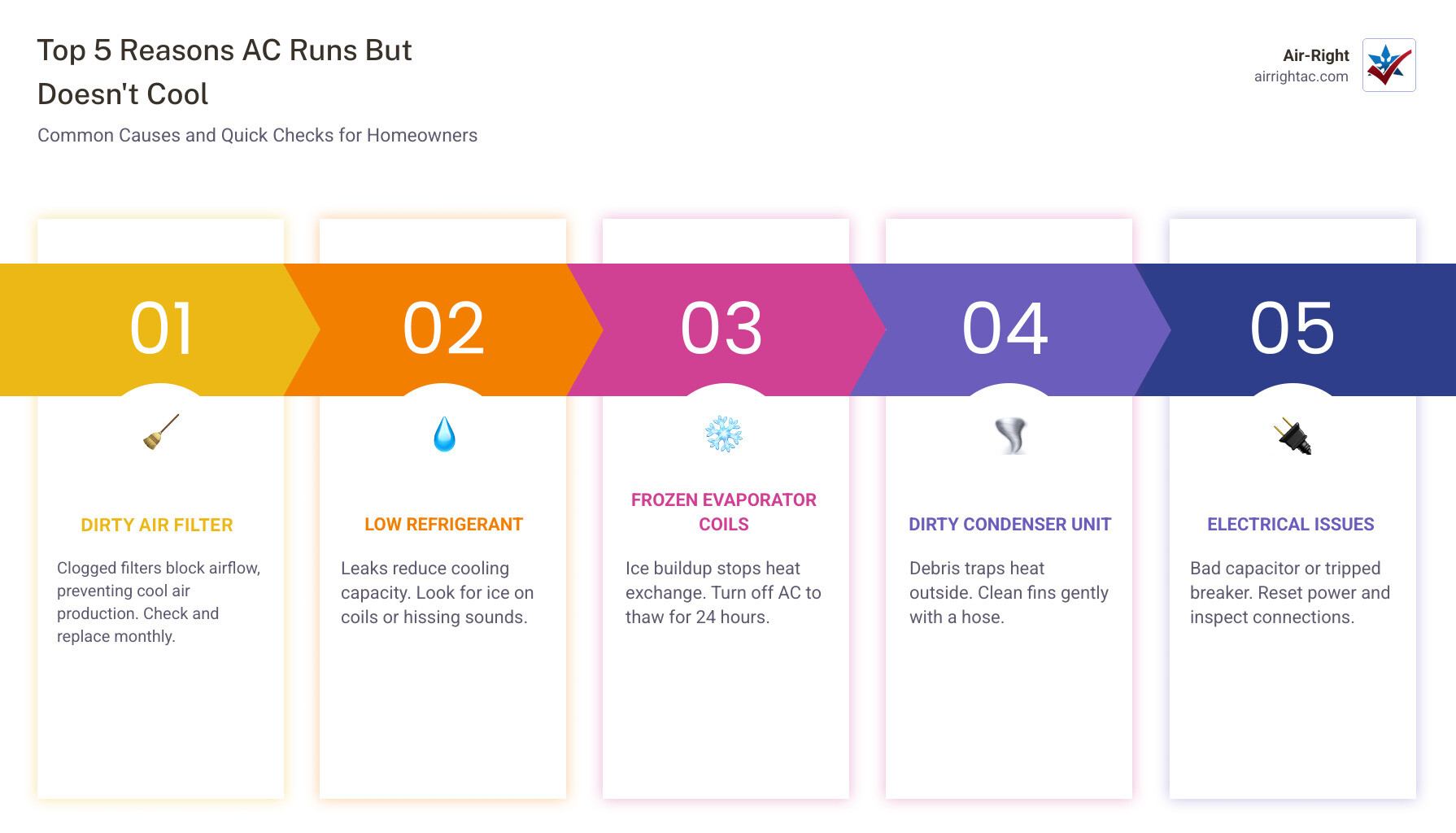
Common Culprits: Why is My AC Running But Not Cooling?
When April 2026 rolls around and the desert sun starts to bake the Las Vegas Valley, your air conditioner becomes your best friend. But when that friend starts “ghosting” you—running its fans but refusing to drop the temperature—it’s time for some detective work.
The first place we always recommend looking is your thermostat. It sounds simple, but you’d be surprised how often a bumped switch is the culprit. Ensure the system is set to “Cool” and the fan is set to “Auto.” If the fan is set to “On,” it will blow air constantly, even when the cooling cycle isn’t running, which can make the air feel lukewarm.
Next, consider the power. Sometimes a “power reset” can clear a glitch in the system’s logic. You can do this by turning the thermostat off, flipping the breaker for about five minutes, and then turning it all back on. If you’re still sweating, it might be time to consult The Ultimate Las Vegas AC Repair Survival Guide to see if your symptoms match larger mechanical issues.
Don’t forget the outdoor unit. In Henderson and Boulder City, wind-blown debris, desert dust, and even stray vegetation can clog the condenser coils. If the outdoor unit is choked with dirt, it can’t release the heat it gathered from inside your home. Finally, keep an eye on the calendar. If your unit has been chugging along for over a decade, it may simply be wearing out. Understanding how to tell when your air conditioner needs repair can help you decide if it’s a minor fix or a sign of system age.
Airflow and Filtration Obstructions
Airflow is the lifeblood of your HVAC system. Think of your AC like a pair of lungs; if it can’t breathe, it can’t perform. The most frequent reason we see for why is my ac running but not cooling is a heavily clogged air filter.
A dirty filter acts like a wall, blocking the air from reaching the evaporator coils. This doesn’t just make your home warmer; it forces the blower fan to work overtime, which can lead to a complete system shutdown or a burnt-out motor. Most filters in the Las Vegas area need replacing every 1–3 months due to our dusty environment. If you haven’t checked yours lately, it might look like a “grey felt blanket.”
Beyond the filter, we look at the bigger picture of your home’s circulation. Our residential services often involve checking the “static pressure” of a system—essentially measuring how hard the fan has to work to push air through your home. If your duct and attic insulation is failing, or if your ducts are undersized, the air might be cold at the source but lose its “chill” before it reaches your bedroom.
Troubleshooting Airflow: Why is My AC Running But Not Cooling My Home?
Before you assume the worst, take a walk through your house and check your registers. Are they all open? We often find that homeowners close vents in unused rooms, thinking they are saving energy. In reality, this increases pressure in the ductwork and can actually reduce cooling efficiency.
Check for obstructions like:
- Furniture placement: Is a couch or rug blocking a return air grille?
- Curtain blockages: Heavy drapes can easily get sucked against a vent, cutting off the air.
- Ductwork leaks: The U.S. Department of Energy estimates that typical duct systems lose 20–30% of conditioned air through leaks. If you hear whistling in the walls, you likely have a leak.
If your system is on the fritz again, these simple checks are the best place to start. For those living in the suburbs, getting expert AC repair in Henderson, NV can help identify if these airflow issues are caused by deeper ductwork failures that a simple filter change won’t fix.
Refrigerant Issues and Frozen Coils
It sounds like a contradiction, but your AC can actually freeze up in the middle of a 110-degree July afternoon. When the evaporator coils (the part inside your home) get too cold, moisture from the air condenses on them and turns to ice.
This happens for two main reasons: restricted airflow (like that dirty filter we mentioned) or low refrigerant levels. Once a layer of ice forms, it acts as an insulator. The refrigerant can no longer absorb heat from your indoor air, and your vents start blowing warm air. If you see frost on the copper lines leading to your outdoor unit, your system is literally “frozen.”
The thawing process is vital. You must turn the AC off at the thermostat and set the fan to “On” to let the ice melt naturally. This can take 2 to 4 hours. Do not try to scrape the ice off, as you could damage the delicate condenser fins. While you wait for the thaw, reading a local’s guide to AC repair in Boulder City can give you perspective on why these desert-specific issues occur. Our AC system services are designed to clean these coils and ensure the heat exchange process is working perfectly.
Identifying Refrigerant Leaks: Why is My AC Running But Not Cooling Effectively?
Refrigerant isn’t like gasoline in a car; your system doesn’t “burn” it. It circulates in a sealed loop forever—unless there is a leak. If your refrigerant levels are low, it is a sign that a seal has failed or a line has been damaged.
Common signs of a leak include:
- Hissing or bubbling sounds coming from the unit.
- Oily residue on the refrigerant lines or near connections.
- Warm air blowing despite the compressor running constantly.
Handling refrigerant is a serious matter that requires EPA certification due to the chemicals involved. If you suspect a leak, please contact us immediately. To help us diagnose the problem faster, it’s useful to be familiar with the common signs of a faulty HVAC unit so you can describe exactly what you’re hearing and seeing.
Mechanical and Electrical Failures
Sometimes the problem isn’t the air or the chemicals—it’s the hardware. Your AC relies on several electrical components to start the motor and keep the fans spinning. The most common failure is the start capacitor. Think of the capacitor like a battery that gives the motor a “kick” to get it started. In the extreme heat of Southern Nevada, these capacitors can bulge or “pop,” leaving the fan spinning but the compressor (the heart of the system) silent.
| Symptom | Likely Capacitor Failure | Likely Compressor Failure |
|---|---|---|
| Sound | Humming or clicking from outdoor unit | Loud grinding or complete silence |
| Air Temp | Lukewarm or room temperature | Hot air |
| Outdoor Fan | May spin slowly or not at all | Usually spins, but no “thrum” from the pump |
| Circuit Breaker | Occasionally trips | Frequently trips upon startup |
Electrical issues aren’t limited to capacitors. Ants are notorious for getting into “contactors” (the switch that turns the unit on), causing them to burn out. Wiring can also vibrate loose over time. This is one of the many reasons to keep your HVAC unit maintained by experts; we can often spot a bulging capacitor or a loose wire before it leaves you in a heatwave. If a major component like a compressor fails, we offer financing options to help make the replacement more manageable.
Frequently Asked Questions
Should I turn off my AC if it’s running but not cooling?
Yes, absolutely. If your system is running but the air isn’t cold, you should shut it down at the thermostat immediately. Continuing to run a malfunctioning unit puts immense strain on the compressor. If the issue is a refrigerant leak, the compressor can overheat and burn out, turning a relatively simple repair into a total system replacement. Beyond the mechanical risk, running a broken AC is a massive waste of energy. You can save your cash and your comfort by stopping the damage before it gets worse.
How do I reset my central air conditioner?
Sometimes the system just needs a “brain” reset. To do this safely:
- Turn the AC off at the thermostat.
- Go to your electrical panel and find the HVAC circuit breaker.
- Flip it to the “Off” position.
- Wait at least 60 seconds (five minutes is better).
- Flip the breaker back to “On.”
- Wait 30 minutes before turning the thermostat back to “Cool.” This allows the internal pressures to equalize.
If the breaker trips again immediately, do not flip it back on. This indicates a short circuit or a grounded compressor, and you should schedule residential service right away to prevent an electrical fire.
How long should it take for my house to cool down?
A properly sized and functioning AC should begin to lower the temperature within 15 to 30 minutes. However, if your home has reached 90 degrees because the unit was off, it may take several hours to feel truly comfortable. The AC has to remove heat not just from the air, but from your walls, furniture, and flooring.
The speed of cooling depends on your unit’s “tonnage” (its cooling capacity) and the quality of your home’s insulation. If you’re wondering how to choose the best AC system service in Boulder City, look for a team that performs a full load calculation to ensure your unit is properly sized for the Nevada heat.
Conclusion
At Air-Right, we’ve seen every possible reason why is my ac running but not cooling. From the simple “oops” of a wrong thermostat setting to the complex task of repairing a refrigerant leak, our goal is to get your home back to being an oasis as quickly as possible.
We proudly serve the Las Vegas, Henderson, and Boulder City communities with licensed, bonded, and insured expertise. Whether you need a quick filter change, a deep coil cleaning, or a full system upgrade, our technicians provide clear, no-pressure recommendations. Don’t spend another night slogging through the heat. Explore our HVAC maintenance category for more tips, or reach out for our professional AC system services today. We’re here to help you keep your cool, no matter how high the desert mercury climbs.
Need Help?
Contact us today to discuss your needs. Our team is ready to help.
Related Articles
- Is It a True Emergency? A Triage Guide for 24-Hour Air Conditioning Service in Las Vegas, NV
- Is That Burning Smell an Emergency? Fall Triage Guide for 24 Hour Air Conditioning Service in Las Vegas, NV
- Beyond 24-Hour Air Conditioning Service in Las Vegas: Heat Pump vs. Gas Furnace Options for Fall Upgrades
Related articles


Ready to Get Started?
Whether you need a repair, maintenance, or a new installation, our expert team is here to help.