How to Save Your AC From a Dusty Desert Death
Air-Right

<p>Discover why is my ac running but not cooling in the desert. Troubleshoot dust, heat, leaks & fix fast with expert Las Vegas AC tips!</p>
Why Is My AC Running But Not Cooling in the Desert?
Why is my ac running but not cooling in the desert is one of the most common questions Las Vegas homeowners ask every summer — and for good reason. When outdoor temperatures push past 110°F, your AC has to work harder than it was ever designed to. The result? A system that hums along perfectly, yet fails to bring your home down to a comfortable temperature.
Here are the most common reasons this happens:
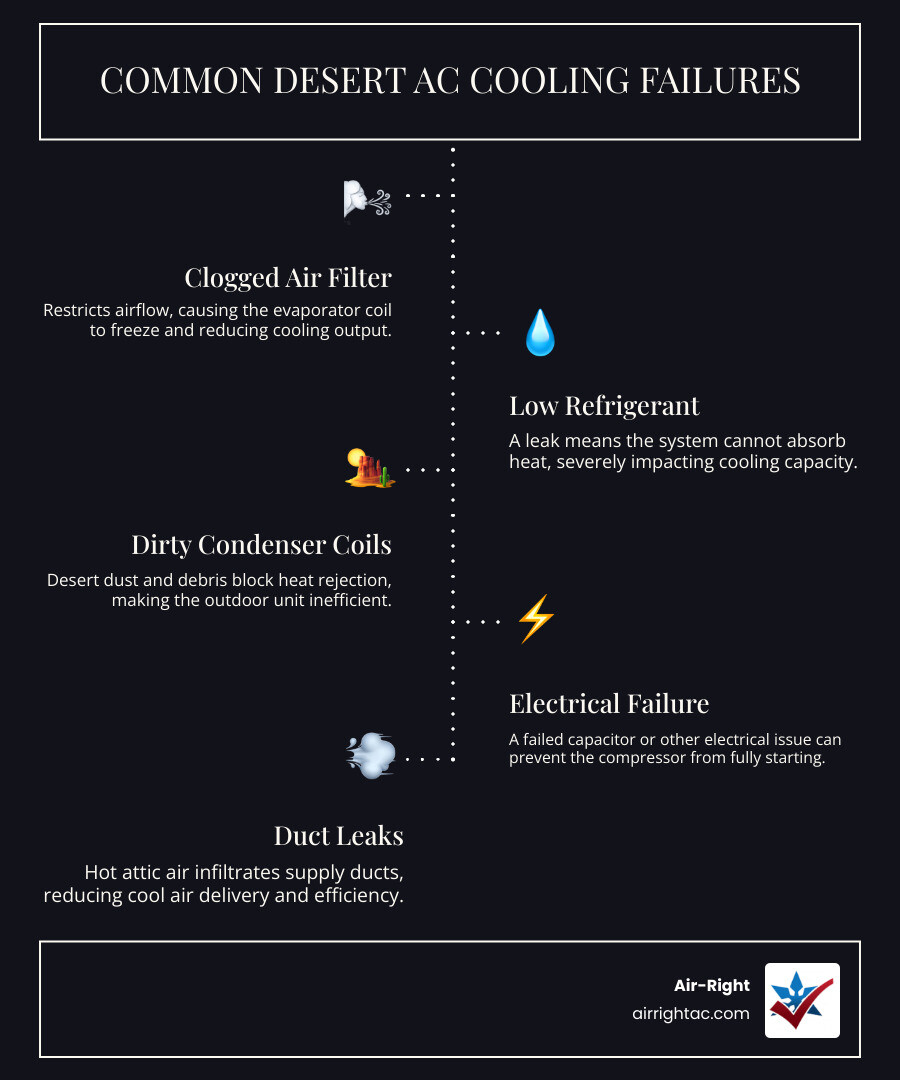
- Dirty or clogged air filter — restricts airflow, causes the evaporator coil to freeze, and kills cooling output
- Low refrigerant from a leak — the system can’t absorb heat without the right charge
- Dirty condenser coils — desert dust and haboobs coat the outdoor unit, blocking heat from escaping
- Failed capacitor — the outdoor unit hums but the compressor never fully starts
- Incorrect thermostat settings — fan set to “On” instead of “Auto” circulates warm air and mimics a cooling failure
- Duct leaks in a hot attic — Las Vegas attics can reach 160°F, and leaky ducts pull that scorching air into your supply system
- System undersized or too old — AC units in Southern Nevada typically last 10 to 12 years, far less than in cooler climates
Most of these issues get worse fast when outdoor temperatures are extreme. And in Las Vegas, Henderson, and Boulder City, “extreme” is just called July.
Why is my ac running but not cooling in the desert?
When you walk into your living room and feel lukewarm air blowing from the vents, your first instinct might be to panic. However, at Air-Right, we often find that the solution starts with a simple check of your control center.
The first thing to investigate is your thermostat settings. It is surprisingly common for the fan setting to be switched from “Auto” to “On.” In “On” mode, the indoor blower fan runs continuously, even when the outdoor compressor isn’t cooling. This circulates room-temperature air (or worse, hot air from the attic) through your home, making it feel like the system has failed. Always ensure your thermostat is set to “Cool” and the fan is on “Auto.”
Another critical metric is the “temperature split.” A healthy AC system in Southern Nevada should produce air at the vents that is roughly 16 to 22 degrees cooler than the air being pulled into the return intake. If you’re experiencing a split of less than 15 degrees while it’s 115°F outside, your system is likely struggling with a mechanical or airflow issue. If you’re in the south valley, you might need Expert AC Repair in Henderson, NV to get those numbers back in line.
Identifying why is my ac running but not cooling in the desert heatwaves
During a Las Vegas heatwave, the sheer “heat load” on your home can exceed what your AC was designed to handle. Most residential systems are engineered to maintain an indoor temperature about 20 to 30 degrees cooler than the outdoors. When the thermometer hits 118°F, asking your AC to keep the house at 68°F is asking for the impossible.
In these extreme conditions, your system may run 12 to 16 hours a day. This constant operation reveals every tiny weakness in the system. A slightly low refrigerant charge or a mildly dusty coil that worked “fine” in May will cause a total cooling collapse in July. For those living near the lake, our Local’s Guide to AC Repair in Boulder City explains how these high-demand periods can push aging components over the edge.
Troubleshooting why is my ac running but not cooling in the desert dust
Living in the Mojave Desert means battling more than just heat; we battle the earth itself. Haboobs and localized dust storms carry fine silt that acts like a blanket on your AC components. This dust creates a massive “airflow restriction.”
When dust coats your indoor evaporator coil, the refrigerant inside can’t absorb enough heat from your home’s air. This causes the coil temperature to drop below freezing, turning the condensation on the coil into a block of ice. Once iced over, air cannot pass through the coil at all, and your cooling stops entirely. Understanding How Desert Dust and Heat Change Your AC Service Schedule is the best way to prevent these “dusty deaths” for your equipment.
Common Causes of Cooling Failure in Extreme Heat
Beyond simple settings and dust, mechanical failures are a primary reason why is my ac running but not cooling in the desert. The intense heat of Southern Nevada puts immense stress on the electrical and chemical components of your system.
| Feature | Mechanical Failure (Compressor/Capacitor) | Airflow Issue (Filter/Coil) |
|---|---|---|
| Sound | Loud buzzing or clicking from outside | Normal humming but weak air from vents |
| Air Temp | Warm or room temperature | Lukewarm or slightly cool, then warm |
| Ice Presence | Rarely seen on lines | Common on copper lines or indoor unit |
| Indoor Fan | Usually runs normally | May run but air feels “choked” |
If your system is showing any of these signs, our AC System Services can provide a precise diagnostic to find the root cause.
Refrigerant Leaks and Low Levels
Your air conditioner is a closed-loop system, meaning it should never “run out” of refrigerant. If the levels are low, there is a leak. In the desert, the extreme expansion and contraction of metal lines due to 40-degree temperature swings between day and night can cause joints to weaken and leak.
Signs of a leak include a persistent hissing sound near the indoor or outdoor unit and ice buildup on the copper refrigerant lines. When the charge is low, the system loses its ability to transfer heat effectively. If you suspect a leak, it’s vital to know How to Tell When Your Air Conditioner Needs Repair before the lack of lubrication damages the expensive compressor.
Electrical Component Failures
The most common “small” part to fail in a Las Vegas summer is the capacitor. Think of the capacitor as a giant battery that gives the compressor the “kick” it needs to start. Extreme heat causes these components to swell and pop.
If you hear your outdoor unit humming or clicking but the fan isn’t spinning or the compressor isn’t engaging, a failed capacitor is the likely culprit. Additionally, power fluctuations during summer storms can trip circuit breakers. If your breaker trips once, you can try to reset it, but if it trips again, you need Top Rated Las Vegas AC Experts to investigate a potential electrical short or compressor failure.
The Impact of Desert Dust and Airflow Restrictions
Airflow is the lifeblood of your AC. In Las Vegas, the combination of construction dust, pet dander, and desert pollen can clog a standard air filter in as little as 30 days during the peak of summer.
Using a filter with a MERV rating that is too high for your specific system can actually be counterproductive. A thick, high-MERV filter in an older system can act like a wall, restricting airflow so much that the evaporator coil freezes. This leads to a total system shutdown. For a complete look at how to handle these local challenges, check out The Ultimate Las Vegas AC Repair Survival Guide.
Clogged Condenser Coils
While the indoor filter is important, the outdoor condenser coil is where the heat actually leaves your home. If this coil is coated in dirt or blocked by overgrown desert landscaping, the heat has nowhere to go. We recommend maintaining at least a 2-foot clearance around your outdoor unit.
Rinsing your outdoor coils gently with a garden hose (never a pressure washer!) can help, but professional cleaning is often needed to remove the deep-seated silt that builds up after a haboob. Keeping this unit clean can Save Your Cash and Your Comfort by preventing the compressor from overheating and shutting down.
Duct Leaks and Attic Heat Gains
In many Henderson and Las Vegas homes, the ductwork runs through the attic. During a July afternoon, your attic can easily reach 160°F. If your ducts have even small leaks, they can pull in that scorching air, mixing it with your cooled air.
Duct leakage can account for a 30% to 40% loss in cooling efficiency. If one room is significantly warmer than others, or if the air coming from the vents feels humid, you may have a disconnected duct. Our Boulder City AC Service Handbook highlights how proper insulation and duct sealing are just as important as the AC unit itself.
When to Call for Professional HVAC Service
While checking your thermostat and air filter are great first steps, many AC issues in the desert require professional tools and licensing. If you notice your system is “short cycling” (turning on and off every few minutes) or making grinding, screeching, or loud rattling noises, it’s time to shut it down and call for help.
A licensed technician from Air-Right can perform a “static pressure test” to see exactly where airflow is being choked or use electronic leak detectors to find microscopic holes in your refrigerant lines. Knowing How to Choose the Best AC System Service ensures you get a technician who understands the specific demands of the Mojave climate.
Repair vs. Replace Decisions
In the Midwest, an AC might last 20 years. In Las Vegas, an AC unit is considered a “senior citizen” at just 10 to 12 years old. The relentless heat and 16-hour run times simply wear out the mechanical parts faster.
If your system is over a decade old and requires a major repair, such as a new compressor or evaporator coil, it may be time to consider a replacement. Modern units with higher SEER2 ratings are significantly more efficient. Moving from an old 10 SEER unit to a new 16 or 20 SEER2 system can cut your cooling costs by 30% or more. When weighing your options, consult The Ultimate List: Local AC Service Companies in Henderson to find a partner who offers clear, no-pressure recommendations.
Conclusion
At Air-Right, we know that a broken AC in the middle of a Southern Nevada summer isn’t just an inconvenience — it’s an emergency. Whether you are in Las Vegas, Henderson, or Boulder City, our licensed, bonded, and insured team is ready to provide the honest, expert service you deserve. From clearing desert dust to installing high-efficiency replacements, we are here to ensure your home remains an oasis.
If your system is struggling, don’t wait for it to fail completely. Explore our AC System Services today and let us help you save your AC from a dusty desert death.
Should I turn off my AC if it’s running but not cooling?
Yes, absolutely. If your AC is running but the air is not cold, turn it off at the thermostat immediately. If the issue is a frozen coil or low refrigerant, continuing to run the unit puts massive strain on the compressor. The compressor is the most expensive part of your system; running it while it’s struggling can lead to a total mechanical failure, turning a simple repair into a full system replacement.
How often should I change my AC filter in Las Vegas?
In the Las Vegas valley, we recommend checking your filter every 30 days during the summer. Between the windblown desert dust and the fact that your system runs almost non-stop in July and August, filters clog much faster here than in other parts of the country. If you have pets or live near new construction, you might even need to change it every 3 weeks to maintain proper airflow and prevent frozen coils.
Why does my AC struggle when it’s over 110°F?
Most AC systems are designed to create a “temperature differential” of about 20 degrees. When it hits 115°F, your system is fighting an uphill battle against ambient heat radiating through your walls, windows, and roof. Additionally, the outdoor unit (the condenser) uses the outside air to cool down the hot refrigerant. When the outside air is already 110°F+, it becomes much harder for the unit to shed that heat, leading to longer run times and reduced cooling efficiency.
Need Help?
Contact us today to discuss your needs. Our team is ready to help.
Related Articles
- Is It a True Emergency? A Triage Guide for 24-Hour Air Conditioning Service in Las Vegas, NV
- Is That Burning Smell an Emergency? Fall Triage Guide for 24 Hour Air Conditioning Service in Las Vegas, NV
- Beyond 24-Hour Air Conditioning Service in Las Vegas: Heat Pump vs. Gas Furnace Options for Fall Upgrades
Related articles


Ready to Get Started?
Whether you need a repair, maintenance, or a new installation, our expert team is here to help.