How to Save Money on Cooling with Best Thermostat Settings for Summer Savings in the Desert
Air-Right

<p>Discover best thermostat settings for summer savings in the desert with smart strategies that cut energy costs and keep Southern Nevada homes comfortable.</p>
Why Your Thermostat Strategy Matters More in the Desert Than Anywhere Else
Finding the best thermostat settings for summer savings in the desert is one of the highest-impact decisions a Las Vegas homeowner can make before June temperatures climb past 110°F. Here’s a quick-reference guide to get you started:
| Situation | Recommended Setting |
|---|---|
| Home during the day | 78°F |
| Away from home | 82-85°F |
| Sleeping at night | 74-76°F |
| Vacation / extended absence | 85°F |
Generic energy advice — the kind written for mild climates with 85°F summer highs — simply doesn’t translate to Southern Nevada. When your home is absorbing 110°F+ heat for 10-plus hours a day, the rules change. Your AC isn’t just fighting outdoor air temperature; it’s fighting radiant heat pouring through windows, attic spaces reaching 140°F, and overnight lows that barely dip below 85°F in July.
The result? Homeowners who follow standard thermostat guidance often end up with higher bills, an overworked system, and a home that never quite feels comfortable.
The good news is that a properly programmed thermostat — one built around desert realities — can cut your cooling bill by 23-30% without sacrificing comfort. This guide walks you through exactly how to do that.
Why Standard Energy Advice Fails in the Mojave Desert
If you have ever read a generic online energy guide, you have probably been told to turn your air conditioner off completely when you leave for work. While that might work beautifully in a mild climate, doing so in the Mojave Desert is a recipe for a massive utility bill and an incredibly strained HVAC system.
The primary reason standard advice fails in Southern Nevada comes down to three factors: extreme daytime heat, intense attic temperatures, and the physics of thermal mass.
During a typical July afternoon in Las Vegas, Henderson, or Boulder City, outdoor temperatures routinely exceed 110°F. Your home’s exterior walls, roof, and concrete foundation absorb this heat all day. Inside, your attic acts as a giant heat reservoir, often reaching temperatures above 140°F. This is why we focus so heavily on helping homeowners understand How to Keep Your Desert Home from Turning into a Giant Oven.
If you turn your air conditioner completely off while you are at work, your home’s indoor temperature can easily climb into the mid-90s. The drywall, furniture, flooring, and cabinets will soak up that heat. When you return home at 5:00 PM and crank the thermostat down to 74°F, your air conditioner has to work at maximum capacity for several consecutive hours just to remove the heat stored in your home’s physical structure.
This prolonged, high-load operation is incredibly inefficient. It also subjects your system to extreme wear and tear during the hottest part of the day, which is when AC compressors are most prone to failure. Instead of turning the system off, desert homeowners need a strategy that manages the indoor temperature gradually.
The Best Thermostat Settings for Summer Savings in the Desert

Finding the right balance between comfort and financial savings does not mean you have to sweat in your own living room. By aligning your thermostat with the recommendations of the Department of Energy and adjusting for our dry desert climate, you can keep your home comfortable while keeping your energy bills manageable.
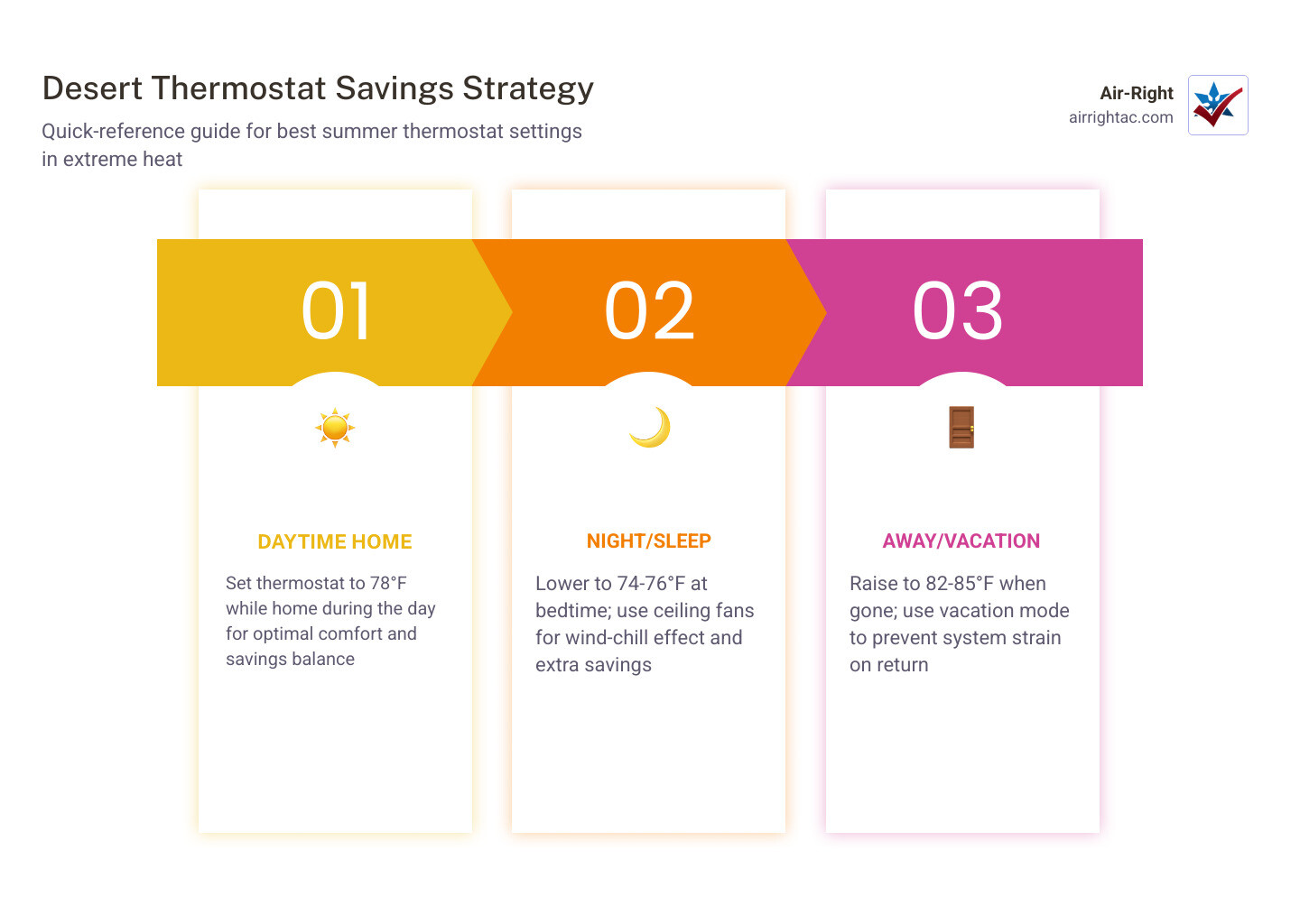
The baseline daytime temperature recommended for an occupied home is 78°F. While this might sound warm to anyone moving to Southern Nevada from a cooler state, the low humidity of the desert makes 78°F feel significantly cooler indoors than it would in a humid climate.
To help you visualize how to structure your daily cooling schedule, we have put together a comprehensive breakdown of the optimal settings for different times of the day:
| Time of Day | Recommended Temperature | Strategic Goal |
|---|---|---|
| Morning (6:00 AM – 11:00 AM) | 75°F – 76°F | Cool the home using cheaper, off-peak electricity. |
| Midday / Peak (11:00 AM – 7:00 PM) | 78°F – 80°F | Minimize AC usage during peak outdoor heat and peak utility rates. |
| Evening (7:00 PM – 10:00 PM) | 77°F | Begin transitioning the home to a comfortable sleeping temperature. |
| Overnight (10:00 PM – 6:00 AM) | 74°F – 76°F | Prioritize deep sleep comfort while utilizing cooler overnight outdoor temperatures. |
Optimal Daytime and Nighttime Best Thermostat Settings for Summer Savings in the Desert
During the day when you are active around the house, keeping your thermostat at 78°F is the ideal starting point. If you are used to keeping your home at 72°F, making the jump to 78°F all at once can feel jarring. We recommend adjusting your thermostat upward by just one degree every few days. This allows your body to naturally acclimate to the warmer setting without a sudden comfort hit.
To make 78°F feel even cooler, you should utilize your home’s ceiling fans. Running a ceiling fan creates a wind-chill effect on your skin, making the room feel roughly 4°F cooler than the actual air temperature. This means a room kept at 78°F with a running fan will feel like 74°F.
However, there are two important rules to remember when using ceiling fans in the desert:
- Fans cool people, not rooms: Ceiling fans do not actually lower the temperature of the air; they only cool your skin through evaporation. Always turn ceiling fans off when you leave a room to avoid wasting electricity.
- Keep your AC fan on “Auto”: Always make sure your thermostat’s fan setting is set to “Auto” rather than “On.” Setting it to “On” forces the HVAC fan to run continuously, which can add significant costs to your monthly power bill.
When it is time for bed, most people sleep best in a cooler environment. Lowering your thermostat to 74°F or 75°F for sleeping is a reasonable compromise. Because outdoor temperatures drop overnight, your air conditioner does not have to work nearly as hard to maintain a cooler temperature during these hours as it does during the blazing afternoon.
Away and Vacation Best Thermostat Settings for Summer Savings in the Desert
When your home is empty for four or more hours during the day, you should raise your thermostat to an away setting of 82°F to 85°F. This setback temperature is high enough to prevent your air conditioner from running unnecessarily while you are gone, but low enough that the system can easily recover your preferred indoor temperature within 20 to 30 minutes of your return.
If you have indoor pets, we recommend keeping the away setting at a maximum of 82°F. This ensures your dogs, cats, or other animals remain safe and comfortable while you are at work.
If you are heading out of town for a summer vacation, do not turn your system off. Instead, set your thermostat to a constant 85°F. This keeps the air circulating and prevents your home from turning into an absolute pressure cooker, which can damage drywall, cause wood furniture to warp, and ruin sensitive household electronics.
Leveraging Smart Thermostats and Time-of-Use Rates
Upgrading to a smart or programmable thermostat is one of the smartest investments you can make for your desert home. Modern smart thermostats do far more than just hold a schedule; they use advanced features like geofencing, adaptive recovery, and remote sensors to maximize your energy savings automatically.
- Geofencing: This feature connects to your smartphone to detect when you leave the house. Once you cross a certain distance from your home, the thermostat automatically shifts to your energy-saving “away” setting. When you head back, it detects your approach and begins cooling the home so it is comfortable the moment you walk through the door.
- Adaptive Recovery: Instead of starting to cool your home at exactly 5:00 PM when you get home, a smart thermostat learns how long your specific HVAC system takes to lower the temperature. It will calculate the precise moment to turn on so your home reaches your target temperature exactly when you arrive, preventing unnecessary runtime.
- Remote Sensors: Desert homes, especially two-story layouts in Henderson or Summerlin, often suffer from uneven cooling. Placing remote sensors in hot upstairs bedrooms allows your thermostat to average the temperature across your entire home, preventing your AC from overcooling the downstairs just to make the upstairs livable.
Maximizing Efficiency with Time-of-Use Rates
If you are a customer of NV Energy, you have access to Time-of-Use (TOU) rate plans. Under these plans, the price you pay for electricity varies depending on the time of day. During summer peak hours—typically from 1:00 PM to 7:00 PM—electricity rates can be three to five times more expensive than off-peak hours.
You can leverage your smart thermostat to “bank” thermal energy in your home and avoid running your air conditioner during these expensive peak hours. This strategy is known as pre-cooling:
- The Pre-Cooling Phase (6:00 AM – 11:00 AM): Lower your thermostat to 74°F or 75°F during the morning hours when electricity is cheap and outdoor temperatures are still relatively low. This cools down the physical structure of your home (the drywall, framing, and furniture).
- The Transition Phase (11:00 AM – 1:00 PM): Let your thermostat rise to 78°F.
- The Peak Coasting Phase (1:00 PM – 7:00 PM): Set your thermostat to 80°F or 82°F. Because you pre-cooled the home’s thermal mass in the morning, your house will slowly absorb heat, allowing you to coast through the most expensive hours of the day with very little air conditioning runtime.
- The Off-Peak Recovery (7:00 PM onward): Once the peak window closes and rates drop, you can safely return your thermostat to your preferred evening and nighttime settings.
Supporting Your Settings with Desert-Proof HVAC Maintenance
Even the most sophisticated thermostat schedule won’t save you money if your air conditioning system is struggling to breathe. Extreme desert heat forces your HVAC system to work incredibly hard, making routine maintenance absolutely vital to your home’s energy efficiency.
To keep your system running at peak performance, we recommend focusing on several key maintenance tasks:
- Change Your Air Filters Monthly: Dust and wind are a constant reality in Southern Nevada. A clogged air filter restricts airflow, forcing your blower motor to work harder and consume more electricity. Check and replace your filters every 30 days during the peak summer cooling season.
- Keep the Outdoor Unit Clear: Your outdoor condenser unit needs plenty of space to release the heat it extracts from your home. Ensure there is at least two to three feet of clear space around the unit, and keep it free of desert landscaping debris, weeds, and dust.
- Schedule Professional Tune-Ups: Having a professional technician clean your system’s indoor evaporator coils and outdoor condenser coils can dramatically improve heat transfer, lowering your energy consumption and extending the lifespan of your system.
For a complete look at how to protect your system from our harsh climate, explore The Ultimate Desert Dweller Guide to HVAC Maintenance and check out our guide on How to Maintain Your AC in Extreme Desert Heat Without Breaking a Sweat.
Taking care of these small details is the key to Beating the Heat with a Desert-Proof Maintenance Plan. If you want to dive deeper into the technical side of system care, don’t miss An Essential Guide to Servicing Your AC in the Desert.
Frequently Asked Questions About Desert Thermostat Settings
Does pre-cooling actually save money on NV Energy plans?
Yes. Pre-cooling is highly effective on NV Energy’s Time-of-Use plans because it shifts the bulk of your air conditioner’s workload to off-peak hours when electricity is significantly cheaper. Additionally, air conditioners operate more efficiently when outdoor temperatures are cooler (such as in the morning) because it is easier for the system to reject heat to the outdoors. This means your system uses less actual power to achieve the same amount of cooling.
Should I set my thermostat fan to “On” or “Auto”?
You should always set your fan to “Auto.” When you select the “On” setting, your HVAC system’s indoor fan runs continuously, even when the air conditioner is not actively cooling. This can add significant costs to your monthly electric bill. Furthermore, running the fan continuously can blow the moisture that was just condensed off your cooling coils back into your home, raising indoor humidity levels and making your home feel warmer and stickier.
How much can I realistically save by raising my thermostat?
According to data from the Department of Energy and local utilities, you can save up to 3% on your cooling costs for every single degree you raise your thermostat above 78°F during the summer. If you currently keep your home at a constant 72°F, raising your baseline setting to 78°F can cut your overall summer cooling costs by as much as 18%. Over the course of a long Southern Nevada summer, those percentage points add up to substantial savings.
Conclusion
Mastering the best thermostat settings for summer savings in the desert does not mean you have to sacrifice your comfort. By establishing a realistic daytime baseline of 78°F, utilizing smart thermostat features, and aligning your cooling schedule with NV Energy’s time-of-use rates, you can enjoy a perfectly comfortable home while keeping your energy bills firmly under control.
At Air-Right, we are dedicated to helping our neighbors throughout Las Vegas, Henderson, and Boulder City stay cool and comfortable all summer long. As a fully licensed, bonded, and insured HVAC contractor, we pride ourselves on providing clear, honest, and completely pressure-free recommendations for your home.
Whether you need a smart thermostat installed, a seasonal system tune-up, or a high-efficiency system upgrade, our team is here to help. Reach out to us today to learn more about our residential services and let us help you maximize your home’s comfort and efficiency this summer.
Need Help?
Contact us today to discuss your needs. Our team is ready to help.
Related Articles
- Is It a True Emergency? A Triage Guide for 24-Hour Air Conditioning Service in Las Vegas, NV
- Is That Burning Smell an Emergency? Fall Triage Guide for 24 Hour Air Conditioning Service in Las Vegas, NV
- Beyond 24-Hour Air Conditioning Service in Las Vegas: Heat Pump vs. Gas Furnace Options for Fall Upgrades
Related articles


Ready to Get Started?
Whether you need a repair, maintenance, or a new installation, our expert team is here to help.