How to Prevent Mold via AC Maintenance in 5 Easy Steps
Air-Right

<p>Discover how proper AC maintenance prevents mold growth with 5 simple steps that protect your Las Vegas home’s air quality and HVAC system.</p>
Why Mold and Your AC System Are More Connected Than You Think
How proper AC maintenance prevents mold growth is something every Las Vegas homeowner should understand — because your air conditioner does far more than keep you cool. It controls moisture, filters the air you breathe, and circulates that air to every room in your home. When maintenance slips, that same system can quietly become a mold distribution network.
Here is a quick look at how AC maintenance stops mold before it starts:
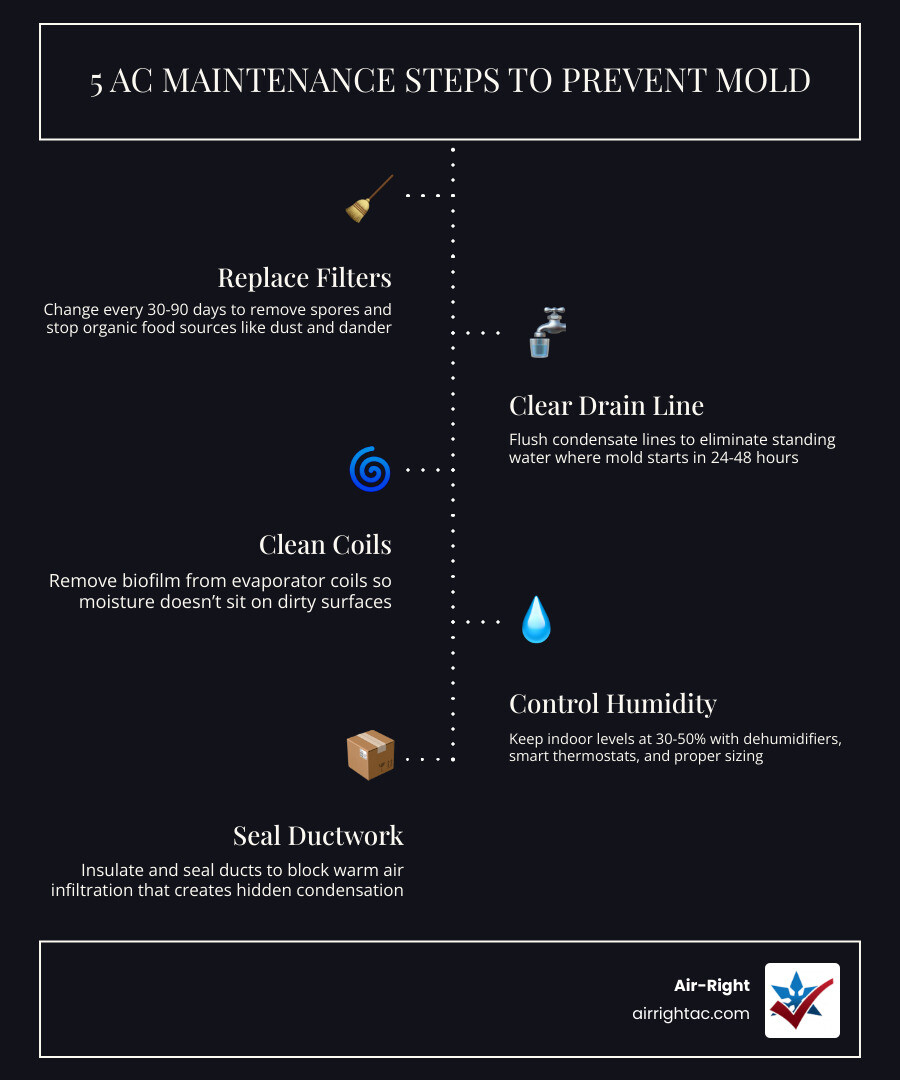
5 AC Maintenance Steps That Prevent Mold Growth:
- Replace air filters every 30-90 days to remove spores and eliminate organic material mold feeds on
- Clear the condensate drain line to prevent standing water, where mold can begin growing within 24-48 hours
- Clean evaporator coils to remove biofilm and stop moisture from sitting on dirty surfaces
- Control indoor humidity between 30-50% using dehumidifiers, smart thermostats, and proper system sizing
- Seal and insulate ductwork to prevent unconditioned air from creating hidden condensation zones
Mold spores are always present in the air around us — that is just a fact of life. The difference between a healthy home and a moldy one usually comes down to moisture. According to the EPA, keeping indoor humidity between 30% and 50% is the single most effective way to control mold risk. And your AC system is the primary tool that makes that possible.
But here is the catch: a neglected AC system does not just fail to prevent mold — it can actively encourage it. Roughly 20% of buildings across the US, Canada, and Europe show signs of dampness linked to poor ventilation and HVAC upkeep. Clogged drain lines create standing water. Dirty coils stay wet longer. Leaky ducts pull in warm, humid air. Each of these is a missed maintenance task that becomes a welcome mat for mold.
The good news? Preventing mold through your AC system is straightforward when you know what to focus on.
Step 1: Prioritize Regular Filter Replacement to Stop Spores
The first line of defense in any HVAC system is the air filter. Many homeowners view the filter as a way to keep the air “fresh,” but its primary job is actually to protect the internal components of your AC unit. When a filter becomes clogged with dust, pet dander, and skin cells, it provides the exact organic “food” that mold needs to thrive.

Mold spores are microscopic and always floating in the air. If your filter is clean and has a proper MERV rating (typically between MERV 8 and MERV 13 for residential homes), it can effectively capture these spores before they enter the dark, damp interior of your air handler. However, if you don’t let the dust settle on your HVAC maintenance routine, you prevent the buildup of organic material that serves as a breeding ground.
We recommend checking your filters every 30 days, especially during the peak Las Vegas summer when your system is running nearly 24/7. In households with pets or allergy sufferers, a monthly replacement is often necessary. HEPA filtration or high-MERV pleated filters offer the best protection, but they must be changed regularly to avoid airflow restriction. A restricted system can cause the evaporator coil to get too cold and freeze, leading to excessive moisture and—you guessed it—more mold.
Step 2: Clear the Condensate Drain Line to Eliminate Standing Water
Your air conditioner doesn’t just cool the air; it dehumidifies it. As warm air passes over the cold evaporator coils, moisture condenses into liquid water. This water is supposed to flow into a drain pan and out of your home through a condensate drain line.
The problem arises when this line gets backed up. Dust and spores can mix with the water to create a sludge-like algae growth or biofilm. This “gunk” clogs the pipe, leading to standing water in the drain pan. Research shows that mold can begin to thrive in as little as 24 to 48 hours in standing water. If that water sits in your dark air handler, mold will inevitably follow.
One of the most important maintenance secrets to keep your AC from quitting on you is the simple vinegar flush. Pouring a cup of distilled white vinegar down the drain line every few months helps kill algae and prevent clogs. For added safety, we often install safety float switches. These devices automatically shut off your AC if the drain pan begins to overflow, preventing stagnant moisture from sitting in your unit and protecting your home from water damage.
Step 3: How Proper AC Maintenance Prevents Mold Growth Through Coil Cleaning
The evaporator coil is the “heart” of the cooling process, but it is also the most common place for mold to hide. Because the coil is constantly wet with condensation during the summer, any dust that bypasses your filter sticks to the fins. This creates a damp, nutrient-rich layer known as biofilm.
| Metric | Maintained HVAC System | Neglected HVAC System |
|---|---|---|
| Humidity Levels | Consistent 30-50% | Often >60% (High Risk) |
| Coil Condition | Clean, efficient heat transfer | Coated in biofilm/dust |
| Drainage | Clear, free-flowing | Standing water/clogged |
| Air Quality | Low spore count, neutral smell | Musty odors, high spore count |
| Mold Risk | Minimal | High |
This biofilm acts as an insulator, reducing heat transfer and making your system work harder. But more importantly, it releases microbial volatile organic compounds (mVOCs)—the source of that “dirty sock” smell. Why your AC needs a checkup before the next heatwave is largely about ensuring these coils are professionally cleaned.
A professional cleaning uses specialized, EPA-approved solutions to dissolve the biofilm that a simple brush can’t reach. By keeping the coils clean, you ensure that moisture can slide off the fins and into the drain pan quickly, rather than being trapped in a layer of mold-friendly dirt.
Step 4: Control Indoor Humidity and Utilize Advanced IAQ Technology
In the Las Vegas desert, we often think we are safe from humidity. However, indoor activities like showering, cooking, and even breathing can raise humidity levels inside a well-sealed home. The EPA states the ideal indoor humidity for comfort and mold prevention is between 30% and 50%. When levels rise above 60%, mold risk increases exponentially.
Modern technology offers incredible tools to help. Many homeowners are now opting for UV-C germicidal lights. These lights are installed inside the HVAC unit, where they stay on 24/7. The UV-C light penetrates the cellular walls of mold, bacteria, and viruses, destroying their DNA and rendering them unable to reproduce.
We also recommend using a hygrometer to monitor your home’s levels. If your home struggles with moisture, a whole-home dehumidifier can be integrated into your existing ductwork. This is a key part of how to keep your desert home from turning into a giant oven while keeping the air dry enough to stop fungal growth.
How proper ac maintenance prevents mold growth by managing moisture
Beyond add-ons, the maintenance of the AC unit itself is vital for moisture control. An oversized AC unit is a common culprit for mold. If the system is too large, it “short-cycles,” meaning it cools the air quickly and shuts off before it has a chance to remove humidity. Proper maintenance includes verifying that your system is running long enough to provide “latent cooling”—the technical term for moisture removal. Keeping the fan set to “Auto” rather than “On” also ensures that moisture on the coils has time to drain away rather than being blown back into your ducts.
Step 5: Seal and Insulate Ductwork to Prevent Condensation
Your ductwork is the “lungs” of your home, but if those lungs have leaks, they can pull in dirty, unconditioned air from your attic or crawlspace. In the summer, your attic can reach temperatures over 130°F. When that hot air hits the cool surface of your ducts, condensation forms—much like a cold soda can “sweating” on a hot day.
This moisture often forms on the inside of the ducts, where it can soak into porous materials like fiberglass duct board. Once these materials are wet, they are nearly impossible to clean and often require replacement. You have to ask yourself: stop the heat leak: is your attic or your ductwork the real culprit?
Sealing leaks with mastic or specialized foil tape ensures that only filtered, conditioned air moves through your home. Proper insulation prevents “thermal bridging,” where temperature differences cause water to bead up on the duct exterior. HVAC maintenance plans usually include a duct inspection to catch these issues before a small leak turns into a major mold colony.
How proper ac maintenance prevents mold growth in desert ductwork
In Las Vegas, our unique challenge is the sheer amount of dust and the windy conditions that drive it into every crevice. Dust is the primary food source for mold. When leaky ducts pull in desert dust, they are essentially “feeding” any spores that manage to find a drop of moisture. Because many homes in our area use flexible ductwork, which has a ridged, porous interior, it is very easy for dust and mold to get trapped. Professional air sealing is the most effective way to turn your ductwork from a potential distribution network into a clean, sealed pathway for healthy air.
Recognizing the Warning Signs of HVAC Mold in Las Vegas
Even with the best intentions, issues can arise. It is important to know what to look for so you can act before the problem spreads.
The most common warning sign is a musty odor. If you notice a damp, earthy smell the moment the AC kicks on, mold is likely present on the coils or in the drain pan. You should also look for visible growth on your vent covers or “black dust” around the registers. This isn’t just dirt; it’s often a sign that spores and moisture are interacting at the point of exit.
Physical symptoms are another major indicator. If your family experiences increased allergy triggers, coughing, or eye irritation that seems to improve when you leave the house, your HVAC system may be the cause. Reading the ultimate desert dweller’s guide to HVAC maintenance can help you stay ahead of these signs. Many homeowners find that an AC maintenance contract is the best way to ensure a professional is looking for these “hidden” signs twice a year.
Frequently Asked Questions about HVAC Mold Prevention
How often should I change my filters to prevent mold?
In Las Vegas, you should replace your air filters every 30 to 90 days. During the peak of summer (June through September), we strongly recommend checking them every 30 days. If you have pets, smokers, or family members with asthma, a monthly change is essential to prevent the organic buildup that mold feeds on.
Can I clean mold out of my air ducts myself?
We generally advise against DIY duct cleaning for mold. Household cleaners often fail to kill the “roots” of the mold, and improper cleaning can actually spread spores throughout your entire home. Professional remediation involves using HEPA-filtered vacuums, negative air pressure to contain spores, and EPA-approved biocides that are safe for your family but lethal to mold.
What is the ideal humidity level for my home?
According to EPA guidelines, you should aim for a relative humidity between 30% and 50%. This range is the “sweet spot” where the air is comfortable for humans but too dry for mold and dust mites to thrive. If your home consistently stays above 50-60%, it’s time to have a professional check your AC’s dehumidification performance.
Conclusion
At Air-Right, we believe that your home should be a sanctuary, not a source of respiratory stress. Understanding how proper AC maintenance prevents mold growth is the first step toward a healthier indoor environment. From the simple task of changing a filter to the technical precision of a professional coil cleaning, every maintenance step you take is an investment in your home’s air quality.
Don’t wait for a musty smell to tell you there’s a problem. Our team of licensed experts is ready to help you optimize your system for the unique challenges of the Southern Nevada climate.
Need Help?
Contact us today to discuss your needs. Our team is ready to help.
Related Articles
- Is It a True Emergency? A Triage Guide for 24-Hour Air Conditioning Service in Las Vegas, NV
- Is That Burning Smell an Emergency? Fall Triage Guide for 24 Hour Air Conditioning Service in Las Vegas, NV
- Beyond 24-Hour Air Conditioning Service in Las Vegas: Heat Pump vs. Gas Furnace Options for Fall Upgrades
Related articles


Ready to Get Started?
Whether you need a repair, maintenance, or a new installation, our expert team is here to help.