How to decide if your AC deserves a second chance
Air-Right

<p>AC trouble? Our repair vs replace your ac decision guide helps you weigh age, cost, and efficiency for smart comfort in Southern Nevada.</p>
Does Your AC Deserve a Second Chance — or Is It Time to Let Go?
The repair vs replace your ac decision guide comes down to a few key factors: your system’s age, the cost of the repair, how often it breaks down, and how well it’s actually cooling your home. Here’s a quick way to size up your situation:
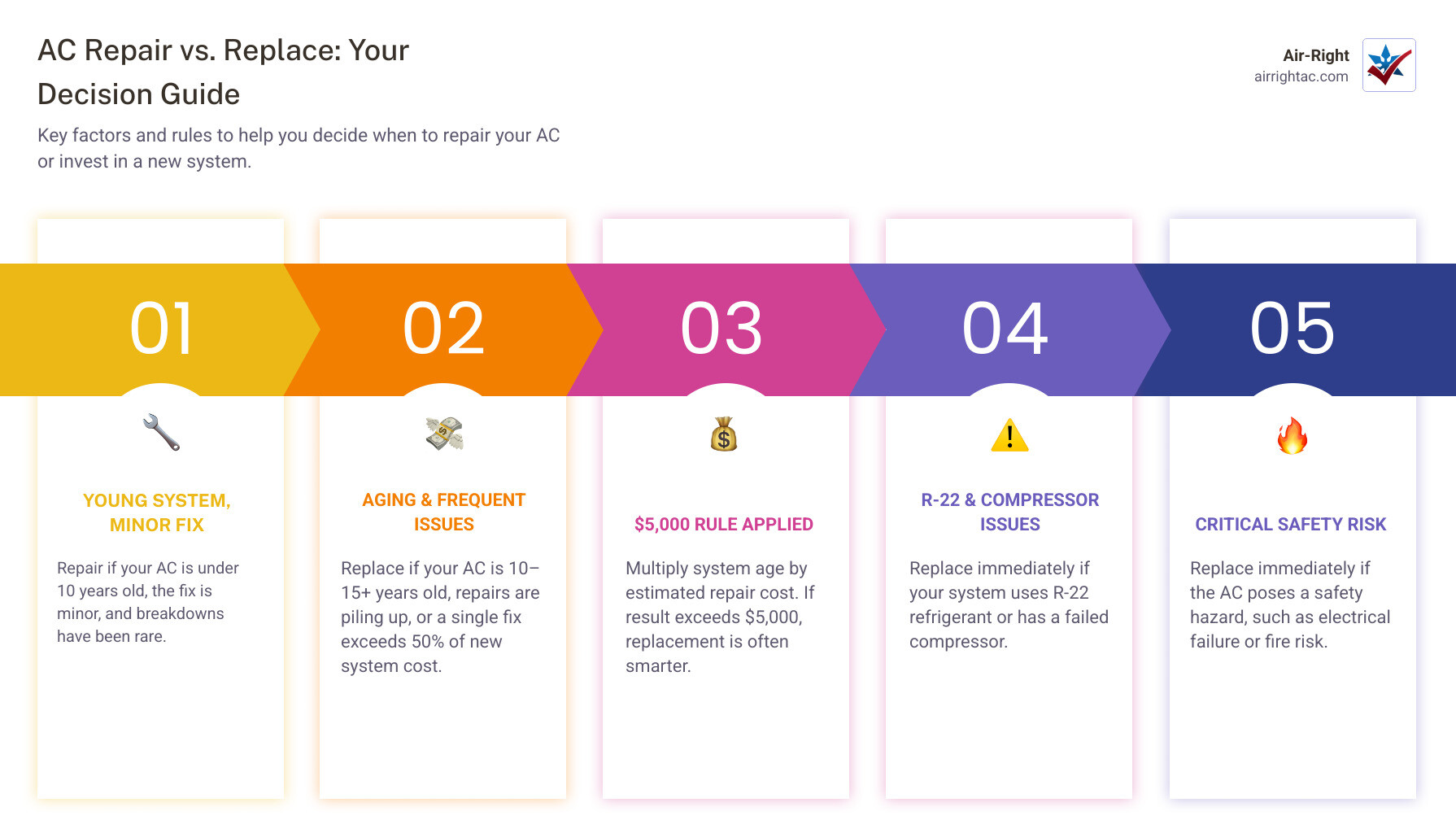
- Repair if your system is under 10 years old, the fix is minor, and breakdowns have been rare
- Replace if your system is 10–15+ years old, repairs are piling up, or a single fix would cost more than 50% of a new system’s price
- Use the $5,000 rule: multiply your system’s age (in years) by the estimated repair cost — if the result exceeds $5,000, replacement is usually the smarter move
- Replace immediately if your system uses R-22 refrigerant, has a failed compressor, or poses a safety risk
When your AC starts struggling in the middle of a Las Vegas summer — temperatures pushing past 110°F, dust in the air, and your house refusing to cool down — the last thing you want is a slow, confusing decision process. Do you call for a repair and hope for the best? Or is this the moment to cut your losses and invest in a new system?
It’s one of the most common questions homeowners face, and it’s rarely black and white. A system that still runs isn’t necessarily worth keeping. And an expensive repair estimate doesn’t automatically mean it’s time to replace. The right answer depends on a mix of age, cost, performance history, and a few industry rules that can make the math a lot clearer.
This guide walks you through everything you need to know — no pressure, no guesswork.
Key factors in the repair vs replace your ac decision guide
Deciding whether to keep pouring money into an old unit or to start fresh with a new installation is a major financial choice. In Southern Nevada, where our cooling systems work harder than almost anywhere else in the country, the stakes are high. We look at several critical pillars to help you make this call: the age of the equipment, its reliability over the last few years, and the overall performance.
A system that “runs” but leaves hot spots in your Henderson living room or results in sky-high utility bills might actually be costing you more than a new monthly payment would. To truly understand your options, you need to look at the big picture. Our AC system services are designed to give you a clear diagnostic, but you can start evaluating your unit right now by looking at these primary factors.
Evaluating the age of your cooling system
In a moderate climate, an air conditioner might hum along for 15 to 20 years. However, in Las Vegas and Boulder City, the intense heat and constant cycling usually limit a central AC unit’s lifespan to between 10 and 15 years.
ENERGY STAR® guidelines suggest that if your air conditioner is older than 10 years, it’s time to start considering a replacement. As a system enters its second decade, the mechanical wear and tear on the compressor and fan motors becomes significant. Think of it like a car with 200,000 miles; even if it’s running today, the likelihood of a major component failure increases every time you turn the key—or in this case, every time the thermostat clicks on.
Analyzing the frequency of mechanical breakdowns
How many times have we seen each other lately? If you feel like you have your HVAC technician on speed dial, that’s a major red flag. One-off repairs are normal, but recurring issues suggest that the system’s components are failing in a “domino effect.”
When one part wears out, it often puts extra strain on the remaining original parts, leading to another breakdown just a few months later. If you’ve had to call for service three or more times in the last two years, you’re likely dealing with a system at the end of its lifecycle. For more local insights on managing these issues, check out Don’t Sweat the Heat: A Local’s Guide to AC Repair in Boulder City.
Should I repair or replace if my AC is still under warranty?
If your system is still covered by a manufacturer’s warranty, repair is almost always the better choice. Most modern units come with a 5- or 10-year parts warranty. If a major component like a coil or motor fails while under warranty, the manufacturer covers the cost of the part itself.
While you may still be responsible for the labor costs, the overall expense is significantly lower than a full replacement. We always recommend checking your warranty status before making a final decision. You can find more information about how we handle these situations on our residential services page.
Industry rules of thumb for homeowners
To take the emotion out of the decision, professionals often use specific mathematical formulas. These “rules of thumb” help you avoid the “sunk cost fallacy”—the tendency to keep spending money on a repair just because you’ve already spent money on it in the past.
| Factor | Favor Repair | Favor Replacement |
|---|---|---|
| Age | Under 8-10 years | Over 12-15 years |
| Repair Cost | Less than 30% of new unit | More than 50% of new unit |
| Efficiency | Still meets your budget | Bills rising 20% or more |
| Refrigerant | R-410A or modern | R-22 (Freon) |
| Comfort | Even cooling | Hot spots and high humidity |
Applying the $5,000 rule to your repair vs replace your ac decision guide
One of the most reliable tools in the repair vs replace your ac decision guide is the “$5,000 Rule.” It’s a simple calculation: multiply the age of your unit by the cost of the proposed repair.
If the total is less than $5,000, repair it. If it’s more than $5,000, it’s time to replace. For example, if you have a 12-year-old unit and the repair estimate is $500, the total is $6,000. In this case, the math suggests that the money is better spent toward a new, warrantied system rather than nursing an aging unit that is statistically likely to break down again soon.
When the 50% rule suggests a system upgrade
The “50% Rule” is even more straightforward. If the cost of a single repair is more than half the price of a brand-new system, replacement is almost always the superior financial strategy.
Major repairs, such as replacing a compressor or an evaporator coil, can be quite expensive. Putting that kind of investment into a machine that is already out of warranty and near the end of its life is like putting brand-new tires on a car with a blown transmission. To see how this applies to local homes, read Save Your Cash and Your Comfort with Affordable Henderson AC Repair.
Real-world scenarios for choosing repair over replacement
Repair isn’t always the “wrong” choice for an older system. If your unit is 12 years old but the issue is just a $200 capacitor or a clogged drain line, it makes sense to fix it. These are minor malfunctions that don’t indicate a total system failure.
Similarly, if you plan to move out of your home in the next year, you might choose a “stop-gap” repair to keep things running until the sale. However, keep in mind that a new, high-efficiency AC system can actually boost your home’s resale value and appeal to potential buyers in the Las Vegas market.
Technical considerations and environmental regulations
The HVAC industry has seen massive changes recently. New regulations that went into effect in 2025 and 2026 have shifted the landscape of what is available and how much it costs to run. These technical factors are just as important as the age of your unit.
The impact of phased-out refrigerants on your repair vs replace your ac decision guide
If your AC was manufactured before 2010, there is a high chance it uses R-22 refrigerant (often called Freon). This refrigerant has been phased out globally due to its environmental impact. Because it is no longer produced, the remaining supply is extremely scarce and expensive.
If an R-22 system develops a leak, the cost to recharge it can be astronomical. Investing in a major repair for an R-22 unit is rarely worth it because the system is inherently obsolete. Modern units use R-410A or newer eco-friendly refrigerants that are more affordable and easier to source. For more on navigating these older systems, see The Ultimate Las Vegas AC Repair Survival Guide.
Efficiency gains and utility bill reduction
Newer air conditioners are significantly more efficient than those built just a decade ago. Efficiency is measured by the SEER2 (Seasonal Energy Efficiency Ratio) rating. While an old unit might have a SEER rating of 10 or 12, modern high-efficiency models can reach 18 to 25+.
Upgrading to a new system can reduce your cooling costs by 30% to 50%. In the desert heat of Southern Nevada, those savings add up quickly, often helping the new system pay for itself over time through lower monthly utility bills. Features like variable-speed technology allow the unit to adjust its output to the exact needs of your home, providing consistent comfort without the “all-or-nothing” blast of older models. Learn more about local efficiency tips in Keep Your Cool with Expert AC Repair in Henderson NV.
How to check your AC’s age, model, and refrigerant type
You don’t need a pro just to find out how old your system is. Go outside to your condenser unit (the big metal box) and look for the manufacturer’s nameplate. This data plate contains the model number, serial number, and the type of refrigerant used.
The serial number often contains the manufacture date. For many brands, the first four digits represent the week and year. For example, a serial number starting with “1214” likely means the unit was built in the 12th week of 2014. If you can’t decode it, you can always take a photo of the plate and send it to us. For more signs of age-related trouble, read How to Tell When Your Air Conditioner Needs Repair.
Comfort and safety indicators for replacement
Sometimes the decision isn’t about the math—it’s about how you feel inside your own home. If your AC is “working” but you’re still miserable, it’s failing its primary job.
Identifying performance red flags in Southern Nevada
In Las Vegas, we deal with more than just heat; we deal with dust and specific airflow challenges. If you notice uneven cooling—where the bedroom is an icebox but the kitchen is a sauna—your system might be improperly sized or the blower motor may be failing.
Excessive dust accumulation near your vents or a house that feels “heavy” and humid even when the AC is running are signs that the system can no longer manage indoor air quality. If you’re tired of “steaming” in your own home, check out our guide to Top Rated Las Vegas AC Experts That Won’t Leave You Steaming.
Critical safety concerns and fire hazards
Safety is the one area where there is no “repair vs. replace” debate. If your system poses a risk to your family, it must be addressed immediately. Signs of critical failure include:
- A persistent burning smell coming from the vents.
- Frequent circuit breaker trips when the AC kicks on.
- Buzzing or grinding noises that indicate electrical short circuits or motor seizure.
- Evidence of scorched wires inside the cabinet.
In these cases, the risk of an electrical fire or total system meltdown makes replacement the only responsible path if the core components are compromised.
Impact of the Las Vegas desert climate on system wear
Our environment is uniquely harsh. Between the 115°F summer peaks and the occasional dust storms, AC units in Henderson and Boulder City experience accelerated deterioration. The outdoor condenser coils can become clogged with desert silt, and the intense UV rays can degrade electrical components faster than in cooler regions.
This “desert tax” means that even a well-maintained system might reach its “old age” a few years earlier than the national average. We recommend heavy-duty units specifically designed for high-ambient temperatures to ensure your replacement can stand up to the local climate.
Conclusion
At Air-Right, we believe in giving you the facts so you can make the best decision for your home and your budget. Whether it’s a quick fix to get you through the season or a full high-efficiency upgrade, our goal is to provide clear, no-pressure recommendations.
If you’re still on the fence, the best time to decide is during the “off-season” in spring or fall. Planning ahead allows you to take advantage of rebates and avoid the stress of a mid-summer emergency. We offer transparent pricing information and flexible financing options to make your comfort more affordable.
Ready for a professional evaluation? Schedule your residential service today and let our experts help you decide if your AC deserves a second chance or if it’s time for a fresh start.
Need Help?
Contact us today to discuss your needs. Our team is ready to help.
Related Articles
- Is It a True Emergency? A Triage Guide for 24-Hour Air Conditioning Service in Las Vegas, NV
- Is That Burning Smell an Emergency? Fall Triage Guide for 24 Hour Air Conditioning Service in Las Vegas, NV
- Beyond 24-Hour Air Conditioning Service in Las Vegas: Heat Pump vs. Gas Furnace Options for Fall Upgrades
Related articles


Ready to Get Started?
Whether you need a repair, maintenance, or a new installation, our expert team is here to help.