How to Change Your AC Air Filter in Dusty Conditions
Air-Right

<p>Learn when to change your ac air filter in dusty conditions to boost airflow, cut energy costs, and protect your HVAC in Southern Nevada’s harsh desert climate.</p>
Why Knowing When to Change Your AC Air Filter in Dusty Conditions Can Save Your System
In Las Vegas, the standard 90-day filter rule simply does not apply. When to change your AC air filter in dusty conditions is one of the most important maintenance questions a Southern Nevada homeowner can ask — and the answer is almost always sooner than the packaging suggests.
During peak summer months, Las Vegas AC systems can run 12 to 18 hours a day. Add desert windstorms, fine silica dust, and the occasional haboob, and a filter that might last three months in a mild climate can become fully clogged in as little as 30 days. According to the U.S. Department of Energy, a dirty filter can increase your AC’s energy consumption by 5% to 15% — and a severely clogged one can cause up to a 20% loss in overall HVAC efficiency.
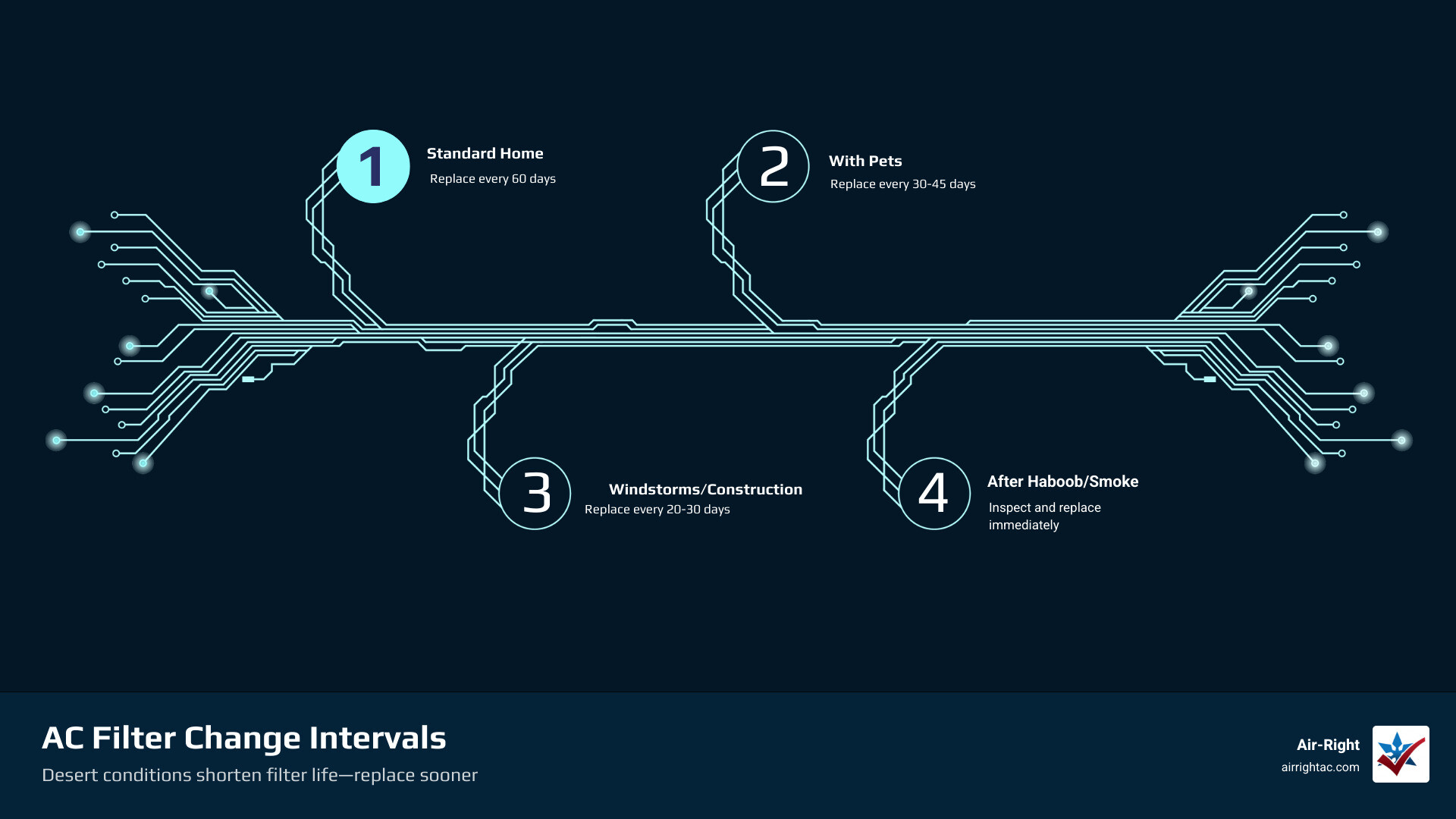
The short answer for most Las Vegas homeowners:
| Condition | Recommended Change Interval |
|---|---|
| Standard household, no pets | Every 60 days |
| Pets or allergy sufferers | Every 30-45 days |
| Dusty conditions, windstorms, construction nearby | Every 20-30 days |
| Multiple pets + dusty environment | Every 20 days or sooner |
| Wildfire smoke or haboob event | Inspect immediately; replace if needed |
The sections below break down exactly what to watch for, which filter to choose, and how to protect your system year-round.
Learn more about when to change your ac air filter in dusty conditions:
- how to maintain your ac in extreme desert heat
- hvac maintenance checklist for hot dry climates
- hvac maintenance mistakes desert homeowners make
Why You Must Know When to Change Your AC Air Filter in Dusty Conditions
Living in Southern Nevada means our heating, ventilation, and air conditioning (HVAC) systems face some of the most brutal operating conditions in the country. When airborne desert dust combines with triple-digit summer heat, your AC system is put under an immense amount of physical strain. Understanding when to change your ac air filter in dusty conditions is not just about keeping your indoor air clean; it is about protecting your entire system from premature failure.
When a filter becomes caked in dust, it creates severe airflow restriction. Your air conditioner operates on a simple principle: it pulls warm air from your home, passes it over a freezing-cold evaporator coil to extract heat and moisture, and blows the cooled air back into your living spaces. If a thick blanket of desert dust blocks that incoming air, your system has to work twice as hard to pull the same volume of air through.
This restriction leads to a dramatic spike in energy consumption. Because the system cannot cool your home efficiently, it runs longer cycles. You will notice your AC running constantly without ever quite reaching the temperature set on your thermostat. This extra workload causes massive system strain on critical, expensive components like the blower motor and the compressor.
For a deep dive into how our unique Southern Nevada environment alters your system’s needs, check out our guide on How Desert Dust and Heat Change Your AC Service Schedule.
During Las Vegas summers, windstorms and haboobs (massive dust storms) can sweep across Henderson, Boulder City, and the rest of the valley. A single severe dust storm can dump what feels like three months’ worth of dust into your home’s ventilation system in a single afternoon. If you ignore your filter after one of these environmental events, you risk choking your system to the point of complete shutdown.
The Baseline Rule for When to Change Your AC Air Filter in Dusty Conditions
While generic manufacturer packaging often boasts that filters can last up to 90 days, this standard guideline is meant for mild, low-dust climates. In our arid desert climate, we recommend a strict 30-day check-and-change rule during the peak cooling season (typically May through September).
Checking your filter every month doesn’t necessarily mean you have to throw it away every single time, but in high-dust conditions, you will find that a replacement is needed far more frequently than you think. During the shoulder seasons when the AC isn’t running 12+ hours a day, you might stretch this interval to 60 days, but you should still perform a monthly visual inspection.
To keep your system running at peak performance and prevent dust from settling deep inside your ductwork, read our expert tips on how to Don’t Let the Dust Settle on Your HVAC Maintenance Routine.
Signs Your Filter Needs Immediate Replacement
Sometimes you don’t need to look at a calendar to know your filter is done. Your HVAC system and your home will drop several obvious clues that a replacement is overdue:
- Weak Airflow: If you hold your hand up to your supply registers and the air feels like a gentle whisper rather than a strong breeze, your filter is likely choked.
- Dusty Vents: Take a close look at the metal grilles of your supply vents. If you notice dark, fuzzy rings of dust forming around them, your filter is saturated, and dust is bypassing the filter frame entirely.
- Frozen Evaporator Coils: When airflow is restricted, the cold refrigerant inside your evaporator coil cannot absorb enough heat. The condensation on the coil freezes solid, turning your indoor unit into a block of ice.
- Rising Utility Bills: If your energy bills are creeping up compared to the same month last year, but your usage habits haven’t changed, a dirty filter forcing your system to run longer is the prime suspect.
- Musty Odors: Dust trapped in a filter can absorb moisture from the air. Over time, this dark, damp environment can cultivate musty smells that blow through your home every time the system cycles on.
Key Factors That Shorten Filter Lifespan
Every home in the Las Vegas valley is different. A retired couple living in a quiet, established neighborhood in Boulder City will have a very different filter lifespan compared to a large family with pets living near a new housing development in Henderson. Understanding the environmental impacts and particulate matter in your specific micro-environment is key to managing your HVAC workload.
For comprehensive strategies on keeping your cooling system happy when temperatures soar, explore our guide on How to Maintain Your AC in Extreme Desert Heat Without Breaking a Sweat.
Household Size and Pet Dander
The number of people and animals living under your roof has a massive impact on your filter. Every human naturally sheds millions of dead skin cells daily, which makes up a large percentage of household dust. When you increase the occupancy rate of a home, you naturally increase the rate of dust accumulation.
If you have shedding pets, your filter has to deal with a constant barrage of pet hair and microscopic dander. Dander is highly sticky and binds to the synthetic fibers of your filter, sealing off the tiny passages where air is supposed to flow.
- One Pet: Adds significant load, typically cutting your filter’s lifespan by 30%.
- Multiple Pets or Allergy Sufferers: Requires a 30% to 50% increase in filter change frequency. If you have two or more pets, you should check your filter every 20 days and replace it at least once a month.
Local Construction and Desert Windstorms
Southern Nevada is constantly growing. If you live near an active construction site, your home is subject to highly abrasive airborne particles, including drywall dust, concrete dust, and fine silica sand. These super-fine particles are much smaller than typical household dust and can clog a standard pleated filter in as little as two weeks.
Similarly, seasonal desert windstorms kick up fine sand and agricultural dust from surrounding dry lake beds. When these winds blow, the negative pressure in your home can pull this outdoor dust inside through microscopic gaps in your home’s envelope.
If your home seems excessively dusty despite frequent filter changes, your ductwork might be pulling dirty air straight from your attic. To learn how to diagnose this hidden issue, read our comparison guide: Stop the Heat Leak: Is Your Attic or Your Ductwork the Real Culprit?.
Selecting the Best Filter for Dusty Environments
Choosing the right filter media is a delicate balancing act. You want a filter that captures as much fine dust as possible, but you must avoid choosing one that restricts airflow so much that it strains your system. Modern filters use various materials, from simple fiberglass to advanced synthetic fibers woven with a permanent electrostatic charge to attract and hold tiny particles.
When shopping for filters, always verify system compatibility. If you are unsure which filter specification is safe for your specific air handler, check out The Ultimate Desert Dwellers Guide to Finding HVAC Pros to get professional guidance tailored to your home.
Here is a quick breakdown of how common filter types stack up in dusty desert conditions:
| Filter Type | Efficiency Level | Dust-Holding Capacity | Recommended Las Vegas Use |
|---|---|---|---|
| Fiberglass (Flat) | Very Low (MERV 1-4) | Poor (Catches only large lint/hair) | Not Recommended. Allows fine desert dust to pass straight through onto your coils. |
| Standard Pleated | Moderate (MERV 8-11) | Good (Balances filtration with solid airflow) | Highly Recommended. Great for standard homes; captures pollen, dust, and dander. |
| High-Efficiency Pleated | High (MERV 12-16) | Excellent (Captures micro-particles and smoke) | Use with Caution. Can cause severe airflow restriction on older or smaller HVAC systems. |
| Deep-Pleat Media (4-5″) | High (MERV 11-16) | Outstanding (Massive surface area) | Highly Recommended. Requires a dedicated media cabinet but can last 6-12 months. |
How MERV Ratings Affect Performance
The Minimum Efficiency Reporting Value (MERV) scale ranges from 1 to 20. It measures a filter’s ability to capture particles between 0.3 and 10 microns.
- MERV 1 to 4: These are your cheap, see-through fiberglass filters. They are designed solely to keep large debris (like dog toys or giant dust bunnies) out of the blower motor. They do almost nothing to improve indoor air quality or protect your coils from fine desert dust.
- MERV 8 to 11: This is the sweet spot for most Southern Nevada homes. These filters capture a high percentage of fine dust, mold spores, and pet dander without creating excessive static pressure.
- MERV 13 and Higher: While these filters are excellent at capturing bacteria and wildfire smoke, they have incredibly dense fibers. If your HVAC system was not designed to handle the high static pressure of a MERV 13+ filter, it will restrict airflow, strain the blower motor, and potentially cause your system to short-cycle or freeze up.
Standard Pleated vs. High-Efficiency Media Filters
The physical thickness of your filter plays a massive role in how much dust it can hold before it begins to choke your system.
Standard 1-inch pleated filters are the most common. However, because they have limited surface area, they can become fully loaded with dust very quickly in our environment.
If your home has a dedicated media cabinet that accepts 4-inch or 5-inch deep-pleat media filters, you have a major advantage. These thick filters use deep, accordion-like folds to pack a massive amount of filtering surface area into a single unit. Because the air has so much more surface area to pass through, these filters can hold up to four times more dust than a 1-inch filter before causing a drop in system performance. While they cost more upfront, they typically only need to be replaced every 6 to 12 months, even in dusty conditions.
Frequently Asked Questions
Managing indoor air quality and keeping your air conditioner running smoothly in Southern Nevada can feel like a full-time job. Here are some of the most common questions we receive from homeowners in Las Vegas, Henderson, and Boulder City.
How do I know when to change your ac air filter in dusty conditions using the light test?
The “light test” is the easiest, most reliable DIY method to check if your filter is truly ready for the trash bin. You don’t have to rely on a calendar or guess based on how grey the filter looks.
- Turn off your HVAC system at the thermostat to prevent dust from entering the system while the filter is removed.
- Slide the filter out of its slot or return grille.
- Hold the filter up toward a bright light source, such as the sun or a bright ceiling light fixture.
- Analyze the light passage: If you can easily see light passing through the filter media, it still has life left in it. If the cardboard frame blocks the light but the pleated fibers are so caked with grey dust and matted fibers that no light can penetrate, the filter is fully loaded and must be replaced immediately.
Can I vacuum or wash a disposable pleated filter?
No. You should never attempt to vacuum, brush, or wash a standard disposable pleated filter.
Disposable filters are made of specialized paper and synthetic fibers that are often electrostatically charged.
- Vacuuming only removes the loose, visible dust on the very surface. It does not remove the deep, microscopic dust wedged inside the fibers. Furthermore, the suction from a vacuum can tear the delicate filter media or create microscopic gaps, rendering the filter useless.
- Washing a disposable filter is even worse. Water destroys the structural integrity of the paper backing and strips the electrostatic charge. Even worse, if you put a damp paper filter back into your dark HVAC system, you will create the perfect breeding ground for mold and mildew, which will then blow throughout your entire home.
If you want a washable option, you must purchase a filter specifically designed and labeled as “washable” or “electrostatic reusable.” These are made with durable plastic or metal meshes that can be safely rinsed, though they must be allowed to dry completely before reinstallation.
What happens if I don’t change my filter often enough?
Neglecting your air filter in a dusty environment triggers a destructive chain reaction throughout your HVAC system:
- Increased Utility Bills: Your system runs longer, less efficient cycles, wasting energy and inflating your monthly power bills.
- Frozen Coils: Restricted airflow causes the evaporator coil to drop below freezing, turning condensation into ice.
- Water Damage: When that ice eventually melts, it can overflow your drain pan, leading to water damage on your ceilings or drywall.
- Blower Motor Burnout: The fan motor has to work incredibly hard to pull air through a clogged filter, eventually overheating and burning out.
- Compressor Failure: If liquid refrigerant floods back to the compressor because it couldn’t evaporate properly, it can destroy the compressor—often requiring a complete system replacement.
- Voided Warranties: Most HVAC manufacturers require proof of regular maintenance, including routine filter changes, to honor parts warranties.
Conclusion
In Southern Nevada, changing your AC air filter is not a chore you can afford to put off. Regularly checking and replacing your filter is the single simplest, most cost-effective way to protect your home’s cooling system, keep your energy bills low, and ensure your family breathes clean indoor air.
At Air-Right, we believe in helping our neighbors in Las Vegas, Henderson, and Boulder City enjoy reliable comfort they can count on. We are a fully licensed, bonded, and insured team dedicated to providing honest, pressure-free recommendations for all your heating, cooling, and clean-air needs.
If you suspect your system is struggling from dust buildup, or if you want to explore advanced air purification options for your home, we are here to help. Contact us today to schedule professional maintenance or explore our comprehensive Air-Right HVAC Services.
Need Help?
Contact us today to discuss your needs. Our team is ready to help.
Related Articles
- Is It a True Emergency? A Triage Guide for 24-Hour Air Conditioning Service in Las Vegas, NV
- Is That Burning Smell an Emergency? Fall Triage Guide for 24 Hour Air Conditioning Service in Las Vegas, NV
- Beyond 24-Hour Air Conditioning Service in Las Vegas: Heat Pump vs. Gas Furnace Options for Fall Upgrades
Related articles


Ready to Get Started?
Whether you need a repair, maintenance, or a new installation, our expert team is here to help.