How Extreme Heat Wears Out Your AC Faster Than a Popsicle in Phoenix
Air-Right

<p>Discover how desert weather shortens HVAC lifespan in Vegas heat. Combat dust, thermal stress & extreme cycles with expert maintenance tips!</p>
Why Desert Weather in Las Vegas Shortens HVAC Lifespan Faster Than Almost Anywhere Else
How desert weather shortens HVAC lifespan is one of the most important things a Las Vegas homeowner can understand — because the numbers are stark. While a well-maintained AC system lasts 15 to 20 years in most parts of the country, the same unit in Southern Nevada often gives out in just 8 to 12 years. That gap isn’t bad luck. It’s the direct result of extreme heat, abrasive dust, brutal UV radiation, and wild daily temperature swings all hitting your system at once.
How desert weather shortens HVAC lifespan — quick answer:
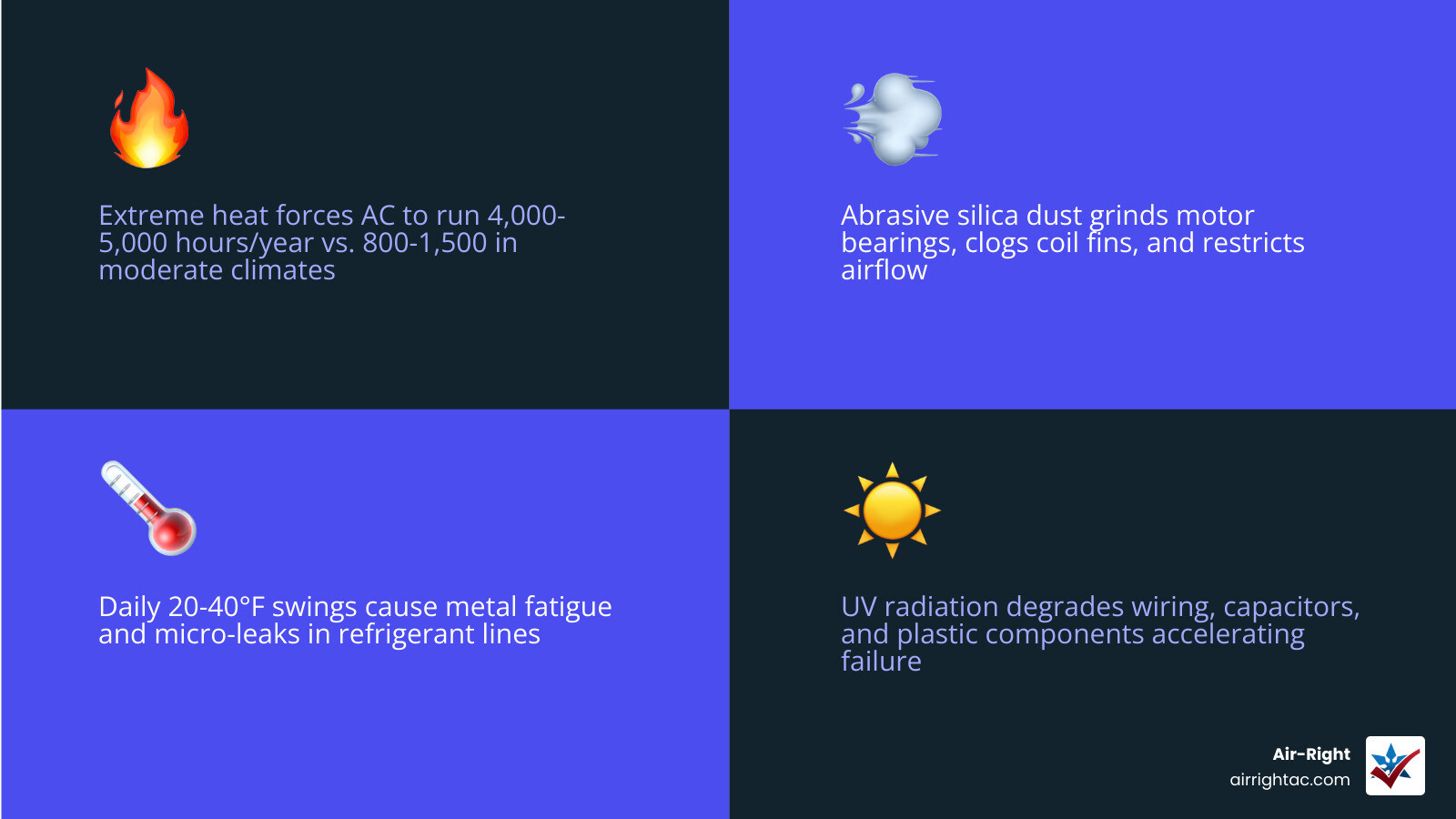
- Extreme heat forces your AC to run 4,000 to 5,000 hours per year, compared to 800 to 1,500 hours in moderate climates
- Abrasive silica dust grinds down motor bearings, clogs coil fins, and restricts airflow
- Daily temperature swings of 20 to 40°F cause metal components to expand and contract repeatedly, creating micro-leaks in refrigerant lines
- UV radiation degrades wiring insulation, plastic fan blades, and capacitors
- High heat pushes efficiency down — a system that started at 16 SEER may be operating at 10 SEER after a decade
- Neglected systems can burn up to 30% more energy and fail years ahead of schedule
Think of it like driving a car 100,000 miles in a single year. The engine isn’t broken — it’s just exhausted. Your AC faces the same problem every single Las Vegas summer, and without the right care, those miles add up fast.
This guide breaks down exactly what’s happening inside your system, which components are most at risk, and what you can do to get the most life out of your AC in Southern Nevada.
The Desert Tax: How Desert Weather Shortens HVAC Lifespan
In the HVAC world, we often talk about the “Desert Tax.” This isn’t a fee you pay to the government; it’s the physical toll that living in an arid, high-heat environment takes on your machinery. When the mercury hits 115°F in Las Vegas, your air conditioner isn’t just “working”—it’s in a fight for its life.
The primary driver here is the thermal workload. Most residential AC systems are engineered for a “design temperature” of about 95°F. When we consistently blow past that number for months at a time, the physics of heat exchange become much harder. To keep your home at a comfortable 75°F, the system has to log an incredible number of cooling hours. In moderate climates, an AC might run for 800 to 1,500 hours a year. In Southern Nevada, we routinely see systems logging 4,000 or even 5,000 hours.
This massive difference in duty cycles means that by the time a Las Vegas AC unit is five years old, it has effectively “lived” as long as a fifteen-year-old unit in a milder state.
Comparing Regional Lifespans: Why Southern Nevada Systems Fail Sooner
Geography is destiny when it comes to HVAC longevity. If you live in a coastal city with mild summers, your unit might comfortably hum along for two decades. However, the high desert environment of the Southwest is a different beast entirely.
- National Average: 15–20 Years
- Las Vegas / Henderson: 8–12 Years
- West Texas (High Dust): 7.5–10 Years
Living in the high desert can shave up to 50% off the life of your AC unit if it isn’t cared for meticulously. The combination of heat and low humidity creates a unique set of challenges that standard maintenance schedules simply weren’t designed to handle. To help mitigate this, we recommend learning How to Keep Your Desert Home from Turning Into a Giant Oven to reduce the overall load on your system.
How desert weather shortens hvac lifespan through extreme duty cycles
When a machine runs continuously, lubricants break down faster. In the desert, your compressor—the “heart” of the system—often doesn’t get the rest periods it needs to cool down internally. This leads to a “slow-motion breakdown” where internal parts wear out long before they should.
Furthermore, this constant operation leads to a significant energy spike. A neglected AC system in our climate can burn up to 30% more energy just to achieve the same cooling results as a clean one. This is why we emphasize the Reasons to Keep Your HVAC Unit Maintained by Experts; professional eyes can spot the early signs of duty-cycle fatigue before they turn into a total system seizure in the middle of July.
The Abrasive Assassin: How Dust and Sand Destroy Internal Components
If heat is the “silent killer” of AC units, then desert dust is the “abrasive assassin.” Desert dust isn’t like the lint you find under your sofa; it’s largely composed of tiny, sharp silica particles and mineral fragments. These are essentially microscopic shards of glass.
When wind-blown dust enters your outdoor unit, it creates a “sandpaper effect.” These particles are fine enough to push deeply into motor bearings and grind down the metal. Over time, this friction leads to overheating and mechanical failure. Even your fan blades aren’t safe; the constant bombardment of grit can lead to pitting and imbalances that eventually snap the motor shaft. Understanding How Desert Dust and Heat Change Your AC Service Schedule is vital for anyone living in Henderson or Boulder City.
How desert weather shortens hvac lifespan through coil insulation
One of the most damaging things dust does is act as a literal layer of insulation. Your AC works by moving heat from inside your home to the outside via the condenser coils. When those coils are coated in a fine layer of desert silt, that heat can’t escape.
- Condenser Fins: Dust clogs the tiny gaps between fins, restricting airflow and forcing the compressor to work twice as hard.
- Evaporator Coils: Inside, dust can mix with the moisture naturally found on the cooling coils to create a “bio-slime” or muddy sludge. This not only blocks airflow but can also clog your condensate drain lines, leading to water damage in your home.
Following consistent Maintenance Secrets to Keep Your AC from Quitting on You—like gently rinsing your outdoor coils—can prevent this “thermal blanket” from suffocating your system.
The Impact of Haboobs on Filtration and Airflow
In the Las Vegas valley, we are all familiar with the “haboob”—those massive walls of dust that roll through during monsoon season. A single dust storm can deposit enough caliche dust to completely saturate a standard air filter in an hour.
When a filter is clogged, the blower motor has to pull harder to move air. This creates “static pressure,” which is like trying to breathe through a thick sweater while running a marathon. In the desert, the “3-month filter” is a myth. During peak dusty seasons, you should be checking and likely replacing your filters every 30 days to prevent blower motor burnout.
Thermal Stress and the “Paperclip Effect” on Metal Components
Have you ever taken a paperclip and bent it back and forth until it snapped? That is exactly what happens to your AC’s metal components in the desert. We call this the “Paperclip Effect,” and it’s caused by diurnal temperature swings.
In Las Vegas, it’s common to see a 40-degree shift between the heat of the afternoon and the cool of the night. This causes the copper refrigerant lines and brazed joints to expand and contract aggressively every single day. Over thousands of cycles, this metal fatigue leads to micro-leaks. Because modern R-410A refrigerant operates at much higher pressures than older gases, even a tiny hairline fracture can lead to a total loss of cooling capacity.
Vulnerable Electrical Parts: Capacitors and Wiring
Your AC’s electrical system is just as vulnerable to the heat as the mechanical parts.
- Capacitors: These are like large batteries that give your motors the “kick” they need to start. Most capacitors are rated for a maximum temperature of 131°F. On a 110°F day, the temperature inside your AC’s electrical cabinet can easily hit 150°F. This causes the internal chemicals to break down, leading to premature failure.
- Wiring and Polymers: Intense UV radiation in Southern Nevada turns plastic fan blades brittle and causes wiring insulation to literally turn to dust. Once the insulation is gone, you’re looking at short circuits and potential fire hazards.
Refrigerant Pressure Cycling in Triple-Digit Heat
As outdoor temperatures rise, the pressure inside your AC lines (head pressure) skyrockets. When it’s 115°F outside, the compressor has to push the refrigerant much harder to get it to release its heat. This extreme pressure puts immense strain on the compressor valves. If the system is also dirty, the internal oil can actually “coke”—turning into an acidic, carbonized sludge that destroys the compressor from the inside out.
Maintenance Strategies to Combat Arid Climate Wear
Because how desert weather shortens HVAC lifespan is so aggressive, your maintenance strategy needs to be equally proactive. In Las Vegas, a “once a year” checkup is often the bare minimum. We recommend a bi-annual schedule:
- Spring “Pre-Flight” Check: To ensure the refrigerant levels are perfect and the capacitors are healthy before the first 100-degree day.
- Fall “Recovery” Inspection: To clean out the massive amounts of dust and grit accumulated during the summer and check for any wire corrosion caused by heat stress.
To help stay on top of this, many homeowners find that HVAC Maintenance Plans Pros Cons and Peace of Mind are the best way to ensure their system survives the “Desert Tax.”
Professional Services Essential for Desert Systems
While rinsing your coils with a garden hose is a great DIY step, desert systems require professional-grade care to reach the 15-year mark. Professional technicians use non-acidic cleaners that remove silica without eating away at the delicate aluminum fins. We also perform “fin straightening” to fix damage caused by wind-blown debris and ensure your electrical connections are tightened—since the “Paperclip Effect” can also loosen electrical terminals over time.
Finding the right partner is key, so check out The Ultimate Desert Dwellers Guide to Finding HVAC Pros to make sure your technician understands the specific needs of Southern Nevada homes.
Knowing When to Replace Your Heat-Stressed System
Eventually, the desert wins. When your system reaches the 10-to-12-year mark in Las Vegas, it enters what we call the “fatigue zone.” At this point, you have to decide if you want to keep pouring money into an aging unit or upgrade to a system built for modern efficiency.
We generally follow the 50% Rule: If the cost of a major repair (like a compressor replacement) exceeds 50% of the cost of a new system, it’s time to replace it. New SEER2 standards and variable-speed compressors are much better at handling the Las Vegas heat because they can ramp down their power when the full 100% isn’t needed, reducing the mechanical strain. If you’re seeing the Signs Your AC Needs Replacing Not Just Fixing, it might be time for an upgrade.
Warning Signs of Premature Aging
If you notice any of the following, the desert weather may have already done significant damage to your system:
- Short Cycling: The unit turns on and off every few minutes, indicating the compressor is overheating.
- 20% Bill Spikes: Sudden increases in energy costs usually mean the system is struggling against dirt or low refrigerant.
- Grinding Noises: This is the sound of desert dust eating your motor bearings.
- Ice Formation: Even in 110-degree heat, a system with restricted airflow or a leak will freeze up.
If you are on the fence, we can help you with How to Decide If Your AC Deserves a Second Chance based on its current condition and age.
Frequently Asked Questions
How often should I change my filters in the desert?
In Las Vegas, Henderson, and Boulder City, you should check your filters every 30 days. If you have pets, live near a construction site, or if we’ve had recent dust storms, you will likely need to replace them every single month during the summer.
Does shading my outdoor unit actually help?
Yes! Providing shade for your outdoor condenser can significantly reduce the thermal load on the system. However, you must ensure there is at least 24 inches of clearance on all sides and above the unit so you don’t trap hot air around it, which would actually make the problem worse.
Why do AC units fail faster in Las Vegas than in coastal cities?
It’s a combination of the “Interaction Effect.” Extreme heat, abrasive silica dust, high UV radiation, and rapid temperature swings all happen at the same time. This forces the unit to run 3 to 4 times as many hours as a coastal unit, essentially packing 20 years of wear into a single decade.
Conclusion
At Air-Right, we’ve spent years helping our neighbors in Las Vegas, Henderson, and Boulder City fight back against the “Desert Tax.” We know exactly how desert weather shortens HVAC lifespan, and we’ve built our business around providing the maintenance and high-efficiency installations needed to survive it.
As a licensed, bonded, and insured team, we provide clear, no-pressure recommendations. Whether you need a spring tune-up to prepare for the heat or a full system replacement to lower your energy bills, we are here to help. Don’t let the Mojave Desert claim your AC before its time. More info about AC system services is just a click away—let us help you keep your home a cool oasis all year long.
Need Help?
Contact us today to discuss your needs. Our team is ready to help.
Related Articles
- Is It a True Emergency? A Triage Guide for 24-Hour Air Conditioning Service in Las Vegas, NV
- Is That Burning Smell an Emergency? Fall Triage Guide for 24 Hour Air Conditioning Service in Las Vegas, NV
- Beyond 24-Hour Air Conditioning Service in Las Vegas: Heat Pump vs. Gas Furnace Options for Fall Upgrades
Related articles


Ready to Get Started?
Whether you need a repair, maintenance, or a new installation, our expert team is here to help.