Don’t Lose Your Cool: Spotting Low Refrigerant Before the Heatwave Hits
Air-Right

<p>Spot low refrigerant signs in hot weather: warm air, ice buildup, hissing. Fix leaks before Vegas heatwaves spike bills!</p>
What Are the Low Refrigerant Signs in Hot Weather?
Low refrigerant signs in hot weather are easier to spot than most homeowners expect — if you know what to look for. Here is a quick summary:
- Warm or barely cool air blowing from your vents despite the AC running
- Ice or frost forming on the copper refrigerant lines or evaporator coils
- Hissing or bubbling sounds near the indoor or outdoor unit
- High indoor humidity — air feels sticky or clammy even with the AC on
- Longer cooling cycles — the system runs and runs but never quite reaches your thermostat setting
- Unexplained spikes in your electricity bill compared to the same period last year
- A faint sweet or chemical odor near the vents or AC unit
If you are noticing one or more of these, your system may have a refrigerant leak that needs professional attention right away.
Nothing tests a Las Vegas home’s air conditioning quite like a July afternoon. When temperatures push past 110°F day after day across the Las Vegas, Henderson, and Boulder City area, your AC has almost no margin for error. A system running low on refrigerant is already struggling — and in that kind of heat, it can go from “barely keeping up” to “total breakdown” faster than most homeowners realize.
Refrigerant is the substance that makes cooling physically possible. It absorbs heat from inside your home and carries it outside, cycling continuously in a sealed loop. When that charge drops — almost always because of a leak — the entire heat transfer process breaks down. Your AC keeps running, your compressor keeps working, but your home stays warm and your electricity bill keeps climbing.
The frustrating part? Many of the signs of low refrigerant look a lot like other common AC problems. That makes it easy to dismiss them, especially early in the season when temperatures are still manageable. But catching a refrigerant issue in May is a very different situation from catching it in the middle of a heatwave when every HVAC technician in the valley is fully booked.
This guide walks you through every key warning sign — so you can act before the desert heat forces your hand.
Understanding the Role of Refrigerant in Desert Heat
To understand why low refrigerant signs in hot weather are so critical, we first have to look at how your AC actually works. Many people believe an air conditioner “creates” cold air. In reality, it removes heat. Refrigerant is the “courier” that carries this heat away.
Through a process called the refrigeration cycle, this chemical compound undergoes a phase change. It starts as a low-pressure liquid in your indoor evaporator coils, where it absorbs heat from your home’s air. As it soaks up that heat, it boils and turns into a gas. It then travels to the outdoor unit, where the compressor squeezes it, raising its temperature even higher so it can release that heat into the 110-degree Nevada air.
This is a closed-loop system. Unlike the gas in your car, refrigerant is not “used up” or consumed. If the level is low, there is a physical hole or crack somewhere in the system. In the Las Vegas climate, our systems face extreme thermal expansion and contraction. When it’s 30°F in January and 115°F in July, the copper lines and joints in your AC system expand and shrink constantly. This stress can lead to tiny pinhole leaks that worsen exactly when you need the cooling most. This is Why Your AC Needs a Checkup Before the Next Heatwave — catching these leaks early prevents the system from failing when the desert sun is at its most relentless.
7 Low Refrigerant Signs in Hot Weather to Watch For
When the refrigerant level drops, the system’s ability to move heat drops with it. This leads to several unmistakable symptoms that every homeowner in Henderson or Boulder City should know.
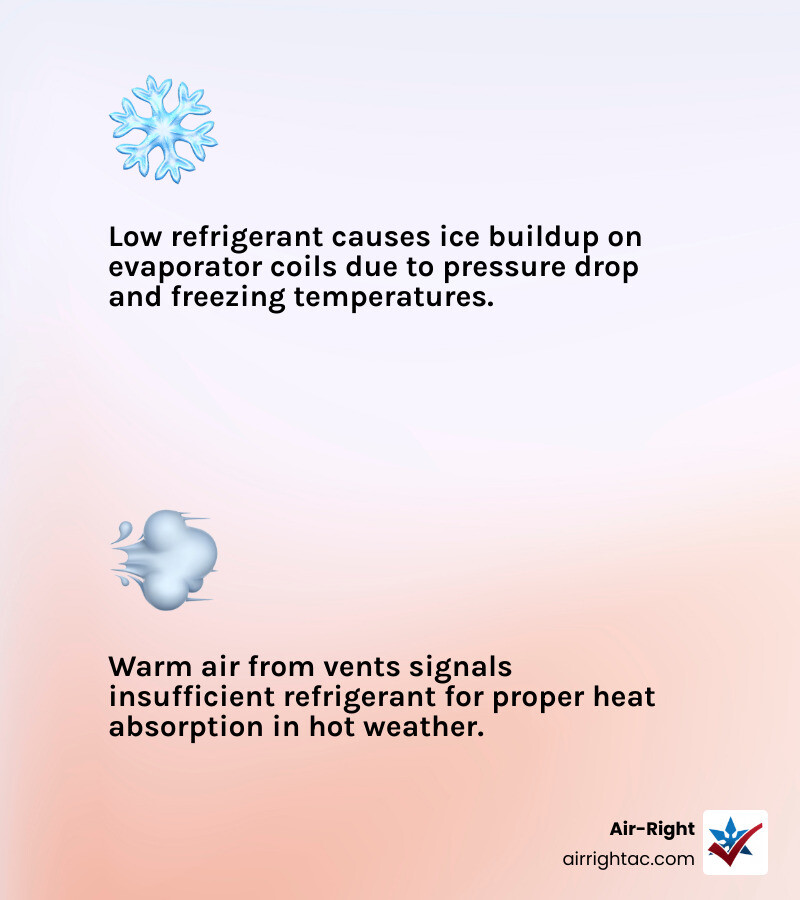
- Lukewarm Air from Vents: This is often the first sign. If you hold your hand up to the vent and the air feels like a weak fan rather than a crisp, cold breeze, the refrigerant likely isn’t cold enough to absorb the heat from the air passing over the coils.
- Weak Airflow: While this can sometimes be a blower motor issue, low refrigerant often causes the coils to freeze (more on that below), which physically blocks the air from moving through the system.
- The “Never-Ending” Cycle: Does your AC run for 14 hours a day to do a job it used to finish in 8? If the system can’t reach the thermostat setting, it will simply stay on, trying in vain to cool the house.
- Thermostat Discrepancies: If you set the dial to 75°F but the indoor temperature refuses to budge past 82°F during the day, your AC has lost its cooling capacity.
- Rising Humidity: Refrigerant doesn’t just cool; it dehumidifies. If the air in your home feels “heavy” or “sticky,” it’s because the coils aren’t cold enough to pull moisture out of the air.
- Unusual Noises: Hissing or bubbling sounds are the literal sound of your cooling fluid escaping.
- Spiking Power Bills: An inefficient system is an expensive system. If your bill is 20% to 40% higher than last May, your AC is likely struggling with a leak.
If your vents are blowing air but there’s no chill, you might feel like My AC is Ghosting Me: Why Your Unit Blows Air But No Coldness. Knowing How to Tell When Your Air Conditioner Needs Repair can save you from a very uncomfortable night.
Why Low Refrigerant Signs in Hot Weather Include Ice Buildup
It sounds like a paradox: Why would your AC freeze into a block of ice when it’s 110 degrees in Las Vegas? The answer lies in the pressure-temperature relationship.
Refrigerant needs to stay at a very specific pressure to function. When the level drops due to a leak, the pressure inside the evaporator coil also drops. This causes the refrigerant to “boil” at a much lower temperature — often well below freezing. As the warm, humid air from your home passes over these super-chilled coils, the moisture in the air instantly flashes into ice.
Over time, this ice builds up, acting as an insulator that prevents the refrigerant from absorbing any more heat. Eventually, you might see frost on the copper lines leading to the outdoor unit or even water pooling on the floor as the “ice dam” melts. If you see this, follow The Ultimate Survival Guide for When Your AC Quits During a Heatwave and turn the system off immediately to prevent the compressor from burning out.
Identifying Auditory and Sensory Low Refrigerant Signs in Hot Weather
Sometimes you can hear or smell a refrigerant leak before you see the ice.
- Hissing: This usually indicates a high-pressure gas leak. It sounds similar to a leaking tire.
- Bubbling: If the leak is in a line where the refrigerant is still in its liquid state, it may sound like air being blown through a straw into a drink.
- The “Sticky” Factor: In the desert, we aren’t used to high humidity. If your skin feels clammy indoors, your AC isn’t doing its secondary job of moisture removal.
- Sweet Smells: Some modern refrigerants have a faint, sweet, or ether-like chemical odor. If you notice a strange new scent near your air handler, it’s time for an inspection.
Our local environment plays a role here, too. How Desert Dust and Heat Change Your AC Service Schedule is a factor because dust can coat coils, making it even harder for a low-refrigerant system to breathe, accelerating the “freeze-up” process.
The Impact of Leaks on Energy Bills and System Health
Ignoring low refrigerant signs in hot weather is a gamble that homeowners rarely win. The most immediate impact is on your wallet. In Nevada, electricity consumption can jump 20% on a 100-degree day compared to a 90-degree day. If your system is low on refrigerant, it has to work significantly harder and run much longer to achieve the same cooling.
| System Status | Avg. Daily Run Time | Monthly Bill Impact (Est.) |
|---|---|---|
| Healthy System | 8 Hours | Standard |
| Minor Leak | 11 Hours | 15% – 20% Increase |
| Major Leak | 14+ Hours | 30% – 40% Increase |
Beyond the bill, there is the mechanical toll. The compressor is the “heart” of your AC and its most expensive component. It relies on the flow of refrigerant to stay cool. When refrigerant is low, the compressor can overheat, leading to permanent mechanical failure.
Regular care is the best defense. There are many Maintenance Secrets to Keep Your AC from Quitting on You, but the most effective is catching leaks while they are small. This is why HVAC Maintenance Plans: Pros, Cons, and Peace of Mind are so popular in the Las Vegas valley — they ensure a professional is checking your “charge” before the summer spikes hit.
Why “Topping Off” Isn’t a Real Solution for Nevada Homeowners
We often hear homeowners ask if we can just “add a little Freon” to get them through the summer. At Air-Right, we explain why this is a bad idea. Because an AC is a sealed system, needing more refrigerant is a symptom of a mechanical failure.
“Topping off” without fixing the leak is like trying to fill a bucket with a hole in the bottom. It’s a temporary fix that wastes money and harms the environment. Furthermore, EPA regulations are becoming stricter. Older systems using R-22 (Freon) are being phased out, and even the current standard, R-410A, is seeing changes in 2025 and 2026.
Leaks are often caused by:
- Formicary Corrosion: A chemical reaction between copper and household cleaners or pollutants that creates microscopic holes.
- Vibration: The constant hum of the unit can eventually cause joints to rub together and crack.
- Aging Seals: Rubber gaskets and seals typically last 12-15 years before they become brittle and fail in the desert heat.
If your system is older and has a major leak, there are clear Signs Your AC Needs Replacing Not Just Fixing. For newer systems, a proper AC Maintenance Contract ensures that if a leak develops, it’s found and sealed correctly, rather than just patched with a temporary “recharge.”
Frequently Asked Questions About AC Refrigerant
Does AC refrigerant ever need to be refilled as part of normal operation?
No. Under normal conditions, your AC should never need a “refill.” It is a closed-loop system. If your refrigerant is low, you have a leak. Period. A professional technician should use electronic “sniffers” or UV dye to find the source of the leak, repair it, and then evacuate and recharge the system to factory specifications.
Why does my AC freeze up when it is 110 degrees outside?
It seems impossible, but the lower the refrigerant pressure, the lower the temperature of the coil. When that pressure drops too far, the coil temperature falls below 32°F. Humidity from your home’s air hits that freezing coil and turns into ice. This ice then blocks airflow, making the house even hotter while the machine itself becomes an ice cube.
What are the dangers of a refrigerant leak in the home?
While small leaks are mostly a performance issue, a large, sudden leak can be dangerous. Refrigerant is heavier than oxygen and can displace the air in a room, leading to “refrigerant poisoning” symptoms like dizziness, nausea, or difficulty breathing. Environmentally, older refrigerants are also significant contributors to ozone depletion and global warming, which is why the EPA regulates their handling so strictly.
Conclusion
Living in Las Vegas, Henderson, or Boulder City means your air conditioner isn’t just a luxury — it’s a necessity for health and safety. Recognizing low refrigerant signs in hot weather early can be the difference between a simple repair and a multi-thousand-dollar compressor replacement in the middle of July.
If you’ve noticed your bills creeping up, your vents blowing lukewarm air, or strange hissing sounds coming from your unit, don’t wait for the next 115-degree afternoon to call for help. At Air-Right, our licensed and insured technicians provide clear, no-pressure recommendations to keep your home efficient and cool. We specialize in finding the root cause of leaks and providing long-term solutions that save you money and stress.
Don’t let a small leak turn into a summer emergency. Schedule your professional cooling service today and make sure your system is ready to handle the heat.
Need Help?
Contact us today to discuss your needs. Our team is ready to help.
Related Articles
- Is It a True Emergency? A Triage Guide for 24-Hour Air Conditioning Service in Las Vegas, NV
- Is That Burning Smell an Emergency? Fall Triage Guide for 24 Hour Air Conditioning Service in Las Vegas, NV
- Beyond 24-Hour Air Conditioning Service in Las Vegas: Heat Pump vs. Gas Furnace Options for Fall Upgrades
Related articles


Ready to Get Started?
Whether you need a repair, maintenance, or a new installation, our expert team is here to help.