Don’t Let the Dust Settle on Your HVAC Maintenance Routine
Air-Right

<p>Conquer desert heat & dust. Use our hvac maintenance checklist for hot dry climates to boost efficiency and extend your AC’s life.</p>
Your HVAC Maintenance Checklist for Hot Dry Climates Starts Here
An HVAC maintenance checklist for hot dry climates looks very different from what works in moderate regions — and if you live in Las Vegas, Henderson, or Boulder City, that difference can mean the gap between a cool home and a failed compressor in July.
Here’s a quick-reference checklist to get you oriented:
Core Tasks at a Glance:
- Monthly (summer): Replace air filter every 30 days, clear 2-foot perimeter around outdoor unit, flush condensate drain
- Spring (March–April): Schedule professional AC tune-up before peak cooling season
- Fall (October): Book heating system inspection before desert nights turn cold
- Year-round: Monitor for unusual noises, weak airflow, or sudden bill spikes
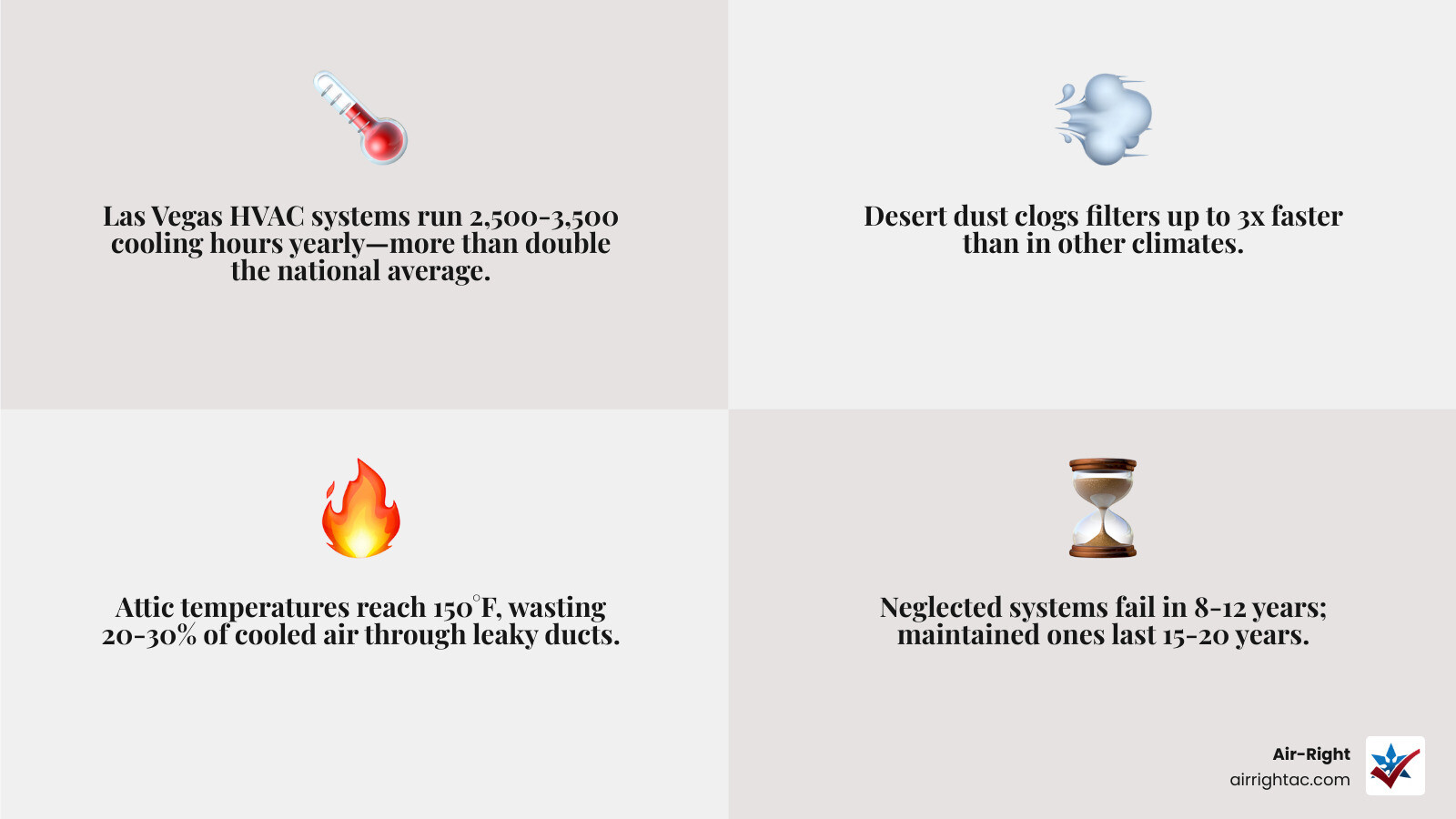
Las Vegas HVAC systems run roughly 2,500 to 3,500 cooling hours per year — more than double the national average. Desert dust clogs filters up to three times faster than in other climates. Attic temperatures can hit 150°F, quietly wasting 20 to 30% of your cooled air through leaky ducts. And haboobs can coat condenser coils in a layer of grit thick enough to visibly gray the fins, choking heat rejection right when temperatures are at their worst.
The result? Neglected systems in harsh desert conditions often fail in 8 to 12 years. Well-maintained ones regularly last 15 to 20 years.
This guide gives you the full picture — monthly DIY steps, professional seasonal checklists, filtration guidance, and the warning signs that mean it’s time to call in a licensed technician.
Why Desert Climates Demand a Specialized HVAC Maintenance Checklist
Living in the Las Vegas Valley means our air conditioners aren’t just a luxury; they are a necessity for survival. As we move into April 2026, it’s important to recognize that the standard “once-a-year” maintenance advice you find in national magazines simply doesn’t apply here. Our climate presents a unique set of stressors that can push even the most robust systems to their breaking point.
First, there is the sheer volume of work. While a typical system in a moderate climate might run for 1,000 to 1,500 hours a year, our units often clock between 2,500 and 3,500 hours. This is the equivalent of driving a car 100,000 miles in a single year. The extreme heat strain during 115°F design days forces the compressor to work under immense head pressure.
Then, we have the dust. Las Vegas faces a “triple threat” of fine desert sand, construction particulates, and seasonal haboobs. This dust acts as an abrasive on moving parts and an insulator on cooling coils. When dust coats your outdoor condenser, it prevents heat from escaping, forcing the system to run longer and hotter. Without intervention, this leads to a 95% higher chance of system failure. Understanding these reasons to keep your HVAC unit maintained by experts is the first step in protecting your investment.
The Essential HVAC Maintenance Checklist for Hot Dry Climates
To stay ahead of the heat, we recommend a twice-yearly professional maintenance schedule: a spring AC startup and a fall heating inspection. In Southern Nevada, the transition from winter to summer happens fast. If you wait until the first 100-degree day in May to check your system, you might find yourself on a week-long waiting list for repairs.
A proactive approach ensures that small issues—like a weakening capacitor or a tiny refrigerant leak—are caught before they turn into a total system shutdown. We’ve seen how desert dust and heat change your AC service schedule, making those pre-season checkups non-negotiable for anyone looking to avoid a summer emergency.
Monthly DIY Tasks for Arid Environments
While professional service is vital, there are several tasks you should handle yourself to keep things running smoothly between visits:
- Filter Inspection and Replacement: In the peak of summer (June through August), check your filters every 30 days. In a dusty environment, a filter that lasts three months in Ohio will be completely choked in four weeks here.
- Clear the Perimeter: Ensure there is at least a 2-foot clear zone around your outdoor condenser unit. Remove any wind-blown weeds, debris, or storage items that might restrict airflow.
- Condensate Drain Flush: Our dry air doesn’t mean there’s no moisture. Your AC pulls humidity from inside the home, which drains through a small pipe. Pouring a cup of white vinegar down the drain line every few months helps prevent algae and mold clogs that could lead to water damage.
- Visual Coil Check: After a dust storm or haboob, take a look at your outdoor unit. If the fins are caked in gray dust, they need a gentle rinse (never use a pressure washer!).
Professional Spring AC Tune-Up Requirements
When our technicians arrive for a spring visit, we go deep into the system’s “vital organs.” A comprehensive professional checklist for our climate includes:
- Refrigerant Charge Verification: A system that is just 10% low on refrigerant can lose 20% of its efficiency. We don’t just “top it off”—we look for the leak.
- Electrical Tightening: Extreme heat causes wires to expand and contract, which can loosen connections over time. We tighten all terminals to prevent arcing.
- Capacitor Testing: Capacitors are the most common “heat casualty” in Las Vegas. We measure their strength to ensure they won’t fail when you need them most.
- Deep Coil Cleaning: We use specialized solutions to break down the calcified desert dust that a garden hose can’t reach.
Many homeowners find that an AC maintenance contract is the most cost-effective way to ensure these tasks are never forgotten.
Managing Airflow and Filtration in Dusty Regions
Airflow is the lifeblood of your HVAC system. In a hot, dry climate, any restriction in airflow acts like a chokehold on your comfort. When filters get dirty or vents are blocked, the blower motor has to work significantly harder to move the same amount of air. This increases “static pressure,” which can lead to overheating and premature motor failure.
We often find that homeowners unintentionally sabotage their systems by closing vents in unused rooms. In our high-pressure desert systems, this can actually disrupt the balance of the unit, leading to duct leaks and frozen coils. Keeping at least 80% of your vents open is a simple way to save on your energy bill while protecting the equipment.
Selecting the Right Air Filters for Your HVAC Maintenance Checklist for Hot Dry Climates
Not all filters are created equal. For our specific environment, we generally recommend MERV 8 to MERV 11 pleated filters.
- Fiberglass (Low MERV): These “blue” filters are almost useless in the desert. They catch large lint but let fine sand and dust pass right through into your sensitive indoor coils.
- High-Efficiency (MERV 13+): While these catch more particulates, they can be too restrictive for older systems, causing the blower motor to burn out.
- Media Filters: If your home allows for 4-inch or 5-inch thick media filters, these are the gold standard. They provide superior filtration with very low airflow resistance and only need changing every 6 to 9 months.
Protecting Ductwork from Extreme Attic Temperatures
Your ductwork is often the most neglected part of the hvac maintenance checklist for hot dry climates. In Las Vegas, attic temperatures can easily soar to 150°F. If your ducts have even small leaks, they are sucking in that scorching attic air or blowing your expensive cooled air into the rafters.
Studies show that leaky ducts can waste 20% to 30% of a system’s cooling capacity. We recommend using mastic sealant rather than standard “duct tape” (which ironically fails quickly in desert heat). Proper insulation and sealing are essential to ensure your AC isn’t fighting a losing battle against the sun.
Maximizing Efficiency and System Lifespan in the Heat
The financial impact of maintenance in a desert climate is massive. Because our systems work so much harder, the “wear and tear” curve is much steeper than in other states.
| Feature | Maintained System | Neglected System |
|---|---|---|
| Expected Lifespan | 15–20 Years | 8–12 Years |
| Energy Efficiency | Peak (Low Bills) | 15–20% Loss (High Bills) |
| Emergency Risk | 5% (Very Low) | 95% (Very High) |
| Warranty Status | Validated | Often Voided |
By keeping your system tuned, you can comfortably set your thermostat to 78°F or 80°F in the summer and still feel cool. If your system is struggling, even 72°F might feel “stuffy.” Knowing how to tell when your air conditioner needs repair can save you thousands in avoided compressor replacements.
Warning Signs to Watch for During Your HVAC Maintenance Checklist for Hot Dry Climates
Even with great maintenance, the desert is tough. Keep an eye (and ear) out for these red flags:
- Unusual Noises: Squealing usually points to a belt or motor issue, while buzzing often indicates an electrical component or contactor failing.
- Weak Airflow: If the air coming from your vents feels “lazy,” you likely have a clogged filter, a failing blower, or dirty indoor coils.
- Short Cycling: If the unit turns on and off every few minutes, it’s likely overheating or has a refrigerant issue.
- Utility Bill Spikes: If your power bill jumps significantly compared to the same month last year (and the weather hasn’t changed), your system is losing its efficiency.
Getting to know common signs of a faulty HVAC unit allows you to call for service before the unit dies completely on a Saturday afternoon in July.
Frequently Asked Questions about Desert HVAC Care
How often should I really change my filters? In Las Vegas, we recommend checking them monthly. If you have pets or live near new construction, you will likely need to replace them every 30 days during the summer.
Do I need to clean my coils after every dust storm? Not necessarily, but a quick visual check is smart. If you can see a visible layer of dirt on the fins, a gentle rinse with a garden hose (with the power off!) will help the unit breathe.
Is a maintenance plan worth it? Absolutely. Most manufacturers require proof of professional annual maintenance to honor parts warranties. Plus, it usually pays for itself in energy savings alone.
Conclusion
At Air-Right, we understand that living in Southern Nevada requires a specialized approach to home comfort. Whether you are in Las Vegas, Henderson, or Boulder City, our goal is to provide you with the peace of mind that your system can handle whatever the desert throws at it.
We are a fully licensed, bonded, and insured team dedicated to clear, no-pressure recommendations. We take pride in helping our neighbors navigate the unique challenges of our climate, from improving attic insulation to installing high-efficiency clean-air solutions.
Before the next heatwave hits, make sure you have the top qualities your residential HVAC contractor must acquire working for you. Join our Club Members today for priority service and regular maintenance that keeps the dust from settling on your home’s comfort.
Explore our full range of Air-Right Services and let us help you stay cool, even when the thermometer hits 115°F.
Need Help?
Contact us today to discuss your needs. Our team is ready to help.
Related Articles
- Is It a True Emergency? A Triage Guide for 24-Hour Air Conditioning Service in Las Vegas, NV
- Is That Burning Smell an Emergency? Fall Triage Guide for 24 Hour Air Conditioning Service in Las Vegas, NV
- Beyond 24-Hour Air Conditioning Service in Las Vegas: Heat Pump vs. Gas Furnace Options for Fall Upgrades
Related articles


Ready to Get Started?
Whether you need a repair, maintenance, or a new installation, our expert team is here to help.