Behind the Scenes of an Emergency AC Service Call
Air-Right

<p>AC quit in Vegas heat? Learn what to expect during an emergency ac service call, from dispatch to repair, and stay cool.</p>
What to Expect During an Emergency AC Service Call in Las Vegas, NV
Knowing what to expect during an emergency AC service call can make a stressful situation much easier to handle — especially when Las Vegas summer temperatures push past 110°F and your cooling system suddenly stops working.
Here’s a quick overview of what typically happens:
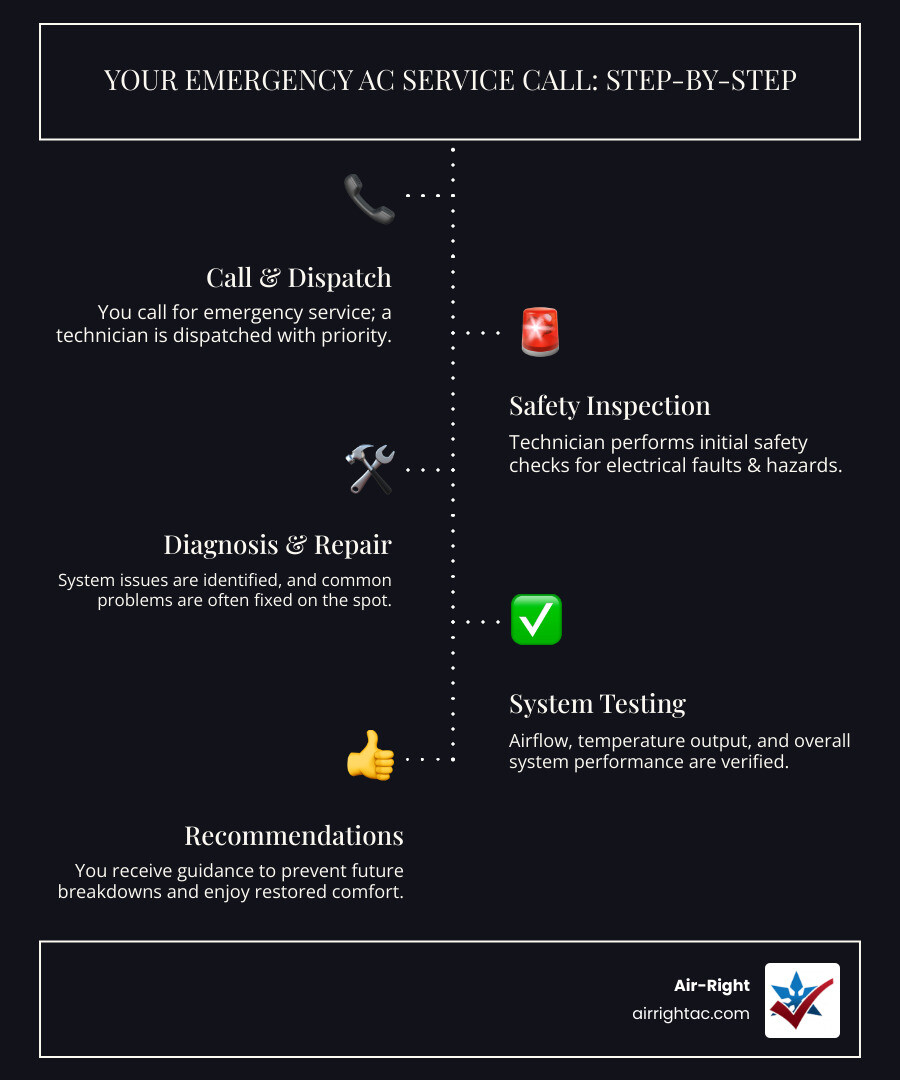
- You call for emergency service — a live dispatcher answers, asks about your symptoms, and confirms whether vulnerable residents are in the home.
- A technician is dispatched — response times vary based on demand and location, but emergency calls are prioritized.
- Safety inspection comes first — the technician checks for electrical faults, refrigerant leaks, and any immediate hazards before running diagnostics.
- Diagnosis and repair — common issues like blown capacitors, faulty contactors, or clogged drain lines are often fixed on the spot.
- System testing — before leaving, the technician verifies airflow, temperature output, and overall system performance.
- Post-repair recommendations — you’ll receive honest guidance on preventing future breakdowns.
When your air conditioner fails without warning — especially in the middle of a Southern Nevada summer — it doesn’t just mean discomfort. For households with young children, elderly residents, or anyone with a medical condition, it can become a genuine health risk within hours. And with over 60% of HVAC emergencies happening during peak seasons when systems are already working at their limits, the chances of a breakdown hitting at the worst possible time are higher than most homeowners expect.
The good news is that understanding the process ahead of time takes most of the anxiety out of it. This guide walks you through every stage of an emergency AC service call — from the moment you pick up the phone to the moment cool air is flowing again — so you know exactly what’s happening and why.
Identifying a True AC Emergency in Southern Nevada
In a city where the sun is relentless, a cooling “hiccup” can feel like a disaster. However, not every service request requires an immediate emergency dispatch. Understanding the difference helps ensure that those in the most critical need get help first. A true emergency is defined by a threat to your health, your safety, or your property.
If you notice burning smells, see electrical sparks coming from your indoor or outdoor units, or hear loud clanging noises that suggest mechanical failure, you should shut the system down immediately and call for help. These aren’t just inconveniences; they are safety hazards. Learning how to tell when your air conditioner needs repair before it reaches the “smoke and sparks” stage can save you a lot of grief.
When to call for immediate assistance
In the Las Vegas Valley, we use the “95-degree threshold.” If the outdoor temperature is soaring and your indoor environment is rapidly climbing toward 90°F or 95°F, it is a true emergency. This is especially critical if your household includes:
- Infants and young children: Their bodies cannot regulate temperature as effectively as adults.
- Seniors: Heat exhaustion can set in very quickly for the elderly.
- Vulnerable residents: Individuals with chronic illnesses or respiratory issues are at high risk when the air stops circulating.
Property damage is another factor. If your AC is leaking water into your ceiling or onto your floors, waiting until Monday morning could result in thousands of dollars in restoration costs. For a deeper dive into managing these high-stakes moments, check out Don’t Sweat It: Your Local Boulder City AC Service Handbook.
Non-emergency vs. urgent situations
Sometimes the system is just acting a bit “ghostly.” If your AC is blowing air but it isn’t quite cold enough, or if the thermostat screen is flickering but the house is still relatively comfortable, it may not require an emergency after-hours visit. Minor noises, such as a slight hum or a recurring click, are often signs that you should schedule a standard service call rather than an emergency one.
If you find that your unit blows air but no coldness, we can certainly help, but if the sun is down and the house is still 75 degrees, you might save yourself the stress of an emergency call by booking the first available standard appointment the next morning.
What to Expect During an Emergency AC Service Call: From Dispatch to Repair

The process begins the moment you realize the air has stopped. When you contact us for an emergency, you won’t be talking to a robot. You’ll speak with a live dispatcher who is trained to triage your situation.
They will ask several specific questions to help the technician prepare:
- Is the system completely dead, or just underperforming?
- Are there any “red flag” symptoms like burning smells or loud noises?
- Are there vulnerable people (infants, seniors) in the home?
- Have you checked your circuit breaker and thermostat batteries?
This initial conversation is vital. It helps us prioritize the most dangerous situations and ensures the technician arrives with the right parts on their truck.
What to expect during an emergency ac service call regarding the diagnostic process
When our technician arrives at your home in Las Vegas, Henderson, or Boulder City, they don’t just start swapping parts. They begin with a comprehensive safety check. This includes inspecting electrical connections for signs of melting or arcing and checking for refrigerant leaks.
Once the safety of the unit is verified, the technician moves into a deep-dive diagnostic. This involves testing the “heart” of the system — the compressor — and checking the “brain” — the thermostat and control board. Our AC system services are designed to identify the root cause, not just the symptom, so the fix actually lasts.
What to expect during an emergency ac service call for system testing and verification
A repair isn’t finished just because the air feels cool again. Before we leave, we perform a series of verification steps. We monitor the system’s performance for at least 15 to 20 minutes to ensure the pressures are stable and the temperature “drop” (the difference between the air going in and the air coming out) is within the manufacturer’s specifications.
We also sync the thermostat and calibrate airflow to ensure every room is getting the relief it needs. This thorough approach is why we are a trusted local guide to AC repair in Boulder City and the surrounding areas.
The On-Site Diagnostic and Safety Inspection
The diagnostic phase is where the “detective work” happens. Our technicians follow strict safety protocols, using specialized tools like multimeters and manifold gauges to see what’s happening inside the sealed system.
Common causes of sudden breakdowns
In the harsh Mojave climate, certain components fail more often than others. About 40% of emergency calls actually stem from simple thermostat or power issues, but the mechanical culprits are often:
- Blown Capacitors: These are like the “batteries” that give your motors the jolt they need to start. High heat is their worst enemy.
- Clogged Condensate Lines: If the drain line plugs up, a safety switch will kill the power to prevent water damage to your home.
- Frozen Coils: Often caused by a dirty filter or low refrigerant, this turns your indoor unit into a block of ice.
- Faulty Contactors: These are electrical switches that can “pitting” or weld shut over time.
Our HVAC services cover all these failure points, and our trucks are typically stocked with these common parts to get you running immediately.
The technician’s arrival and initial assessment
When we give you an arrival window, we stick to it. Our technicians carry clear identification and will start the visit by interviewing you about the timeline of the failure. Did it happen after a power flicker? Did you hear a loud “pop” before it stopped? This visual and verbal inspection helps us narrow down the problem quickly. If you’re wondering how to vet a provider, we have a guide on how to choose the best AC system service to help you feel confident in your choice.
Staying Cool While Waiting for Your Technician
Depending on the time of day and the current heatwave, there may be a short wait before a technician can reach your door. During this time, your priority is heat management.
Immediate steps to protect your home
Before the pro arrives, you can take a few steps to help the process:
- Shut the system down: If you hear grinding or smell burning, turn the AC off at the thermostat.
- Check the breaker: If the unit is totally dead, check your electrical panel. Reset the breaker once; if it trips again, leave it off.
- Check the filter: A clogged filter is the #1 cause of system overheating.
- Clear the area: Ensure the technician has a clear path to the indoor air handler and the outdoor condenser.
You can schedule service online or via phone, but taking these steps first ensures we can get right to work when we arrive.
Managing indoor temperatures effectively
While you wait, keep the sun out. Close all blinds and thermal curtains. If you have ceiling fans, make sure they are rotating counter-clockwise to create a downdraft.
| Method | Effectiveness | Why it Works |
|---|---|---|
| Closing Blinds | High | Blocks radiant heat from the sun. |
| Using Fans | Medium | Creates a wind-chill effect on skin. |
| Hydration | Critical | Keeps your internal body temperature safe. |
| Limiting Appliances | Medium | Ovens and dryers add massive heat to the home. |
For a complete list of survival tactics, see The Ultimate Survival Guide for When Your AC Quits During a Heatwave.
Frequently Asked Questions about Emergency AC Service
How quickly can a technician typically arrive for an emergency?
We strive for same-day service for all emergencies. Response times are influenced by the time of day, your specific location in the Las Vegas Valley, and current weather conditions. We prioritize households with high-risk occupants like infants or the elderly.
Are emergency AC repairs more common in the summer?
Absolutely. Over 60% of HVAC emergencies occur during peak seasons. When it’s 115°F outside, your AC might run for 18 to 20 hours a day. This sustained strain exposes any weak points in the electrical or mechanical components.
Can regular maintenance prevent future AC emergencies?
Yes! Statistics show that regular professional maintenance can reduce emergency breakdowns by about 95%. Homeowners who schedule annual tune-ups are 50% less likely to experience a total system failure. A well-maintained system in Nevada can last 15 to 20 years, while a neglected one might fail in half that time. Check out our service handbook for more maintenance tips.
Conclusion
At Air-Right, we understand that an AC failure in Southern Nevada is more than just a nuisance — it’s a crisis. Our team serves Las Vegas, Henderson, and Boulder City with 24/7 reliability and a commitment to honest, no-pressure service. We are fully licensed, bonded, and insured, ensuring that when we step into your home, you are getting professional expertise you can count on.
Whether you need an immediate repair or want to prevent the next emergency with a high-efficiency upgrade, we are here to help. Don’t wait for the heat to win — contact us for AC system services today and get your comfort back on track.
Need Help?
Contact us today to discuss your needs. Our team is ready to help.
Related Articles
- Is It a True Emergency? A Triage Guide for 24-Hour Air Conditioning Service in Las Vegas, NV
- Is That Burning Smell an Emergency? Fall Triage Guide for 24 Hour Air Conditioning Service in Las Vegas, NV
- Beyond 24-Hour Air Conditioning Service in Las Vegas: Heat Pump vs. Gas Furnace Options for Fall Upgrades
Related articles


Ready to Get Started?
Whether you need a repair, maintenance, or a new installation, our expert team is here to help.