Are You Making These Costly Desert HVAC Maintenance Blunders?
Air-Right

<p>Avoid HVAC maintenance mistakes desert homeowners make. Fix filters, tune-ups & vents to beat Las Vegas heat blunders!</p>
Why the HVAC Maintenance Mistakes Desert Homeowners Make Are So Costly in Las Vegas, NV
The hvac maintenance mistakes desert homeowners make in Las Vegas, Henderson, and Boulder City are not the same as the ones homeowners face in milder climates — and the consequences here are far more severe. While a neglected system in a temperate city might mean a slightly higher energy bill, in Southern Nevada it can mean a complete compressor failure during a 115°F heat wave, with no relief in sight.
Here is a quick look at the most common desert HVAC mistakes to avoid:
| Mistake | Why It Matters in the Desert |
|---|---|
| Not changing filters monthly | Desert dust and caliche particles clog filters in as little as 30 days, raising energy use by up to 15% |
| Skipping spring tune-ups | Prevents catching refrigerant leaks and electrical wear before the 110°F rush hits |
| Setting thermostat too low | Systems are designed for a 20-25°F differential; pushing past that can freeze coils and destroy the compressor |
| Closing vents in unused rooms | Increases static pressure, which can physically blow duct joints apart in the attic |
| Ignoring odd noises or rising bills | Small faults trigger a “cascade effect” — one cheap-to-fix part takes out the most expensive components |
| Skipping post-monsoon condenser cleaning | Mud-caked fins force the compressor to work 30% harder |
| Neglecting attic insulation | Attic temperatures above 130°F undo the work of even a perfectly maintained AC system |
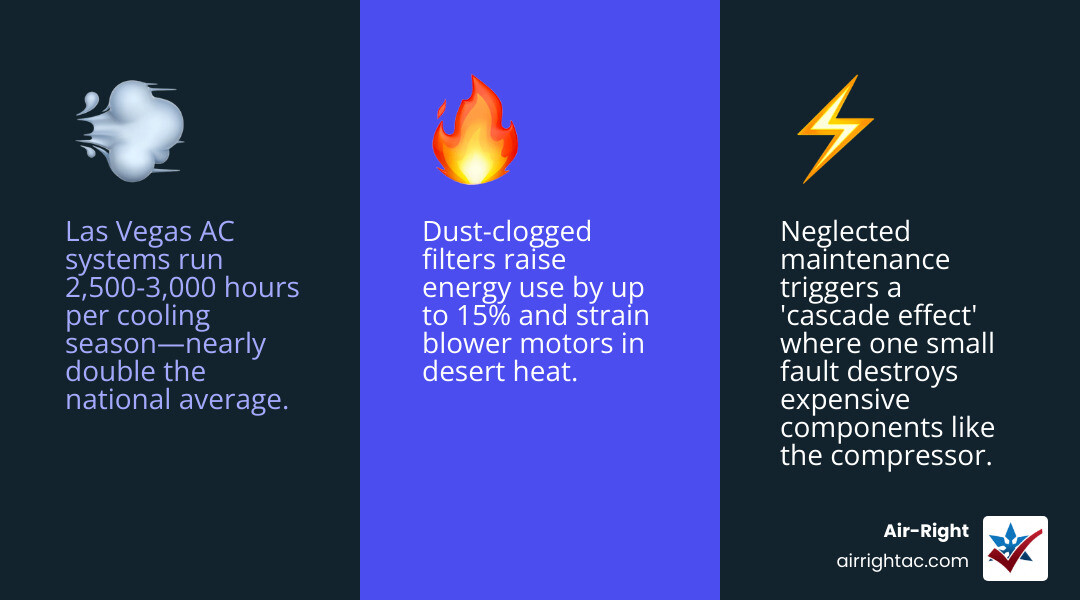
Las Vegas HVAC systems run an average of 2,500 to 3,000 hours per cooling season — nearly double the national average. That kind of workload turns minor maintenance oversights into major mechanical failures faster than most homeowners expect. A system that might survive years of neglect in Seattle can break down in a single Southern Nevada summer.
The good news is that most of these failures are completely preventable. Knowing what to watch for — and when to act — is the first step.
Neglecting the “Desert Dust” Air Filter Cycle
One of the most frequent hvac maintenance mistakes desert homeowners make is following the “standard” advice found on the back of filter packaging. Most manufacturers suggest changing filters every 90 days. However, in the Las Vegas Valley, our air is thick with unique challenges like caliche dust, silica particles, and gypsum. These abrasive minerals don’t just sit on the surface of the filter; they weave into the fibers, creating a wall that your air conditioner has to struggle to breathe through.
In Southern Nevada, a standard filter can become functionally clogged in as little as 30 to 45 days. When we allow this buildup to remain, we aren’t just dealing with dusty air. We are forcing the system to work harder to pull air through a restricted space. This lack of airflow is a primary cause of frozen evaporator coils and excessive strain on the blower motor.
To keep your system healthy, we recommend a 30-day inspection. If you have pets or live near new construction in Henderson or Summerlin, you might even need a replacement sooner. Understanding How Desert Dust And Heat Change Your Ac Service Schedule is vital for anyone living in the Mojave Desert.
Why skipping filters is one of the top hvac maintenance mistakes desert homeowners make
When airflow is restricted by a dirty filter, the consequences ripple through the entire system:
- Energy Consumption Spikes: A clogged filter can reduce airflow enough to raise your energy usage by 15%.
- Evaporator Coil Freezing: Without enough warm air passing over the coils, the refrigerant inside gets too cold, causing moisture to turn into ice.
- Blower Motor Strain: The motor must spin faster and work harder to move air, leading to premature burnout.
- Poor Indoor Air Quality: Once a filter is “full,” it can no longer trap particulate matter, allowing dust and allergens to recirculate through your home.
By mastering these Maintenance Secrets To Keep Your Ac From Quitting On You, you can avoid the “suffocation” that kills so many desert AC units.
Skipping Professional Tune-ups Before the 110°F Rush
In Las Vegas, our air conditioners are not a luxury; they are a lifeline. Many homeowners assume that if the air is blowing cold in April, it will continue to do so in July. This is a dangerous gamble. A professional spring tune-up is designed to catch the “silent killers” of HVAC systems—like a capacitor that is slightly out of spec or a minor refrigerant leak—before they turn into a mid-summer emergency.
| Service Item | Preventative Maintenance | Emergency Replacement |
|---|---|---|
| Cost | Minimal (Scheduled Tune-up) | Significant (Emergency Rates) |
| Component | Capacitor or Contact Check | Full Compressor Failure |
| Downtime | 1-2 Hours (Planned) | 2-4 Days (During Heatwave) |
Scheduling an inspection in March or April allows us to ensure your system is ready for the 3,000-hour marathon ahead. You can learn more about Why Your Ac Needs A Checkup Before The Next Heatwave to understand the technical checks we perform. For those who want year-round security, exploring Hvac Maintenance Plans Pros Cons And Peace Of Mind can help you decide if a structured program is right for your home.
The danger of bi-annual neglect in Southern Nevada
Even though our winters are mild, desert HVAC systems need attention twice a year. In the fall, we check heat pump reversing valves and gas furnace connections. In the spring, the focus shifts to the cooling components that will be pushed to their limit.
- Capacitor Failure: High heat degrades the electrical chemicals inside capacitors, which are the most common failure point in Las Vegas.
- Electrical Connections: The extreme expansion and contraction caused by 30-degree daily temperature swings can loosen electrical terminals.
- Lubrication: Moving parts like fan motors need to be checked for proper lubrication to prevent friction-based heat.
Securing an Ac Maintenance Contract ensures these small details aren’t forgotten, protecting your system from the unforgiving Nevada sun.
Critical hvac maintenance mistakes desert homeowners make with Thermostats and Vents
There is a common myth that setting your thermostat to 65°F will cool your home faster when it’s 110°F outside. In reality, your AC system is designed to provide a specific temperature “drop” (usually 20-25°F) between the intake air and the supply air. When you demand a 40-degree differential, you aren’t making the system work faster; you are making it work forever.
This constant running can lead to “liquid slugging,” where liquid refrigerant makes its way back to the compressor—a component designed only to handle gas. This is a fast track to a dead system. Understanding these limits is part of Getting To Know Common Signs Of A Faulty Hvac Unit.
How closing vents leads to hvac maintenance mistakes desert homeowners make
Many homeowners in Boulder City or Henderson try to save money by closing vents in guest rooms. This is one of the most misunderstood hvac maintenance mistakes desert homeowners make. Your HVAC system is a “closed-loop” pressure system. It is designed to move a specific volume of air (typically 400 CFM per ton). When you close vents, you increase the “static pressure” inside your ductwork.
- Ductwork Joint Separation: High pressure can physically blow flex duct connections off their metal boots in the attic.
- Attic Energy Loss: Pressurized air will find the smallest leak in your ducts and escape into the 130-degree attic instead of your living room.
- System Short-Cycling: Increased pressure causes the system to overheat or freeze, leading to frequent on-and-off cycling that wears out the motor.
Ignoring the Warning Signs of Mechanical Fatigue
Your air conditioner will usually try to tell you it’s struggling before it quits entirely. One of the biggest hvac maintenance mistakes desert homeowners make is ignoring “the little things.” A squealing sound might just be a belt, but if left unaddressed, it can snap and cause the blower to fail. A grinding sound in the compressor often points to mechanical wear that, if caught early, might be repairable.
If you see ice on your refrigerant lines, do not simply turn the thermostat down further. This is a sign of a major airflow issue or a refrigerant leak. You should immediately learn How To Tell When Your Air Conditioner Needs Repair to prevent the “Cascade Effect” from destroying your unit. If your system is running but the house feels warm, check out My Ac Is Ghosting Me Why Your Unit Blows Air But No Coldness for troubleshooting tips.
Recognizing when to repair versus replace
In the desert, an HVAC unit’s lifespan is typically 10 to 14 years—significantly shorter than the 20-year national average. If your system is over a decade old and requires frequent repairs, you may be throwing good money after bad. We provide Reasons To Keep Your Hvac Unit Maintained By Experts so you can maximize the life you have left, but it’s also important to recognize the Signs Your Ac Needs Replacing Not Just Fixing.
Overlooking Attic Insulation and Monsoon Debris
The “thermal envelope” of your home is just as important as the AC unit itself. In Las Vegas, attic temperatures regularly exceed 130°F. If your insulation has settled or thinned, that heat radiates directly through your ceiling. This forces your AC to work overtime just to maintain a basic level of comfort. Upgrading to proper blown-in fiberglass or adding radiant barriers can significantly reduce the load on your HVAC system.
Furthermore, the “Monsoon Season” in late summer brings a unique set of hazards. Dust storms turn into mud when they hit the moisture on your outdoor condenser fins. This “mud-caking” acts like a blanket, trapping heat inside the unit and forcing the compressor to work 30% harder. Tumbleweeds and debris can also blow against the unit, choking off airflow. Finally, always consider surge protection; monsoon lightning strikes are a leading cause of fried control boards in Henderson and Boulder City.
Frequently Asked Questions about Desert HVAC Care
How often should I change my air filter during a Las Vegas summer?
In the dusty Las Vegas Valley, filters should be checked every 30 days and replaced at least every 45 days during peak cooling months. Neglecting this can lead to a 15% increase in energy usage and eventual system failure due to restricted airflow.
Why is it dangerous to set my thermostat to 68°F when it is 115°F outside?
Most residential systems are engineered for a 20-25°F temperature differential. When you ask for a 40-degree gap, the system runs indefinitely, which can cause the evaporator coils to freeze and lead to “liquid slugging,” a condition that can permanently destroy the compressor.
Can I clean my own outdoor AC coils?
Homeowners can safely use a garden hose to gently rinse away surface dust and monsoon mud from the outdoor unit. However, you must be careful not to use high pressure, as the aluminum fins are very delicate. A professional deep cleaning is recommended once a year to reach the internal components without causing damage.
Conclusion
Avoiding the common hvac maintenance mistakes desert homeowners make is the key to surviving the brutal Southern Nevada summers without breaking the bank. At Air-Right, we pride ourselves on being a licensed, bonded, and insured partner for homeowners in Las Vegas, Henderson, and Boulder City. Our goal is to provide clear, no-pressure recommendations that keep your home comfortable and your energy bills manageable.
Whether you need a quick repair, a high-efficiency installation, or a seasonal tune-up to beat the heat, our team is ready to help. Don’t wait for the next 110-degree day to find out if your system is up to the task.
Need Help?
Contact us today to discuss your needs. Our team is ready to help.
Related Articles
- Is It a True Emergency? A Triage Guide for 24-Hour Air Conditioning Service in Las Vegas, NV
- Is That Burning Smell an Emergency? Fall Triage Guide for 24 Hour Air Conditioning Service in Las Vegas, NV
- Beyond 24-Hour Air Conditioning Service in Las Vegas: Heat Pump vs. Gas Furnace Options for Fall Upgrades
Related articles


Ready to Get Started?
Whether you need a repair, maintenance, or a new installation, our expert team is here to help.