An Essential Guide to Servicing Your AC in the Desert
Air-Right

<p>Learn how often should you service your ac in the desert: bi-annual tune-ups for max reliability in extreme heat & dust. Expert tips!</p>
Your Las Vegas AC Works Harder Than Almost Any Other System in the Country
How often should you service your AC in the desert is one of the most important questions a Las Vegas homeowner can ask — and the answer is more urgent than most people expect.
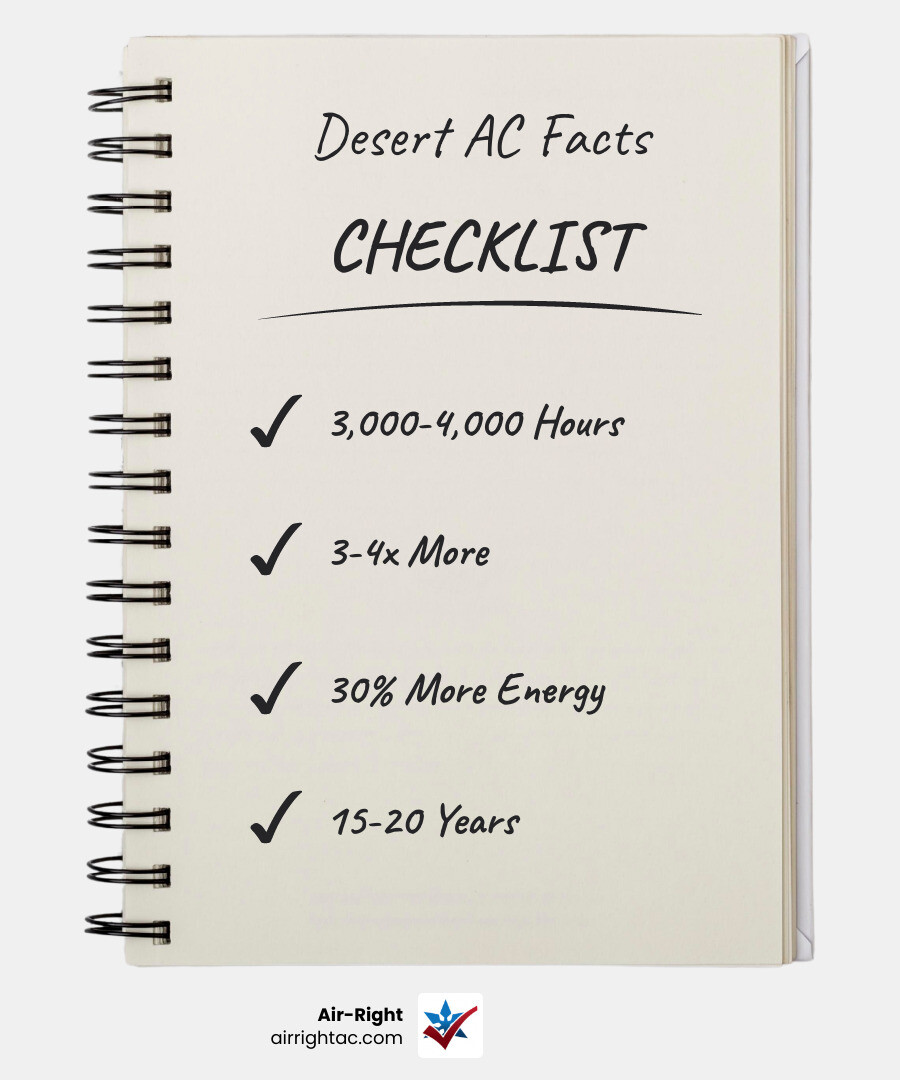
Here in Southern Nevada, your AC is not a seasonal appliance. It runs almost continuously from spring through fall, battling temperatures that regularly push past 110°F. A Phoenix or Las Vegas AC unit logs 3,000 to 4,000 operating hours every year. That’s three to four times more than a system in a moderate climate. The wear adds up fast.
The short answer:
| Your Situation | Recommended Service Frequency |
|---|---|
| Standard central AC (newer system) | Once per year, minimum |
| Most Las Vegas/Henderson homes | Twice per year (spring + fall) |
| System 10+ years old | Twice per year, without exception |
| Heat pump (heating and cooling) | Twice per year |
| High-dust home or frequent use | Twice per year |
Spring (March–April) is when you prepare your system for the brutal summer ahead. Fall (September–October) is when you repair the damage summer inflicted and get ready for cooler nights. Skip either visit, and you’re gambling with the most essential piece of equipment in your home.
Neglected systems in desert climates can burn up to 30% more energy and may fail in under a decade. Well-maintained units regularly last 15 to 20 years. That gap comes down to one thing: consistent, timely professional service.
How Often Should You Service Your AC in the Desert for Maximum Reliability?
When we talk about “maximum reliability,” we aren’t just talking about keeping the air cool. We’re talking about ensuring that when the mercury hits 115°F in July, your compressor doesn’t decide to take an early retirement. In the Mojave Desert, your air conditioner is essentially a survival tool.
For most of our neighbors in Las Vegas, Henderson, and Boulder City, the “Gold Standard” is bi-annual maintenance. While national blogs might tell you that once a year is plenty, they aren’t accounting for the “marathon run in a sandstorm” that is a Nevada summer.
There are several reasons to keep your HVAC unit maintained by experts, but the biggest one is the sheer volume of work the system performs. Think of it like a car: if you drive 5,000 miles a year, one oil change is fine. If you’re a cross-country trucker doing 100,000 miles, you’re in the shop every few weeks. Your AC is the trucker of appliances.
Why the standard recommendation for how often should you service your ac in the desert is twice a year
The math is simple but staggering. In moderate climates, an AC might run for 750 to 1,000 hours a year. In Southern Nevada, that number jumps to 4,000 hours. Because our systems run 10 to 14 hours a day during peak heat, they age three to four times faster than systems elsewhere.
This constant operation leads to significant component fatigue. Metals expand and contract violently as they go from 110°F outside to the freezing temperatures of the refrigerant lines. This causes electrical connections to loosen and mechanical parts to wear down. Furthermore, how desert dust and heat change your AC service schedule is largely due to the “insulation effect.” Dust coats the coils, trapping heat inside the system and forcing the compressor to work even harder to dump that heat outside. If you don’t clear that dust twice a year, you’re basically asking your AC to run while wearing a parka in the middle of July.
Ideal timing for Southern Nevada tune-ups
Timing is everything. You don’t want to realize your AC is struggling on the first 100-degree day in June, because that’s when everyone else realizes it, too. At Air-Right, we see “emergency season” kick off the moment the heat spikes, and waiting lists can get long.
- The Spring Tune-Up (Late February to April): This is the “pre-game” checkup. We focus on cleaning the coils, checking refrigerant levels, and ensuring the electrical components (like capacitors) are strong enough to handle the 140°F temperatures inside your attic or the direct sun on your roof.
- The Fall Checkup (September to October): This is the “recovery” phase. After a brutal summer, your system is often caked in dust and may have small refrigerant leaks or worn contactors. We clear out the summer’s debris and ensure the system is ready for the temperature swings of the desert winter.
Learning how to choose the best AC system service in Boulder City or Las Vegas means finding a team that understands these specific windows. Scheduling in the “off-season” ensures you get priority and that your system is never caught off guard by a sudden heatwave.
Unique Environmental Challenges for Desert Cooling Systems
The Mojave Desert is a beautiful place, but it is objectively hostile to mechanical equipment. We aren’t just dealing with heat; we are dealing with a trifecta of AC-killing factors: Caliche dust, extreme UV radiation, and massive daily temperature swings.
Caliche dust is fine, alkaline, and incredibly invasive. It doesn’t just sit on top of your unit; it works its way into the smallest crevices of the motor and the fins of the condenser coils. Once it gets wet (from a monsoon or even just humidity), it can harden like concrete. This is why we share so many maintenance secrets to keep your AC from quitting on you—it takes more than a quick rinse to keep a desert system healthy.
Impact of dust and heat on how often should you service your ac in the desert
Heat is the primary enemy. In a Las Vegas attic, temperatures can easily soar to 140°F. This heat puts immense stress on the electrical capacitors—the small “batteries” that give your motors the kick they need to start. In the desert, capacitors are often the first thing to fail. If a capacitor is weak and you don’t catch it during a routine HVAC maintenance visit, it can cause the compressor to overheat and burn out. Replacing a capacitor is a minor fix; replacing a compressor is a major surgery that can cost thousands.
The heat also affects your refrigerant. While the system is sealed, the extreme pressure caused by 115°F ambient air can exacerbate tiny pinhole leaks that wouldn’t even be an issue in a cooler climate. A system that is even 10% low on refrigerant will struggle to cool, run longer cycles, and spike your energy bill by 20% or more.
The “Fatigue Zone” for older desert units
If your AC system is over 10 years old, it has entered what we call the “Fatigue Zone.” In more temperate states, a 10-year-old unit is middle-aged. In Las Vegas, it’s a senior citizen.
The national average lifespan for an AC is 15 to 20 years, but in Arizona and Southern Nevada, that average drops to 8 to 12 years for neglected units. However, we’ve seen well-serviced units in Henderson reach that 20-year mark. The difference is the frequency of AC system services. Once a unit hits the 10-year mark, bi-annual service becomes non-negotiable if you want to avoid a total system seizure during a July heatwave.
What a Professional Desert Tune-Up Includes
If a technician is in and out of your house in 15 minutes, you didn’t get a “desert-grade” tune-up. A thorough professional service for a home in Southern Nevada should take between 60 and 90 minutes. It’s a deep dive into the health of your system.
At Air-Right, our residential tune-ups are designed to counteract the specific stresses of our climate. Here is what a real professional tune-up should include:
- Condenser Coil Deep-Cleaning: We don’t just spray it with a hose. We use specialized cleaners to break down the caliche dust and grime that act as an “insulating blanket” on your coils. Clean coils can improve heat transfer efficiency by up to 20%.
- Refrigerant Charge Verification: We check the “sub-cooling” and “super-heat” levels. In the desert, being off by just a few ounces of refrigerant can mean the difference between a cool home and a $500 energy bill.
- Electrical Tightening and Inspection: We check for pitted contactors and “swollen” capacitors. We also tighten all electrical connections, as the vibration of the unit and the expansion from heat can loosen them over time.
- Condensate Line Clearing: Desert air is dry, but your AC still pulls gallons of water out of the air inside your home. If the drain line clogs with dust and algae, it can flood your ceiling. We flush these lines to ensure they are clear.
- Blower Motor Lubrication and Cleaning: A dusty blower wheel is heavy and inefficient. We ensure the motor is lubricated and the wheel is balanced.
- Thermostat Calibration: If your thermostat is off by just two degrees, your system might run for two extra hours a day. We make sure it’s reading the room accurately.
Warning Signs Your System Needs Immediate Attention
Sometimes, your AC won’t wait for your scheduled appointment to tell you something is wrong. In the desert, a small problem can become a catastrophic failure in 48 hours because of the extreme heat. You should consult your local Boulder City AC service handbook—or just keep an eye out for these red flags:
- Weak Airflow: If the air coming out of your vents feels like a gentle sigh rather than a steady breeze, your blower motor might be failing or your coils might be frozen.
- Unusual Noises: Grinding, squealing, or loud “banging” when the unit starts are signs of mechanical failure. A hissing sound usually indicates a refrigerant leak.
- Musty Odors: This often points to “Dirty Sock Syndrome,” where bacteria and mold grow on the damp evaporator coils. It’s a sign that your system needs a professional cleaning.
- Short-Cycling: If your AC turns on and off every few minutes, it’s struggling. This is incredibly hard on the compressor and is often caused by an overheating motor or a faulty sensor.
- Ice on the Lines: It sounds counterintuitive in 110-degree heat, but if your refrigerant is low or your airflow is blocked, the coils can drop below freezing and turn into a block of ice. If you see ice, turn the system off immediately and call us. Running a frozen system can destroy the compressor.
Essential Homeowner Maintenance Between Professional Visits
While we handle the heavy lifting, there are several things you can do to support your system. Think of us as the doctor and you as the person making sure the system eats its vegetables and gets enough sleep.
1. The 30-45 Day Filter Rule In most parts of the country, you can change your filter every three months. In Las Vegas, that’s a recipe for disaster. Between the desert dust and the fact that your system runs 3x more than average, your filters get clogged fast. We recommend checking them every 30 days. If they look gray or dusty, swap them out. Clogged filters are the #1 cause of service calls because they choke the system and cause it to freeze up.
2. Clear the “Zone of Death” Your outdoor unit (the condenser) needs to breathe. Keep at least two feet of clear space around it. Remove any weeds, debris, or “desert landscaping” that has migrated too close. If the unit is surrounded by bushes or storage boxes, it will recirculate its own hot air, making it much less efficient.
3. The Gentle Rinse Once a month during the summer, you can gently rinse the outdoor coils with a garden hose. Do not use a pressure washer, as the high pressure can bend the delicate aluminum fins and ruin the unit. Just a gentle spray to wash away surface dust can help the system breathe a little easier between professional cleanings.
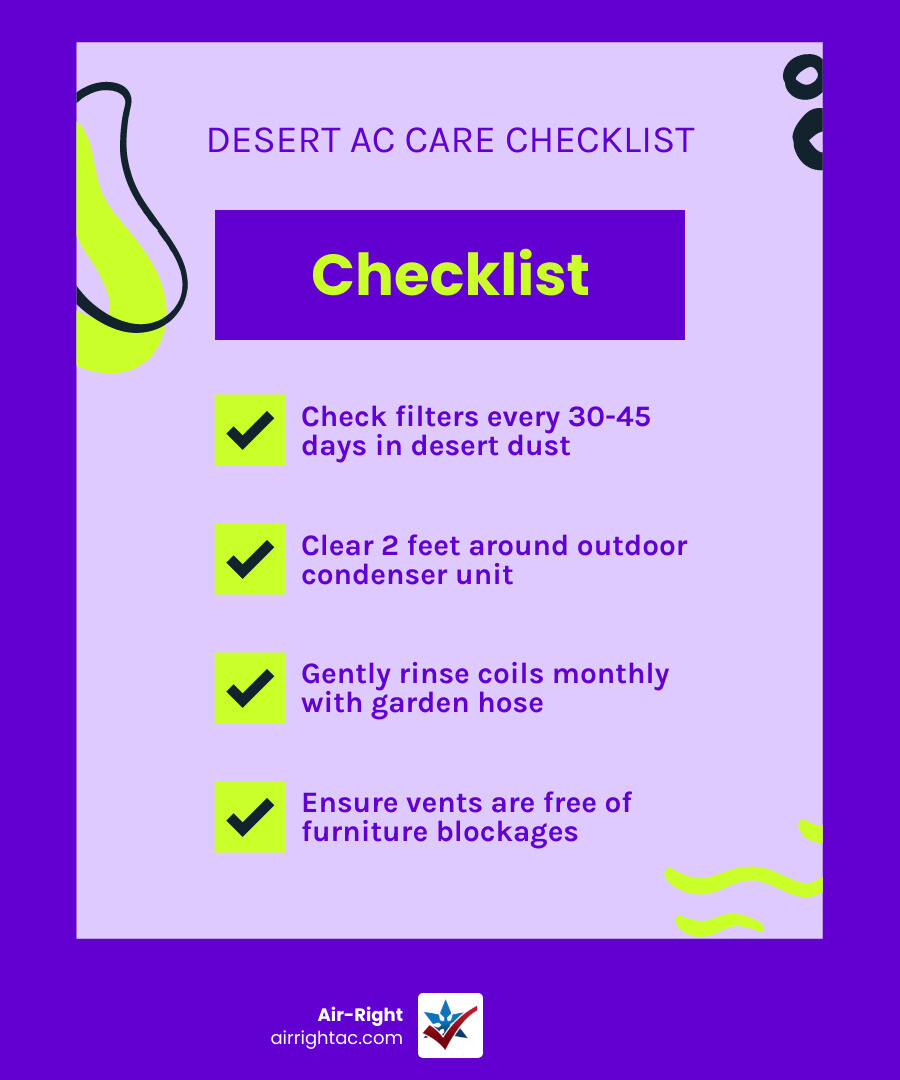
4. Vent Obstruction Checks Walk through your home and make sure no furniture, rugs, or drapes are blocking the return air vents or the supply registers. Your AC needs a specific amount of “inhale” and “exhale” to stay balanced. Blocking vents increases the pressure in your ductwork and can lead to leaks or motor failure.
Frequently Asked Questions about Desert AC Maintenance
How often should I change my filters in Las Vegas?
In Las Vegas, you should check your filters every 30 days and replace them at least every 45 to 60 days during the peak of summer. If you have pets or live near a construction site (which is common in Henderson and Summerlin), you may need to change them every single month. High-quality MERV 8 to MERV 11 filters are usually the best balance between air filtration and airflow for desert homes.
Is a maintenance contract worth it for desert homeowners?
Absolutely. An AC maintenance contract is essentially insurance for your comfort. At Air-Right, our club members get bi-annual tune-ups, but they also get priority scheduling. When it’s 115°F and everyone’s AC is breaking down, being at the front of the line is priceless. Plus, regular professional maintenance is required by almost every manufacturer to keep your warranty valid. If your compressor fails in year five but you can’t prove you had it serviced, the manufacturer may deny your claim.
What happens if I skip a year of maintenance in the desert?
Skipping one year in the desert is like skipping four years in a place like Oregon. You’ll likely see a 15% to 25% spike in your energy bills as the system struggles to work through dirty coils. More importantly, you risk “The July Surprise”—a total system failure on the hottest day of the year. The most expensive part of an AC is the compressor, and the most common cause of compressor failure is the strain caused by lack of maintenance.
Conclusion
At Air-Right, we’ve spent years helping our neighbors in Las Vegas, Henderson, and Boulder City stay cool when the desert tries its best to do the opposite. We know that a well-maintained AC isn’t just about luxury; it’s about peace of mind. Our team is fully licensed, bonded, and insured, and we pride ourselves on providing clear, no-pressure recommendations. We’ll never try to sell you a part you don’t need, but we will always tell you the truth about what it takes to keep your system running in this harsh climate.
Don’t wait for the heat to find the weak spots in your cooling system. Schedule service residential today and ensure your home remains a cool oasis all summer long. Whether you need a quick spring tune-up or a comprehensive system evaluation, we’re here to help you beat the heat.
Need Help?
Contact us today to discuss your needs. Our team is ready to help.
Related Articles
- Is It a True Emergency? A Triage Guide for 24-Hour Air Conditioning Service in Las Vegas, NV
- Is That Burning Smell an Emergency? Fall Triage Guide for 24 Hour Air Conditioning Service in Las Vegas, NV
- Beyond 24-Hour Air Conditioning Service in Las Vegas: Heat Pump vs. Gas Furnace Options for Fall Upgrades
Related articles


Ready to Get Started?
Whether you need a repair, maintenance, or a new installation, our expert team is here to help.