An Essential Guide to High SEER AC Value
Air-Right

<p>Is a high SEER AC worth it in extreme heat? Discover how SEER2 ratings, EER performance, and desert-ready efficiency keep Southern Nevada homes cool without wasting energy.</p>
Is a High SEER AC Worth It in Extreme Heat? Here’s What Las Vegas Homeowners Need to Know
Is a high SEER AC worth it in extreme heat? For most Las Vegas homeowners replacing an older 10-14 SEER system, the answer is yes — but the details matter more than the marketing.
Quick Answer: When Is a High SEER AC Worth It in Extreme Heat?
| Your Situation | Worth It? |
|---|---|
| Replacing a system below 14 SEER | Yes — strong payback, clear savings |
| Upgrading from 14-16 SEER to 16-18 SEER | Usually yes — especially with tax credits |
| Jumping from 16 SEER to 21+ SEER | Often not — diminishing returns in extreme heat |
| Home has leaky ducts or poor insulation | Fix those first — ratings won’t matter otherwise |
| Running AC 2,000+ hours per year (Las Vegas summers) | Higher SEER pays back faster than in mild climates |
Here’s what most salespeople won’t tell you: in Southern Nevada, where summer temperatures regularly push past 105°F and AC systems run almost continuously for months, the SEER rating on the brochure doesn’t always predict real-world performance. That’s because SEER is calculated based on an average outdoor temperature of around 83°F — a figure that Las Vegas sees for maybe a few weeks in spring, not July.
When your system is grinding through a 110°F afternoon, a different rating called EER (Energy Efficiency Ratio) — tested at 95°F — is actually a much better predictor of what you’ll pay on your NV Energy bill. Two units, one rated at 42 SEER and another at 24 SEER, can have the identical EER of 15, meaning they perform exactly the same during a desert heatwave despite wildly different headline numbers.
That said, high-efficiency systems with variable-speed compressors and inverter technology do offer real advantages in extreme heat — not just on paper. They avoid short cycling, run more quietly, and maintain steadier temperatures during the long shoulder hours of morning and evening when Las Vegas still stays hot but not at peak load. And when paired with sealed ductwork and proper attic insulation, the savings add up significantly over a system’s 15-20 year lifespan.
This guide breaks down the honest financial case, the SEER vs. EER distinction, and what actually moves the needle for homes in Southern Nevada.
Understanding SEER vs. EER in Desert Climates
To make an educated decision for your home in Las Vegas, Henderson, or Boulder City, you have to look past the standard marketing buzzwords. Every new air conditioner comes with a yellow EnergyGuide label proudly displaying its Seasonal Energy Efficiency Ratio (SEER or the updated SEER2). But in the Mojave Desert, relying strictly on SEER to predict your summer energy bills is a bit like buying a car based solely on its highway fuel economy when you only plan to drive it up a steep mountain in first gear.
The Seasonal Energy Efficiency Ratio (SEER)
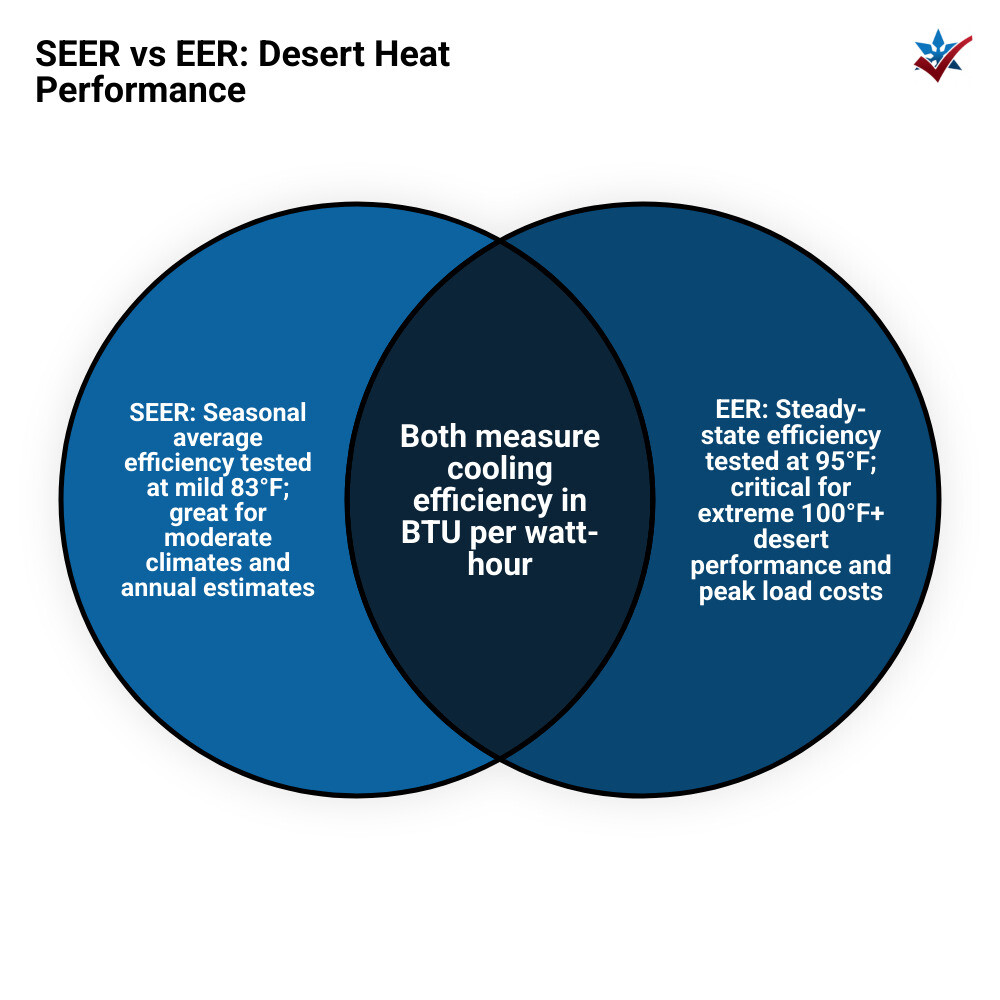
SEER measures how efficiently an air conditioner performs over an entire cooling season. To calculate this, manufacturers test the system across a range of outdoor temperatures spanning from 64°F to 104°F. However, the math is heavily weighted toward an average temperature of 83°F.
While an 83°F afternoon sounds like a delightful spring day, it doesn’t represent the grueling reality of a Southern Nevada summer. When the sun is beating down on your roof and the ambient temperature reaches 115°F, your system isn’t running under “seasonal average” conditions. It is running at maximum capacity under extreme thermal stress.
The Energy Efficiency Ratio (EER)
This is where the Energy Efficiency Ratio (EER) becomes your best friend. Unlike SEER, EER is not an average. It is a steady-state efficiency measurement tested at one specific, harsh temperature: 95°F.
Because EER measures how efficiently the system runs when it is actually hot outside, it is a much more accurate gauge of peak summer performance. In desert climates, prioritizing a high EER rating ensures your air conditioner won’t choke under pressure when the grid is strained and temperatures hit triple digits. If your system is already struggling, you might be experiencing some of the classic issues detailed in our guide on Triple Digit Trouble: Why Your Air Conditioner Is Quitting On You.
| Rating Metric | Testing Temperature Framework | What It Actually Measures | Why It Matters to Southern Nevada Homeowners |
|---|---|---|---|
| SEER / SEER2 | Evaluated across a range (64°F to 104°F), heavily weighted at 83°F | Seasonal average efficiency over mild and warm months | Great for calculating spring and autumn “shoulder season” energy use. |
| EER / EER2 | Tested at a constant, steady-state 95°F | Peak-load efficiency under high-stress conditions | The true indicator of how much power your AC draws during a July heatwave. |
Understanding this structural difference helps explain why some ultra-high SEER systems don’t deliver the massive utility savings in Southern Nevada that they might in milder climates. If two systems have different SEER ratings but identical EER ratings, their energy consumption during the hottest hours of the day will be virtually identical.
Is a High SEER AC Worth It in Extreme Heat?

When the thermometer climbs past 100°F, every air conditioner experiences a performance drop. As the outdoor air gets hotter, it becomes harder for the condenser coil in your outdoor unit to shed the heat it extracted from your home. The compressor has to work significantly harder, drawing more electricity to do the same amount of cooling.
At 110°F and beyond, standard single-stage air conditioners run continuously at 100% capacity. Because they can only turn fully on or fully off, they have no flexibility.
High-efficiency systems, however, typically utilize advanced variable-speed compressors powered by inverter technology. Instead of running at either 0% or 100%, an inverter-driven compressor can adjust its output in tiny 1% increments.
During the hottest parts of the day, even a variable-speed system will run at full capacity. But as the sun goes down and the outdoor temperature drops to 90°F, a high-efficiency system will scale back its output to 40% or 50%. This constant, low-speed operation prevents the system from turning on and off repeatedly—a process known as short cycling.
Short cycling is incredibly hard on electrical components and is one of the leading causes of premature compressor failure in desert environments. If you are noticing uneven cooling, frequent cycling, or soaring energy bills, it might be time to review the Signs Your AC Needs Replacing Not Just Fixing.
The Financial Verdict: Is a High SEER AC Worth It in Extreme Heat?
Investing in a high-efficiency system in Southern Nevada is a long-term financial decision. Because our cooling season is exceptionally long—often running from late April through October—our systems accumulate over 2,000 runtime hours per year. This high usage dramatically shortens the payback period of a high-efficiency upgrade compared to colder northern states.
Upgrading from an old, worn-out 10 SEER system to a modern 16 to 18 SEER2 system can slash your annual cooling costs by 30% to 40%. Over the typical 15-to-20-year lifespan of a well-maintained system, those monthly savings add up to thousands of dollars back in your pocket.
Key Financial Benefits of High-Efficiency AC Systems:
- Substantial Utility Reductions: Lower monthly power bills during our brutal summer billing cycles.
- Extended Equipment Lifespan: Variable-speed systems experience less mechanical wear and tear because they avoid the harsh startup spikes of single-stage units.
- Enhanced Home Value: A modern, high-efficiency HVAC system is a major selling point for future buyers in the Las Vegas real estate market.
- Minimized Repair Costs: Newer systems utilizing inverter technology run smoother, reducing the risk of sudden, expensive mid-summer breakdowns.
However, chasing the absolute highest SEER rating available (such as 22 to 25+ SEER) often leads to diminishing returns. The price jump from an 18 SEER2 system to a 24 SEER2 system is substantial, but the actual energy savings between the two in extreme heat are relatively small because their EER ratings are often very close. For most local homeowners, the financial “sweet spot” is a high-quality 16 to 18 SEER2 system with a strong EER rating.
Why EER Matters More Than SEER When Temperatures Exceed 100°F
During a classic Southern Nevada heatwave, peak demand on the electrical grid occurs between 1:00 PM and 7:00 PM. This is also when utility companies often charge higher rates for electricity.
Because your air conditioner runs continuously during these peak hours, its steady-state EER rating determines exactly how much power it pulls from the grid. A system with a high EER rating draws fewer kilowatts under maximum load, directly protecting you from peak-rate billing spikes.
Furthermore, dry desert climates require systems with a high Sensible Heat Ratio (SHR). In humid climates, an air conditioner has to spend a massive amount of energy removing moisture from the air (latent cooling).
In Las Vegas, our air is already dry, meaning almost all of our AC’s energy goes toward lowering the actual air temperature (sensible cooling). Systems optimized with a balanced EER perform exceptionally well at sensible cooling, ensuring you get maximum temperature relief for every watt of power consumed.
Maximizing High-Efficiency AC Performance Beyond the Ratings
Many homeowners make the mistake of assuming that buying a high-SEER air conditioner will instantly solve all of their comfort and energy problems. In reality, your air conditioner is only one part of a complex machine: your entire home envelope.
Installing a high-efficiency AC in a home with leaky ducts and poor insulation is like putting a brand-new hybrid engine into a car with flat tires and a slipping transmission. You will never see the performance or savings you paid for.
How Ductwork and Insulation Impact the Question: Is a High SEER AC Worth It in Extreme Heat?
In typical Las Vegas homes, a staggering 20% to 30% of conditioned air is lost to the attic through leaky, unsealed ductwork. When you consider that attic temperatures in Henderson and Boulder City can easily climb past 140°F in July, any cool air escaping into that space is money vaporizing instantly.
Worse yet, leaky return ducts can actually pull superheated, dusty attic air directly into your living spaces, forcing your new AC to work twice as hard.
To truly get your money’s worth from a high-efficiency system, you must address these thermal barriers. Ensuring your attic has a robust thermal barrier keeps the heat out and the cool air in. For an in-depth look at how to stop wasting energy, check out our guide on how to Stop Burning Cash With The Best Insulation ROI Upgrades.
Home Efficiency Upgrades That Support High SEER Systems:
- Professional Duct Sealing: Prevents conditioned air from escaping into unconditioned attic spaces.
- Attic Insulation Upgrades: R-38 to R-60 insulation creates a powerful barrier against radiant roof heat.
- Airflow Balancing: Ensures equal static pressure and air distribution throughout every room in your home.
- Smart Thermostat Integration: Allows you to pre-cool your home during off-peak hours and manage cooling schedules efficiently.
The Role of Professional Workmanship in System Efficiency
A high-efficiency air conditioner must be precisely matched to the unique layout of your home. This process starts with a proper Manual J load calculation, which evaluates your home’s square footage, window exposure, insulation levels, and local climate to determine the exact size of the system you need.
If a contractor simply guesses your system size based on your old unit, you run a massive risk. An oversized system will cool the house too quickly and shut off, leading to short cycling and hot spots. An undersized system will run constantly without ever reaching your thermostat setting.
Furthermore, the indoor evaporator coil and outdoor condenser unit must be a certified matched system. Mixing and matching different brands or pairing a new outdoor unit with an old indoor coil will completely destroy the system’s rated SEER2 and EER2 efficiency.
Proper static pressure management and meticulous installation workmanship are essential to unlocking the true potential of your investment. To understand what separates a rushed installation from a high-quality job, read about The Secret Sauce Behind High Quality HVAC Workmanship.
Choosing a certified, local professional who understands the specific demands of our desert climate is critical. Working with a dedicated neighborhood team ensures your system is installed to survive the local elements. Learn why keeping it local matters in our article on Local Vs Big Box Why Your HVAC System Craves A Hometown Hero.
Frequently Asked Questions About AC Efficiency in Extreme Heat
Maintaining your cooling system during a long hot season requires a mix of proper settings and consistent care. For a deep dive into keeping your system running smoothly, check out our comprehensive guide on How To Maintain Your AC In Extreme Desert Heat Without Breaking A Sweat.
Below are some of the most common questions we hear from local homeowners trying to navigate the complex world of HVAC efficiency ratings.
What is the difference between SEER and EER?
SEER (Seasonal Energy Efficiency Ratio) represents the average efficiency of an air conditioner over an entire cooling season, calculated across a variety of mild and warm outdoor temperatures. EER (Energy Efficiency Ratio) is a steady-state measurement of how efficiently the system operates at a constant outdoor temperature of 95°F.
In desert climates like Southern Nevada, EER is often a more reliable indicator of peak summer performance because it measures efficiency under actual high-heat conditions rather than seasonal averages.
Does a high SEER AC lose efficiency when temperatures exceed 100°F?
Yes, all air conditioners lose some efficiency as the outdoor temperature rises because the system must work harder to reject heat into the hot outdoor air. However, high-efficiency systems utilizing variable-speed compressors and advanced inverter technology manage this drop much better than standard single-stage systems.
While they do reach their capacity limits during continuous operation on 115°F afternoons, they still consume significantly less electricity under peak loads than lower-rated units.
What rebates or tax credits are available for high-efficiency AC units in 2026?
Under the federal Energy Efficient Home Improvement Credit (Section 25C), homeowners can qualify for federal tax credits of up to $2,000 for qualifying high-efficiency heat pumps or up to $600 for qualifying central split-system air conditioners. To qualify, systems must meet strict Energy Star efficiency standards.
Additionally, local utility companies like NV Energy offer periodic rebates for upgrading to high-efficiency smart thermostats and qualifying high-efficiency cooling systems.
Conclusion
When you live in Southern Nevada, your air conditioner isn’t just an appliance—it is a vital piece of survival equipment. While the marketing behind ultra-high SEER ratings can sometimes be misleading in extreme heat, investing in a high-quality 16 to 18 SEER2 system with a strong EER rating is undeniably worth it.
The key is to avoid chasing empty numbers on a brochure and instead focus on a complete, balanced home comfort strategy. By pairing an appropriately sized variable-speed system with sealed ductwork, proper attic insulation, and professional installation, you will enjoy lower utility bills, superior indoor comfort, and a system that won’t quit on you when the desert summer is at its worst.
At Air-Right, we believe in giving our neighbors in Las Vegas, Henderson, and Boulder City clear, honest, and pressure-free recommendations. We are fully licensed, bonded, and insured, and our technicians are dedicated to helping you find the perfect balance of efficiency and long-term value for your home.
Ready to stop burning cash and start enjoying reliable, energy-efficient comfort? Schedule your high-efficiency AC consultation with Air-Right today.
Need Help?
Contact us today to discuss your needs. Our team is ready to help.
Related Articles
- Is It a True Emergency? A Triage Guide for 24-Hour Air Conditioning Service in Las Vegas, NV
- Is That Burning Smell an Emergency? Fall Triage Guide for 24 Hour Air Conditioning Service in Las Vegas, NV
- Beyond 24-Hour Air Conditioning Service in Las Vegas: Heat Pump vs. Gas Furnace Options for Fall Upgrades
Related articles


Ready to Get Started?
Whether you need a repair, maintenance, or a new installation, our expert team is here to help.