An Essential Guide to Federal Tax Credits for AC and Insulation Upgrades
Air-Right

<p>Claim federal tax credits for AC and insulation upgrades and maximize your energy savings this year.</p>
Why Federal Tax Credits for AC and Insulation Upgrades Matter Right Now
Federal tax credits for AC and insulation upgrades are still available for qualifying improvements made through December 31, 2025 — and for Las Vegas homeowners dealing with brutal summer heat and high energy bills, this is one of the most valuable opportunities to save money on upgrades you may already need.
Here’s a quick look at what’s available:
| Upgrade Type | Credit Rate | Maximum Credit |
|---|---|---|
| Central air conditioner | 30% of cost | $600 |
| Insulation and air sealing | 30% of cost | $1,200 |
| Heat pump (alternative to AC) | 30% of cost | $2,000 |
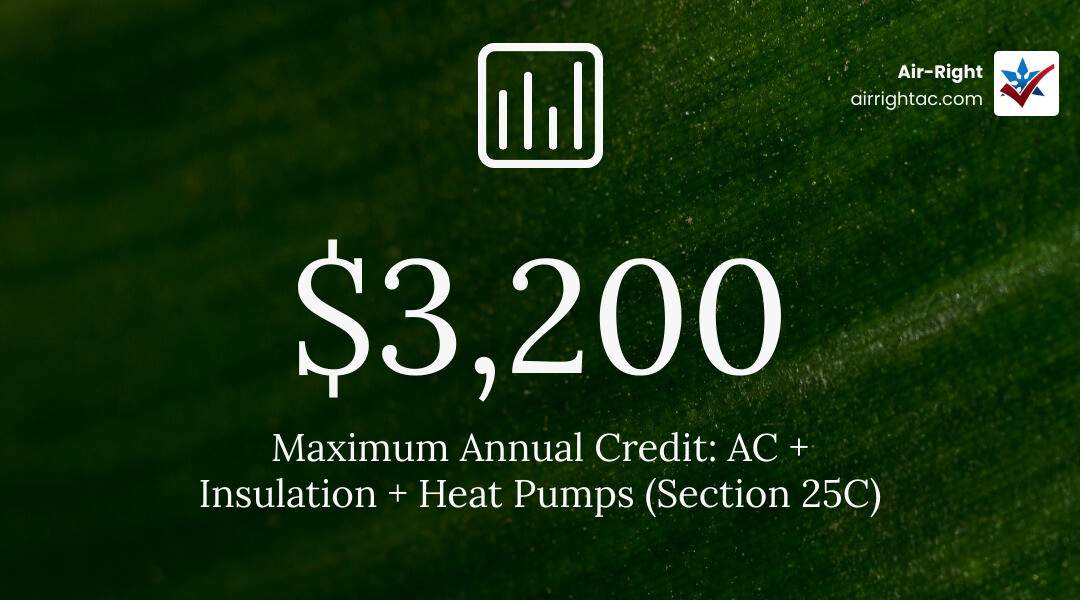
| Overall annual maximum | – | $3,200 |
These credits come from the Energy Efficient Home Improvement Credit (Section 25C), which was expanded by the Inflation Reduction Act of 2022. Unlike older versions of this credit, there is no lifetime cap — you can claim it every year through 2025. But the window is closing, and qualifying installations must be completed before year-end.
If your AC system is aging and your home is losing conditioned air through poor insulation, upgrading now means you could reduce your energy costs and get a meaningful tax break at the same time. The key is knowing what qualifies, how the annual limits work, and what documentation you’ll need when tax season arrives.
This guide covers everything Las Vegas homeowners need to know to take full advantage of these credits before they expire.
Understanding Federal Tax Credits for AC and Insulation Upgrades
When we talk about saving money on home comfort, we usually focus on monthly utility bills. However, the federal government offers a massive incentive to help offset the upfront cost of making your home more efficient. Under Section 25C of the Internal Revenue Code, the Energy Efficient Home Improvement Credit allows taxpayers to deduct a significant portion of their home improvement expenses directly from their federal tax liability.
The Inflation Reduction Act completely transformed this credit. Previously, homeowners faced a lifetime limit of $500. Once you used it, it was gone forever. Today, the credit has been restructured into an annual incentive. This means you can claim up to the maximum limit every single year the program is active.
For homeowners in the Las Vegas valley, Henderson, and Boulder City, this is a game-changer. Our summers put an incredible amount of stress on cooling systems. If you have been delaying an upgrade to your cooling system or attic insulation, understanding how these tax credits work can help you make a smart investment. Upgrading your home’s thermal envelope and installing high-efficiency cooling equipment is one of the most reliable ways to Stop Burning Cash with the Best Insulation ROI Upgrades.
Qualifying for Federal Tax Credits for AC and Insulation Upgrades
Before you plan your upgrades, it is important to understand who qualifies for these tax credits. The IRS has strict guidelines regarding the types of properties and ownership structures that can claim Section 25C benefits:
- Primary Residence Requirement: To claim the credit for insulation and air sealing materials, the property must be your principal residence. This is the home where you live most of the year.
- Existing Homes Only: The credit is designed to incentivize energy efficiency upgrades in existing structures. New construction homes do not qualify for the Section 25C credit, as builders are expected to meet modern energy codes during construction.
- Ownership Rules: Both homeowners and renters can technically claim credits for certain improvements, though renters must have the landlord’s permission to make structural changes like adding insulation. However, landlords cannot claim these credits for rental properties they own but do not live in.
- Second Homes: Second homes or vacation homes do not qualify for building envelope improvements like insulation and air sealing. However, certain residential energy property, such as highly efficient heat pumps, can sometimes be claimed on a second home used as a residence by the taxpayer, provided it is not rented out.
Annual Limits and Savings Caps for Energy Upgrades
One of the most common points of confusion is how the annual aggregate limits interact. The Energy Efficient Home Improvement Credit has an overall annual maximum limit of $3,200, but you cannot simply spend money on any upgrade and claim the full amount. The IRS divides this limit into two distinct categories with separate caps.
The first category covers general building envelope components (insulation, windows, doors) and standard heating and cooling equipment (like central air conditioners and furnaces). This category is capped at a maximum of $1,200 per year. Within this $1,200 cap, there are specific sub-limits for individual upgrades. For instance, central air conditioners are capped at $600, while insulation materials can claim the full $1,200.
The second category is dedicated to heat pump technology, including heat pump air conditioners, heat pump water heaters, and biomass stoves. This category has a separate annual limit of $2,000.
Because these two categories operate independently, you can combine them to reach the absolute maximum annual credit of $3,200. For example, you could install a qualifying heat pump (claiming a $2,000 credit) and upgrade your attic insulation (claiming a $1,200 credit) in the very same tax year.
To help you visualize how these caps apply to your upcoming projects, we have broken down the limits in the table below:
| Upgrade Category | Specific Component | Max Annual Credit | Category Cap |
|---|---|---|---|
| Building Envelope & Standard HVAC | Insulation & Air Sealing | $1,200 | $1,200 Total |
| Central Air Conditioner | $600 | ||
| Gas/Electric Furnaces | $600 | ||
| Exterior Windows & Skylights | $600 | ||
| Exterior Doors | $250 per door ($500 total) | ||
| Heat Pump Technology | Electric/Gas Heat Pumps | $2,000 | $2,000 Total |
| Heat Pump Water Heaters | $2,000 | ||
| Combined Maximum | Any qualifying combination | – | $3,200 Total |
Understanding these limits is key to scheduling your home improvements. If you plan to tackle both your cooling equipment and your home’s insulation, you need to know how they fit together to prevent leaving money on the table. To learn more about how insulation keeps your home comfortable, check out The Hot Truth About Attic Insulation Upgrades for Energy Savings.
How to Maximize Federal Tax Credits for AC and Insulation Upgrades
If you want to get the absolute most out of your federal tax credits, you do not have to do everything at once. In fact, because the Section 25C credit resets every calendar year, multi-year planning is the smartest strategy a homeowner can use.
If your home needs both a new central air conditioner and an attic insulation upgrade, doing them in the same calendar year means you will hit the $1,200 category cap. Because the central AC is capped at $600 and insulation is capped at $1,200, installing them together would yield a total combined credit of $1,200 (not the $1,800 mathematical sum, because of the category cap).
By phasing your installations, you can maximize your tax savings:
- Year One: Upgrade your attic insulation and perform comprehensive air sealing. You can claim 30% of the material costs up to the full $1,200 limit.
- Year Two: Replace your aging central air conditioner with a qualifying high-efficiency unit. You can claim 30% of the total cost (including professional installation labor) up to the $600 limit.
This phased approach allows you to claim a total of $1,800 in tax credits over two years instead of capping out at $1,200 in a single year. Additionally, improving your insulation first reduces the heating and cooling load on your home, which may allow us to install a smaller, highly efficient AC system in year two. To determine where your home is losing the most energy, read our guide on how to Stop the Heat Leak: Is Your Attic or Your Ductwork the Real Culprit?.
Technical Efficiency Standards for AC and Insulation

To qualify for federal tax credits, the products you install must meet strict energy efficiency standards. The federal government does not reward homeowners for installing standard, entry-level equipment; instead, the incentives are reserved for systems that meet or exceed the highest efficiency tiers.
Central Air Conditioner Standards
For central air conditioning units, the equipment must meet the standards established by the Consortium for Energy Efficiency (CEE) highest efficiency tier (excluding advanced tiers) in effect at the start of the year the system is placed in service.
- Split Systems: These are the most common residential AC systems, featuring an outdoor condenser and an indoor evaporator coil. To qualify, a split system must achieve a SEER2 rating of 17.0 or higher and an EER2 rating of 12.0 or higher.
- Packaged Units: Often installed on rooftops or ground-level concrete pads in the Las Vegas area, packaged systems house all components in a single outdoor cabinet. To qualify, packaged units must achieve a SEER2 rating of 16.0 or higher and an EER2 rating of 11.5 or higher.
Insulation and Air Sealing Standards
Unlike cooling equipment, which relies on mechanical testing ratings, insulation materials and air sealing systems must meet the prescriptive criteria of the International Energy Conservation Code (IECC).
For installations, the insulation must meet the prescriptive requirements of the IECC standard in effect two years prior to the installation year. The typical materials that qualify include:
- Bulk insulation such as fiberglass batts, rolls, blow-in cellulose, rigid foam boards, and expanding spray foam.
- Air sealing materials designed to stop drafts, including weather stripping, caulk, house wrap, and spray foam in a can.
When we evaluate your home, we look at the entire system to ensure your upgrades deliver maximum comfort and qualify for the appropriate incentives. Deciding where to focus your efforts is easier when you understand the difference between Choosing Between Duct and Attic Insulation for a Cooler Home.
How to Claim Your Energy Efficiency Tax Credits
Claiming your federal tax credits is a straightforward process, but it requires careful record-keeping and attention to detail. When tax season arrives, you will need to file IRS Form 5695 (Residential Energy Credits) along with your standard individual income tax return.
Here is what you need to know about the claiming process:
- Keep Itemized Receipts: Your documentation must clearly separate the cost of materials from the cost of labor. For building envelope components like insulation, only the cost of the materials qualifies for the credit—professional installation labor is excluded. For central air conditioners and heat pumps, both the equipment and the installation labor costs are fully eligible.
- Manufacturer Certification Statements: Always keep the Manufacturer Certification Statement for the specific model of AC or insulation material installed. This document is a signed statement from the manufacturer certifying that the product meets the necessary energy efficiency standards to qualify for the tax credit.
- Qualified Manufacturer ID (QMID) & PINs: For qualifying HVAC equipment installed, the IRS requires taxpayers to include the manufacturer’s Qualified Manufacturer Index (QMID) or a product-specific registration PIN on their tax return. We provide all necessary manufacturer documentation and codes upon completing your installation. Insulation and air sealing materials are exempt from this QMID reporting requirement.
- Nonrefundable Nature of the Credit: The Energy Efficient Home Improvement Credit is nonrefundable. This means the credit can reduce your tax liability to zero, but any excess credit will not be refunded to you as cash, nor can it be carried forward to future tax years. You must have federal tax liability in the year of installation to benefit from the credit.
- Tax Extensions: If you filed an extension for your tax return, you can still claim the credits for qualifying upgrades installed during that tax year, provided the equipment was placed in service before the end of that calendar year.
Frequently Asked Questions about Energy Tax Credits
Can I claim the credit for a second home?
The rules depend on the type of upgrade you are making. For building envelope components like insulation and air sealing, the credit is strictly limited to your principal residence (the primary home where you live). Second homes, vacation homes, and rental properties do not qualify for insulation tax credits.
However, for certain energy-efficient property upgrades—such as highly efficient heat pumps or heat pump water heaters—you may be able to claim the credit on a second home, provided you use the home as a residence during the year and do not rent it out to others.
Do DIY insulation projects qualify for the tax credit?
Yes, DIY projects qualify, but with an important limitation. If you purchase qualifying insulation or air sealing materials and install them yourself, you can claim the 30% credit on the cost of the materials.
However, you cannot claim any credit for the value of your own labor or time. It is also worth noting that because insulation performs best when installed without gaps or compression, professional installation is highly recommended to ensure you achieve the energy savings you expect. To see if your home is showing signs of poor thermal resistance, read about The Cold Hard Truth: Signs Your Home Needs Better Insulation.
What happens if the tax credits expire before my installation?
Under current legislation, the Energy Efficient Home Improvement Credit (Section 25C) is scheduled to remain active for qualifying installations completed through December 31, 2025. To claim the credit, the qualifying equipment or insulation must be fully installed and “placed in service” before the end of the year.
If the credits are allowed to expire or are altered by future legislative changes before your installation is complete, you may lose the ability to claim them. This is why we encourage Southern Nevada homeowners to plan and schedule their upgrades early to avoid year-end contractor backlogs and ensure all installations are completed well before the December deadline.
Conclusion
Upgrading your home’s cooling system and insulation is one of the most effective ways to combat the extreme Southern Nevada heat. By taking advantage of federal tax credits, you can significantly reduce the net cost of these vital home improvements while enjoying lower utility bills and improved indoor comfort for years to come.
At Air-Right, we make the process simple. As a fully licensed, bonded, and insured HVAC contractor serving Las Vegas, Henderson, and Boulder City, we provide clear, pressure-free recommendations tailored to your home’s unique needs. We will help you select qualifying high-efficiency equipment, install it to the highest professional standards, and provide all the necessary manufacturer documentation and certification statements you need to confidently claim your tax credits.
Ready to make your home more comfortable and energy-efficient? Here are your next steps:
- Schedule a Home Assessment: We will evaluate your current AC system and attic insulation to identify where you are losing energy.
- Get an Itemized Quote: We provide clear, detailed proposals that break down equipment specifications and material costs.
- Plan Your Upgrade Timeline: We will help you phase your projects over multiple years if needed to maximize your annual tax caps.
- Enjoy Professional Installation: Our expert technicians will complete your upgrades cleanly, safely, and efficiently.
To get started on your home comfort upgrade, visit our Air-Right Services page or contact our team today to schedule your consultation!
Need Help?
Contact us today to discuss your needs. Our team is ready to help.
Related Articles
- Is It a True Emergency? A Triage Guide for 24-Hour Air Conditioning Service in Las Vegas, NV
- Is That Burning Smell an Emergency? Fall Triage Guide for 24 Hour Air Conditioning Service in Las Vegas, NV
- Beyond 24-Hour Air Conditioning Service in Las Vegas: Heat Pump vs. Gas Furnace Options for Fall Upgrades
Related articles


Ready to Get Started?
Whether you need a repair, maintenance, or a new installation, our expert team is here to help.