A Comprehensive Guide to AC Installation in Las Vegas
Air-Right

<p>Discover how an ac installation cost breakdown helps Las Vegas homeowners choose the right system for energy-efficient comfort in Southern Nevada.</p>
What the AC Installation Cost Breakdown Really Means for Las Vegas Homeowners
Understanding the ac installation cost breakdown is the first step to making a smart, confident decision about your home’s cooling system. In Las Vegas, where summer temperatures regularly push past 110°F, a properly installed air conditioner isn’t a luxury — it’s a necessity.
Here’s a quick overview of what most Las Vegas homeowners can expect to pay:
| Installation Scenario | Typical Cost Range |
|---|---|
| Replacement with existing ductwork | $3,500 – $9,000 |
| New installation with full ductwork | $8,000 – $15,000+ |
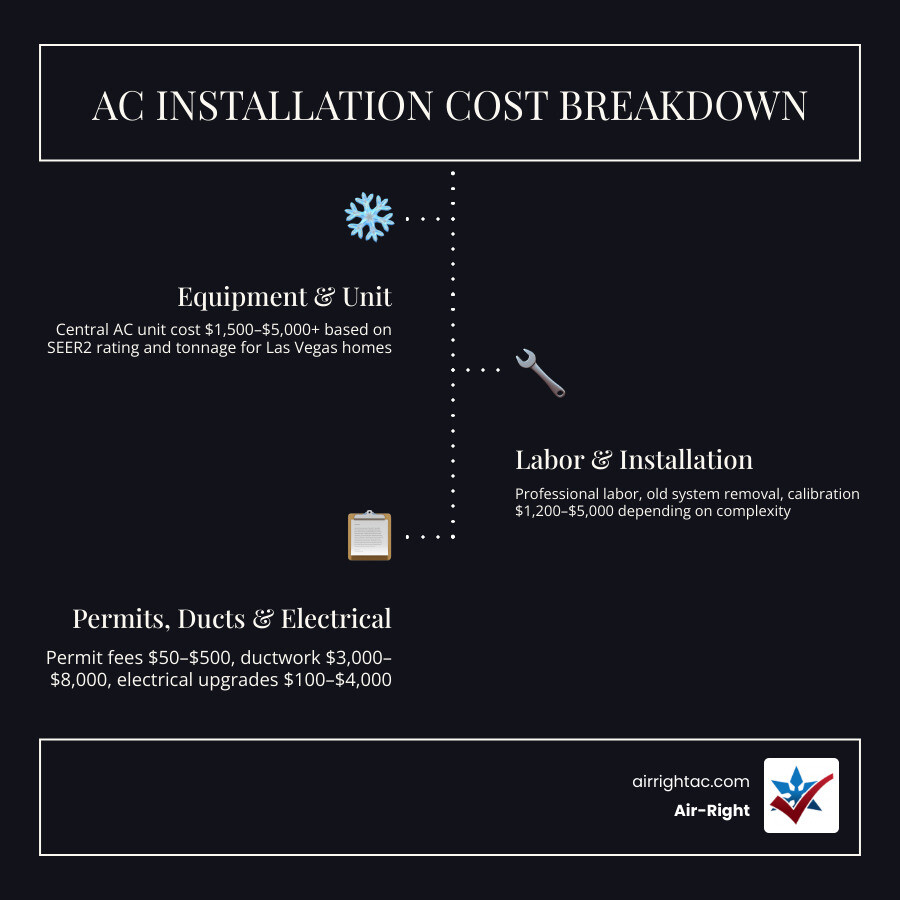
| Equipment (unit only) | $1,500 – $5,000+ |
| Labor | $1,200 – $5,000+ |
| Ductwork modifications or new ducts | $3,000 – $8,000 |
| Permit fees | $50 – $500 |
| Electrical upgrades (if needed) | $100 – $4,000 |
Quick answer: Most Las Vegas homeowners pay between $5,000 and $12,000 for a full central AC installation, depending on home size, system efficiency, ductwork condition, and labor complexity.
The gap between the low and high end of that range is wide — and that’s exactly where homeowners get caught off guard. Two homes on the same street with the same square footage can produce quotes that differ by thousands of dollars. The reason comes down to factors that go far beyond the unit itself: the condition of your existing ductwork, the efficiency tier you choose, whether your electrical panel needs upgrading, and the quality of the contractor doing the work.
Since 2020, HVAC equipment costs have risen roughly 40% industry-wide, driven by supply chain disruptions, new federal efficiency standards, and the ongoing transition away from older refrigerants. That context matters when you’re budgeting — prices today reflect a market that looks very different from just a few years ago.
In this guide, Air-Right walks you through every line item in a typical AC installation so you know exactly what you’re paying for and why — with no surprises.
Understanding the Components of an AC Installation Cost Breakdown
When we look at a quote for a new system, it is easy to focus solely on the outdoor unit. However, a professional installation is a complex mechanical project involving several distinct categories. To truly understand the ac installation cost breakdown, we have to look at equipment, labor, and the regulatory environment of May 2026.

Equipment and Technology
The physical hardware typically represents a significant portion of your investment. This includes the outdoor condenser, the indoor evaporator coil, the refrigerant lineset, and the thermostat. Technology has advanced rapidly; modern systems are far more complex than the “on-off” boxes of twenty years ago. More info about AC system services can help you understand how these components work together to manage the intense Nevada heat.
The Refrigerant Transition
A major factor in current equipment pricing is the industry-wide shift in refrigerants. As of 2025, the industry has transitioned away from R-410A in favor of newer, more environmentally friendly options like R-454B. This transition has influenced equipment design and manufacturing, contributing to the price increases seen over the last few years. These newer systems require specific tools and training for proper handling, which is reflected in the overall installation value.
Labor Complexity
Labor is not just about “dropping in” a unit. In Southern Nevada, installations often involve working in extreme attic temperatures or navigating tight crawl spaces. Professional labor covers the removal and disposal of your old system, the brazing of refrigerant lines, electrical connections, and the critical “startup and test” phase where we ensure the system is calibrated to factory specifications.
How Home Size and Unit Capacity Influence Your Installation
One of the most common questions we hear is: “Why does my neighbor’s AC cost less than mine?” The answer usually starts with tonnage and capacity. In the HVAC world, “tonnage” refers to the system’s ability to remove heat. One ton of cooling capacity can remove 12,000 BTUs of heat per hour.
The Importance of the Manual J Calculation
We never guess the size of a system based on square footage alone. A “rule of thumb” approach often leads to oversized systems that short-cycle (turn on and off too frequently), which ruins efficiency and leaves your home feeling humid. Instead, we perform a Manual J load calculation. This takes into account:
- Total square footage and ceiling height.
- The quality and R-value of your attic insulation.
- The number, size, and orientation of your windows (crucial in sunny Las Vegas).
- Local climate data for the Mojave Desert.
More info about residential services can provide deeper insight into how we tailor these calculations for homes in Henderson and Boulder City.
Comparing System Types
The type of system you choose will significantly alter your ac installation cost breakdown.
| System Type | Best Use Case | Installation Complexity |
|---|---|---|
| Split System | Homes with existing ductwork | Standard |
| Packaged Unit | Rooftop installations or small lots | Moderate (may require a crane) |
| Ductless Mini-Split | Home additions or homes without ducts | Variable (depends on number of zones) |
The Role of Efficiency Ratings in Your System Selection
Efficiency is measured by the Seasonal Energy Efficiency Ratio 2 (SEER2). Higher SEER2 ratings indicate that the system uses less electricity to provide the same amount of cooling. In our climate, where the AC might run for 12 hours a day during July and August, efficiency ratings are the biggest factor in your long-term monthly savings.
Analyzing the AC Installation Cost Breakdown for High-Efficiency Units
Entry-level systems meet the federal minimum standards, but many Las Vegas homeowners opt for mid-range or high-efficiency units. These premium systems often feature:
- Two-Stage Cooling: The system has a “high” and “low” setting, allowing it to run more efficiently on days when it isn’t 115°F.
- Variable-Speed Compressors: These function like a dimmer switch, adjusting precisely to the cooling demand. They provide the ultimate in comfort and noise reduction.
- Energy Star Certification: Units that meet these standards may qualify for additional savings and incentives.
Investing in high-efficiency hardware can reduce monthly energy bills by up to 30%. More info about HVAC products can show you the latest SEER2-compliant models available today.
Maximizing Value Through Incentives and Warranties
While the upfront investment for a high-efficiency system is higher, there are several ways to offset that cost.
- Federal Tax Credits: Through 2032, homeowners can claim federal income tax credits for Energy Star-approved upgrades, sometimes up to $2,000 or more depending on the equipment.
- Utility Rebates: Local utility companies in Southern Nevada often offer rebates for residents who switch to higher-efficiency cooling solutions.
- Warranties: A standard parts warranty is typically 10 years (provided the unit is registered), but labor warranties vary. Choosing a system with a robust warranty protects your investment for a decade or more. More info about warranties is essential for understanding your long-term protection.
Additional Factors: Ductwork, Electrical, and Permits
The “hidden” parts of an ac installation cost breakdown are often found in the attic or the electrical panel. An air conditioner is only as good as the distribution system it relies on.
Ductwork and Airflow
If you are installing a high-efficiency 5-ton unit but your ducts were designed for an older 3-ton unit, the system will suffocate. We often find that existing ductwork is leaky or undersized.
- Duct Modifications: Adjusting the “plenum” or adding return air vents to ensure proper airflow.
- Air Sealing: Ensuring that the cool air you pay for actually reaches your living room rather than leaking into a 140°F attic.
- Insulation: Upgrading your attic insulation can drastically reduce the workload on your new AC.
Electrical and Permits
Modern AC units may require different electrical requirements than your old system.
- Panel Upgrades: Older homes in Las Vegas may need a sub-panel or a full 200-amp service upgrade to handle the load.
- Disconnects and Whips: Replacing the safety switch and wiring near the outdoor unit is a standard safety requirement.
- Mechanical Permits: We always pull permits. This ensures a third-party inspector verifies that the installation meets local building codes in Las Vegas or Henderson. Skipping permits can lead to fines and issues when you try to sell your home.
More info about general services covers these essential “behind-the-scenes” upgrades.
Navigating the Professional Installation Process
A professional installation is a choreographed event. It isn’t just about the day of the install; it’s about the preparation and the follow-up.
What to Expect in a Professional AC Installation Cost Breakdown
- Site Assessment: A thorough inspection of your current system, ductwork, and electrical capacity.
- Equipment Procurement: Ordering the specific tonnage and SEER2 model that fits your home.
- Old System Removal: Safe recovery of old refrigerant and eco-friendly disposal of the old units.
- Professional Labor: The actual mechanical, electrical, and plumbing work required to set the new system.
- System Calibration: Testing refrigerant pressures, airflow, and thermostat communication.
- Final Inspection: Ensuring everything is sealed, leveled, and operating at peak performance.
More info about scheduling residential service can help you get this process started with a professional evaluation.
Choosing the Right Contractor for Your Las Vegas Home
The most expensive AC you will ever buy is the one that is installed incorrectly. Research shows that over 65% of systems are improperly installed, leading to a 20-30% loss in efficiency. When choosing a partner, look for:
- Licensing and Insurance: Protecting you and your property.
- Clear Recommendations: You should receive honest “repair vs. replace” advice without high-pressure sales tactics.
- Financing Options: Flexible payment plans can make a necessary replacement much easier on the family budget. More info about financing options can help you explore monthly payment solutions.
Frequently Asked Questions about AC Installation
How long does a typical central AC installation take in Las Vegas?
A standard replacement where the ductwork is in good condition usually takes 4 to 8 hours. If we are performing significant ductwork modifications or a full new installation in a home that never had central air, the project can take 3 to 5 days.
Should I replace my furnace at the same time as my air conditioner?
In many cases, yes. Because the indoor evaporator coil sits on top of or inside your furnace (or air handler), replacing them together ensures they are perfectly matched for efficiency. It also saves you money on labor, as we only have to “open up” the system once.
What are the benefits of upgrading to a high-SEER2 system in a desert climate?
In Las Vegas, the “payback period” for a high-efficiency system is much shorter than in cooler climates. Because our cooling season is so long, the monthly utility savings add up quickly. Additionally, high-SEER2 systems often feature better humidity control and quieter operation, which significantly improves indoor comfort.
Conclusion
Navigating an ac installation cost breakdown can feel overwhelming, but it is the key to ensuring your home remains a sanctuary during the blistering Nevada summers. From understanding the tonnage required for your specific square footage to choosing the right SEER2 rating for your budget, every decision impacts your comfort and your wallet.
At Air-Right, we pride ourselves on providing clear, no-pressure recommendations to our neighbors in Las Vegas, Henderson, and Boulder City. Whether you need a simple replacement or a full system overhaul with new insulation and ductwork, our goal is to provide energy-efficient upgrades that stand up to the Mojave Desert heat.
Ready to see what a custom solution looks like for your home? More info about AC system services is just a click away, or you can reach out to us to schedule a professional assessment today.
Need Help?
Contact us today to discuss your needs. Our team is ready to help.
Related Articles
- Is It a True Emergency? A Triage Guide for 24-Hour Air Conditioning Service in Las Vegas, NV
- Is That Burning Smell an Emergency? Fall Triage Guide for 24 Hour Air Conditioning Service in Las Vegas, NV
- Beyond 24-Hour Air Conditioning Service in Las Vegas: Heat Pump vs. Gas Furnace Options for Fall Upgrades
Related articles


Ready to Get Started?
Whether you need a repair, maintenance, or a new installation, our expert team is here to help.