5 Critical Steps for Your Pre-Summer AC Tune-Up Checklist
Air-Right

<p>Prepare your desert home with this pre summer ac tune up checklist for desert homes to beat extreme heat and dust.</p>
Why Your Pre-Summer AC Tune-Up Checklist for Desert Homes Can’t Wait
A solid pre-summer AC tune-up checklist for desert homes is the single most important thing you can do before Las Vegas temperatures climb past 110°F. When your AC runs 12 to 16 hours a day for months on end, small problems that would be minor inconveniences in milder climates become full system failures at the worst possible time.
Quick Answer: Pre-Summer AC Tune-Up Checklist for Desert Homes
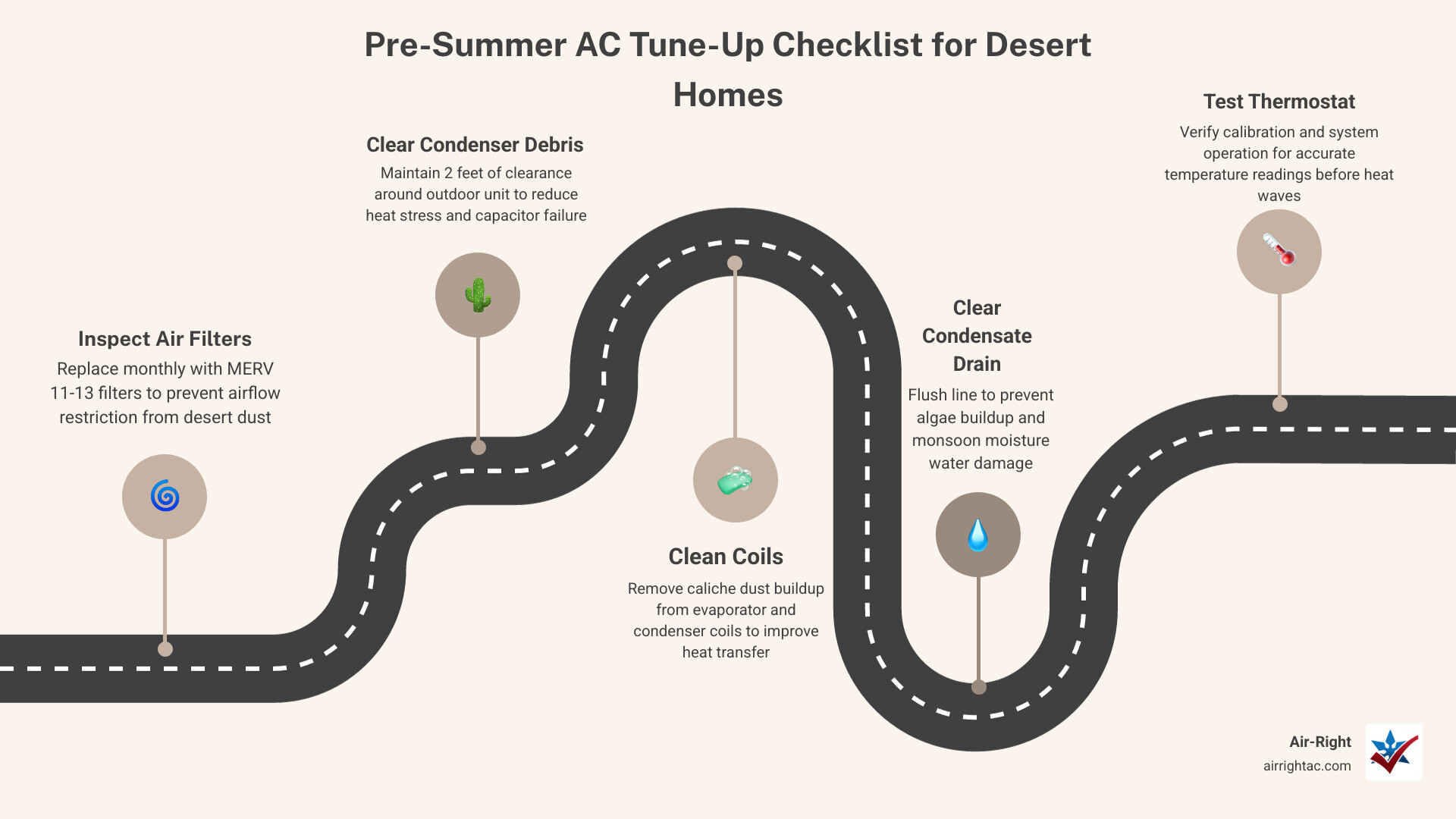
- Inspect and replace air filters – Monthly in dusty desert conditions (MERV 11-13 recommended)
- Clear debris around the outdoor condenser unit – Maintain at least 2 feet of clearance
- Clean evaporator and condenser coils – Desert dust creates an insulating layer that forces the compressor to work harder
- Clear the condensate drain line – Prevents algae buildup and water damage
- Test thermostat calibration and run the system – Verify accurate temperature readings before the first heat wave
The stakes in Southern Nevada are real. AC service companies in Las Vegas can be booked out several weeks by mid-June, meaning a system that fails during the first major heat event of the year could leave you waiting in dangerous heat with no quick fix available.
Desert conditions are simply harder on HVAC equipment than anywhere else. Fine caliche dust coats coils and acts like insulation. UV radiation degrades components faster. Heat stress pushes electrical parts like capacitors — the number one failure point in desert AC systems — right to their limits. A system that was quietly struggling in April becomes a system that stops working entirely on a 115°F afternoon in July.
The good news: most of these failures are preventable. Scheduling a professional tune-up between March and May, combined with a few simple DIY steps, is the difference between a comfortable summer and an expensive emergency.
Why a Pre-Summer AC Tune-Up Checklist for Desert Homes Is Essential
Living in the Mojave Desert means our cooling systems don’t just provide comfort—they are essential survival tools. In Las Vegas, Henderson, and Boulder City, air conditioning systems run between 2,000 and 2,700 hours per year. This is double or even triple the usage seen in more moderate regions of the country.
Without proactive care, this relentless workload causes rapid wear and tear. Neglected air conditioning units in our climate can burn up to 30% more energy just trying to keep up with the outdoor heat. Over time, this extra stress slashes the system’s lifespan. While a well-maintained desert AC unit can comfortably last 12 to 15 years (and sometimes up to 20 years with exceptional care), a neglected system often suffers catastrophic failure in under a decade.
Understanding Why Your AC Needs a Checkup Before the Next Heatwave is the first step toward protecting your investment. Proactive spring maintenance restores lost efficiency, lowers your monthly utility bills, and ensures your home remains a safe sanctuary when the summer sun is at its most punishing.
| Performance Metric | Well-Maintained Desert AC | Neglected Desert AC |
|---|---|---|
| Average Lifespan | 12 to 15+ Years | 8 to 10 Years |
| Energy Consumption | Standard / Highly Efficient | Up to 30% More Energy Burned |
| Cooling Capacity | 100% (Properly Charged & Clean) | Loses 20%+ Capacity (Dirty/Low Charge) |
| Risk of July Breakdown | Extremely Low | High (Due to component heat stress) |
| Airflow Quality | Clean, unrestricted, and healthy | Restricted, dusty, and allergen-heavy |
The Impact of Desert Dust and Heat Stress
The desert environment presents two major enemies to your HVAC system: invasive caliche dust and extreme heat stress.
Caliche dust is incredibly fine and alkaline. When windstorms kick up, this dust settles deep inside your outdoor condenser unit. It coats the aluminum fins of your coils, creating a thermal blanket. Because the coils cannot effectively release heat, your compressor is forced to work up to 30% harder to cool your home. This fine dust also acts like sandpaper on moving mechanical parts, wearing down fan motors and bearings prematurely.
At the same time, heat stress takes a massive toll on electrical components. During peak summer, attic temperatures in Las Vegas can soar past 140°F. This intense heat causes metal components to expand and contract aggressively. It also degrades the electrical capacitors that start and run your compressor and fan motors. In Southern Nevada, failed capacitors are the single most common cause of sudden AC breakdowns. Keeping your system clean and checked is the best way to Don’t Let the Dust Settle on Your HVAC Maintenance Routine.
Timing Your Pre-Summer AC Tune-Up Checklist for Desert Homes
Timing is everything when preparing your home for summer. The ideal window to complete your pre-summer AC tune-up checklist for desert homes is between March 1 and May 15.
Scheduling your service during early spring offers several distinct advantages:
- Avoid the Summer Rush: By mid-June, local HVAC companies are completely swamped with emergency calls. Waiting until the first triple-digit day to test your system means you could face weeks of delay if a part needs to be ordered.
- Catch Problems Early: Running your system for a test drive in April allows you to identify weak capacitors, minor refrigerant leaks, or worn fan belts before they turn into a major breakdown.
- Optimize Energy Savings: Getting your system tuned up in the spring ensures you reap the maximum energy-efficiency benefits from day one of the cooling season.
By utilizing holidays like Mother’s Day or Memorial Day as your annual mental reminders, you can make sure this essential chore never slips through the cracks. For a complete look at how to structure your seasonal home care, check out The Ultimate Desert Dweller Guide to HVAC Maintenance.
5 Critical Steps for Your Pre-Summer AC Tune-Up Checklist
Preparing your air conditioner for a desert summer requires a mix of consistent homeowner habits and professional expertise. By executing these five steps, you can keep your system running smoothly and safeguard against sudden failure. Dive into these Maintenance Secrets to Keep Your AC from Quitting on You to understand the mechanics behind a reliable system.

Step 1: Inspect and Replace Air Filters Frequently
In a desert environment, your air filter is your system’s first line of defense against dust, sand, and pollen. While standard national advice suggests changing filters every three months, desert homes require much more frequent attention.
During the cooling season, you should check your air filter every 30 days. If you hold the filter up to a light and cannot see light passing through it, it is time for a replacement.
- Choose the Right MERV Rating: For desert homes, we recommend using high-efficiency filters rated between MERV 11 and MERV 13. These filters are tightly woven enough to capture fine caliche dust and airborne allergens without choking your system’s airflow.
- The Danger of Restricted Airflow: A clogged filter starves your system of air. This causes the evaporator coil to drop below freezing, leading to ice buildup, weak airflow, and ultimately a burnt-out blower motor or compressor.
Step 2: Clear Debris and Maintain Condenser Clearance
Your outdoor condenser unit needs to breathe to disperse the heat it pulls from inside your home. If the unit is crowded by plants, landscaping debris, or windblown trash, it won’t run efficiently.
- Maintain 2-3 Feet of Clearance: Clear away any weeds, shrubs, or decorative plants within at least two feet of your outdoor unit.
- Remove Windblown Debris: Desert winds frequently trap leaves, plastic bags, and twigs against the condenser fins. Gently brush these away.
- Consider a Windbreak: If your home is located in an area prone to high winds and blowing sand, installing a physical windbreak or fence about three feet away from the unit can significantly reduce the amount of dust that settles on the coils.
Step 3: Clean Evaporator and Condenser Coils
Clean coils are fundamental to efficient heat transfer. When dirt and dust coat these coils, your system has to run much longer cycles to achieve your desired indoor temperature.
- Condenser Coils (Outdoor): Because the outdoor unit is exposed to the elements, it accumulates a thick layer of grime. Washing the coils annually with a gentle garden hose (never use a pressure washer, which can bend the delicate aluminum fins) removes this barrier. Proper coil cleaning alone can improve your system’s operating efficiency by 15% or more.
- Evaporator Coils (Indoor): Located inside your home or attic, these coils can become caked with fine dust that slips past cheap filters. Clean coils prevent compressor strain and keep your utility bills manageable. Learn more about managing this process in How to Maintain Your AC in Extreme Desert Heat Without Breaking a Sweat.
Step 4: Clear the Condensate Drain Line
As your AC cools your home, it also removes moisture from the air. This moisture drips into a drain pan and flows out through a condensate line.
In the desert, high temperatures can combine with standing water in the drain line to create a perfect breeding ground for algae and mold. During monsoon season, increased humidity levels accelerate this buildup, which can completely plug the pipe.
- Prevent Water Damage: A clogged drain line will back up, causing the drain pan to overflow. This can lead to severe water damage to your ceilings, drywall, and floors.
- How to Clear It: You can use a wet-dry vacuum to suck out blockages from the outdoor termination point, or flush the line with a cup of regular white vinegar once a month during the summer to keep algae from taking root.
Step 5: Test Thermostat Calibration and System Operation
Your thermostat is the brain of your HVAC system. If it isn’t calibrated correctly, your system may run too long, short-cycle, or fail to keep your home comfortable.
- Verify Accuracy: Place a separate digital thermometer next to your thermostat. After 15 minutes, compare the readings. If they differ by more than one or two degrees, your thermostat may need calibration or replacement.
- Upgrade to a Smart Thermostat: Consider upgrading to a smart, programmable thermostat. Setting your system to 78°F when you are home, and raising it when you are away, can save you up to 10% annually on cooling costs.
- Do a Test Run: Don’t wait for a 105°F day to turn your AC on for the first time. Turn it on in April, let it run for 30 minutes, and listen for unusual noises or weak airflow. Catching Triple-Digit Trouble: Why Your Air Conditioner Is Quitting on You early saves you from emergency summer headaches.
Professional Maintenance vs. DIY Care
While homeowners can easily handle tasks like changing filters and clearing weeds around the outdoor unit, a comprehensive pre-summer tune-up requires specialized tools and technical training.
Working with electricity and pressurized refrigerant carries inherent risks. A licensed professional has the expertise to safely diagnose hidden issues before they lead to an emergency breakdown. If you want to take the stress out of managing these seasonal tasks, exploring HVAC Maintenance Plans: Pros, Cons, and Peace of Mind can help you decide on the best approach for your home.
When to Call a Professional for Your Pre-Summer AC Tune-Up Checklist for Desert Homes
There are several critical maintenance tasks that must be left to a qualified technician:
- Checking Refrigerant Levels: A system that is even 10% low on refrigerant loses 20% of its cooling capacity and forces the compressor to run much hotter. Technicians use specialized gauges to measure superheat and subcooling, ensuring your system has the exact charge specified by the manufacturer.
- Testing Electrical Connections: Technicians use multimeters to check voltage and measure the capacitance of your run capacitors. Tightening loose electrical terminals and replacing weak capacitors prevents sudden failures and electrical fires.
- Inspecting Ductwork: Leaky ducts in unconditioned attics can pull in dusty, 140°F air, destroying your system’s efficiency and indoor air quality. Professionals can identify and seal these leaks to keep your home clean and cool.
Deciding how to budget for these visits? Weigh your options by reading Choosing Between HVAC Memberships and Pay-As-You-Go Service.
Frequently Asked Questions About Desert AC Maintenance
How often should I change my AC filter in the desert?
In Las Vegas, Henderson, and Boulder City, you should inspect your air filter every month. Because of blowing dust, pet dander, and high system runtimes, most desert homeowners find they need to replace their filters every 30 to 60 days during the peak spring and summer seasons. Using high-efficiency MERV 11 to 13 filters is highly recommended to trap fine desert dust.
What are the warning signs that my AC is failing?
Common red flags include weak airflow from your vents, warm air blowing when the compressor is running, frequent cycling on and off, strange squealing or grinding noises, and sudden, unexplained spikes in your monthly power bills. If you notice these issues, it’s time to evaluate whether your system needs a professional repair or if it’s time to transition. Learn more about making this choice in Signs Your AC Needs Replacing, Not Just Fixing and How to Decide If Your AC Deserves a Second Chance.
Why is my AC running constantly during peak summer?
When outdoor temperatures exceed 110°F, your home absorbs heat rapidly through the roof, windows, and walls. Standard AC systems are designed to maintain a 20-degree difference between the outdoor temperature and indoor air. On extreme days, your system will run almost continuously to combat this heat gain. You can help your system by keeping blinds closed, ensuring your attic insulation is adequate, and keeping your thermostat set to a reasonable 78°F.
Conclusion
A proactive approach to your pre-summer AC tune-up checklist for desert homes is the absolute best way to ensure your family stays cool, safe, and comfortable all summer long. By tackling simple DIY tasks like filter replacements and outdoor clearing, and partnering with a trusted professional for technical inspections, you can maximize your system’s lifespan and keep your monthly energy bills under control.
At Air-Right, we are proud to serve our neighbors in Las Vegas, Henderson, and Boulder City with honest, dependable HVAC care. Our fully licensed, bonded, and insured team is here to provide clear, pressure-free recommendations to keep your home running efficiently.
Don’t wait for the triple-digit heat to arrive. Schedule your professional AC tune-up with Air-Right today and enjoy peace of mind all summer long.
Need Help?
Contact us today to discuss your needs. Our team is ready to help.
Related Articles
- Is It a True Emergency? A Triage Guide for 24-Hour Air Conditioning Service in Las Vegas, NV
- Is That Burning Smell an Emergency? Fall Triage Guide for 24 Hour Air Conditioning Service in Las Vegas, NV
- Beyond 24-Hour Air Conditioning Service in Las Vegas: Heat Pump vs. Gas Furnace Options for Fall Upgrades
Related articles


Ready to Get Started?
Whether you need a repair, maintenance, or a new installation, our expert team is here to help.