A – Z Guide to Repair vs Replace Your AC System
Air-Right

<p>Discover when to repair vs replace your AC system with our A-Z guide: rules, signs, efficiency tips & Las Vegas upgrades. Schedule now!</p>
When to Repair vs Replace Your AC System: The Quick Answer
Knowing when to repair vs replace your ac system is one of the most important — and expensive — decisions you’ll make as a Las Vegas homeowner. In Southern Nevada, where summer temperatures routinely push past 110°F, a reliable air conditioner isn’t optional. It’s essential.
Before diving deep, here’s a fast-reference guide to help you decide:
Repair your AC if:
- The unit is under 10 years old and well-maintained
- The repair cost is less than 30% of a new system’s price
- You’ve had no more than one repair in the past 12 months
- No major components (compressor, evaporator coil) have failed
Replace your AC if:
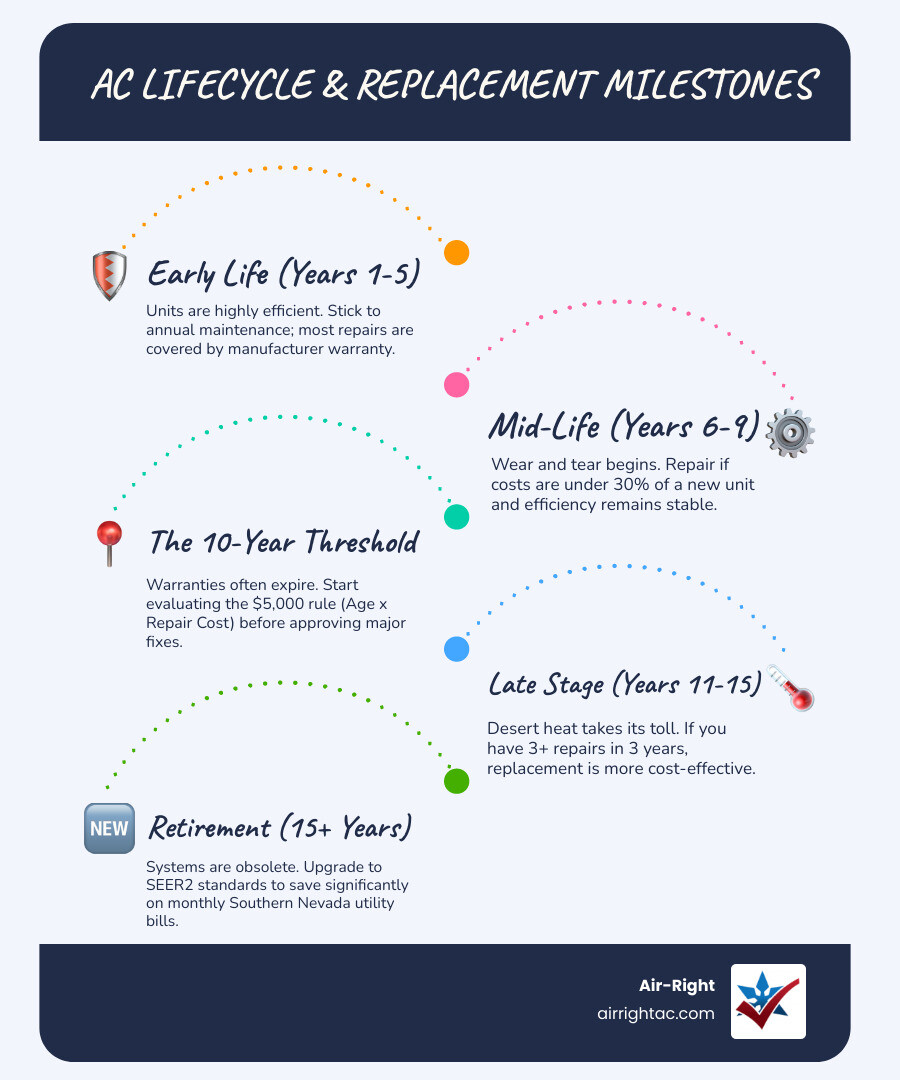
- The unit is 10–15+ years old
- Repair cost x system age exceeds $5,000 (the $5,000 Rule)
- The repair cost exceeds 50% of a new system’s price
- The system uses R-22 (Freon) refrigerant
- You’ve had 3 or more repairs in the last 3 years
Most central air conditioners last between 10 and 15 years. In Las Vegas, that window can shrink due to the relentless heat, dust, and the sheer number of hours your system runs each year. What works as a rule of thumb in a mild climate becomes a hard deadline here.
The tricky part? A system that’s limping along can feel like it’s “still working” — right up until it isn’t. And an emergency AC failure in July in Henderson or Boulder City is the worst time to start comparing quotes.
This guide walks you through every factor that matters — age, cost, efficiency, refrigerant type, and more — so you can make a confident, clear-headed decision without any pressure.
The Financial Formulas: When to Repair vs Replace Your AC System
Deciding whether to sink more money into an aging unit or invest in a brand-new one shouldn’t be a guessing game. In the HVAC industry, we use a few tried-and-true mathematical formulas to remove the emotion from the decision. These rules help homeowners in Henderson and Boulder City determine if a repair is a smart “bridge strategy” or just a case of throwing good money after bad.
The $5,000 Rule
This is the gold standard for HVAC decision-making in 2026. To use it, multiply the age of your system by the repair estimate. If the total is more than $5,000, you should seriously consider a replacement.
For example, if you have a 12-year-old unit and the repair bill is $500, that’s $6,000. Under this rule, a replacement is the smarter financial move. If the unit is only 5 years old and the repair is $500 ($2,500 total), repairing it is usually the way to go.
The 50% Rule
This one is even simpler: if the cost of a single repair is 50% or more of the value of a new system, it’s time to upgrade. Spending half the price of a new, warrantied unit on a machine that is already halfway through its life expectancy rarely makes sense.
The 3-in-3 Rule (Repair Frequency)
Are you on a first-name basis with your AC technician? If you’ve needed three or more significant repairs in the last three years, your system is signaling a systemic failure. Frequent breakdowns are a sign that components are wearing out in a “domino effect.” Once one major part goes, the stress often causes the next weakest link to fail shortly after.
To help you navigate these numbers, check out our guide on how to decide if your AC deserves a second chance.
| Decision Factor | Favor Repair | Favor Replacement |
|---|---|---|
| System Age | Under 10 years | Over 12–15 years |
| Repair Cost | Less than 30% of new | More than 50% of new |
| Frequency | First major issue | 3+ repairs in 3 years |
| Refrigerant | R-410A or R-32 | R-22 (Freon) |
| Energy Bills | Consistent | Rising 15%+ annually |
Identifying When to Repair vs Replace Your AC System Based on Performance
Sometimes the math isn’t the only factor; the way your home feels is a major indicator. If your living room feels like the Arctic but your bedroom feels like Death Valley, your system is struggling.
Uneven cooling often stems from a compressor that can no longer push air effectively or ductwork that has deteriorated. While some duct issues can be fixed with duct and attic insulation services, an old unit that can’t maintain a steady temperature across the house is often nearing its end.
Humidity control is another red flag. Even in our dry Las Vegas climate, your AC plays a vital role in removing the small amount of moisture produced by cooking, showering, and breathing. If your home feels “sticky” or damp, the evaporator coil may be failing.
Lastly, watch out for short cycling. If your AC turns on and off every few minutes, it’s not just annoying—it’s killing your compressor. This often happens when a system is improperly sized or its internal sensors are failing. If you’re wondering why your vents are moving air but the house isn’t getting cooler, read more about why your AC might be ghosting you.
Evaluating Efficiency and When to Repair vs Replace Your AC System
Efficiency standards have changed dramatically in the last decade. If your system was installed before 2015, it likely has a SEER (Seasonal Energy Efficiency Ratio) rating of 10 or 13. By 2026 standards, those units are energy hogs.
Modern systems now use SEER2 ratings, which are more stringent and accurate. Upgrading from an old SEER 10 unit to a modern SEER2 18+ system can reduce your energy consumption by 30% to 50%. In a city like Las Vegas, where the AC runs almost 24/7 in the summer, those monthly utility savings can actually help “pay back” the cost of the new unit over time.
If you notice your utility bills jumping by 15% or more year-over-year without a change in your habits, your system is likely working twice as hard to produce half the cooling. You can explore modern, high-efficiency HVAC products to see how much technology has improved.
Critical Signs It’s Time for a Full System Upgrade
Beyond the numbers and the cooling performance, there are “deal-breaker” scenarios where replacement is almost always the only logical path.
- The R-22 Refrigerant Phase-Out: If your unit was built before 2010, it likely uses R-22 (Freon). Production of R-22 was banned in 2020 because it depletes the ozone layer. Today, R-22 is extremely scarce and expensive. If an R-22 system develops a leak, the cost of the refrigerant alone can be astronomical. We almost always recommend a replacement for R-22 systems because they are at least 16 years old and use obsolete technology.
- Excessive Dust and Poor Air Quality: Older units struggle to filter out the fine desert dust common in Southern Nevada. If you find yourself dusting every other day or suffering from increased allergies, your old system’s blower motor and filtration housing may be compromised.
- Strange Noises: A healthy AC should hum quietly. If you hear grinding (bearings), banging (loose parts), or squealing (belt or motor issues), these are “death rattles.” These sounds usually indicate major mechanical failure is imminent.
- Obsolete Technology: Modern homes in 2026 rely on smart integration. If your system can’t communicate with a smart thermostat or lacks variable-speed capacity, you’re missing out on significant comfort and savings.
For a deeper look at these “red flags,” check out our article on signs your AC needs replacing, not just fixing and our guide on common signs of a faulty HVAC unit.
Modern Benefits and Efficiency Standards in 2026
If you do decide that replacement is the best path, the good news is that 2026 technology offers benefits that simply weren’t available a decade ago.
- Variable-Speed Compressors: Unlike old units that are either “100% on” or “off,” modern variable-speed systems can run at 30% or 50% capacity. This allows them to maintain a perfectly steady temperature and provides much better dehumidification.
- Smart Thermostat Integration: Today’s systems use AI-driven diagnostics to alert us to a problem before it causes a breakdown. You can monitor your home’s cooling from your phone anywhere in the world.
- Federal Tax Credits: Under current energy acts, homeowners can often claim a federal tax credit of 30% of the cost (up to $2,000) for high-efficiency heat pump systems. There are also local utility rebates in the Las Vegas area that can make the upgrade more affordable.
- Quieter Operation: Modern units are designed with sound-dampening blankets and swept-wing fan blades, making them significantly quieter than the “rumbling boxes” of the past.
- Better Air Quality: New systems often come with integrated UV lights or HEPA-grade filtration to scrub the air of viruses, bacteria, and desert allergens.
Our full suite of HVAC services can help you integrate these technologies into your home seamlessly.
Frequently Asked Questions about AC Replacement
What is the average lifespan of an AC unit in Las Vegas?
In most parts of the country, an AC unit lasts 15 to 20 years. However, the Southern Nevada climate is much harsher. Between the 115°F summer peaks and the fine caliche dust that can clog coils, we typically see a lifespan of 10 to 14 years for Las Vegas systems. Regular maintenance can push you toward the higher end of that range, but after 12 years, any major repair should be weighed against replacement. If you’re unsure if yours is still healthy, learn how to tell when your air conditioner needs repair.
Is it worth replacing an AC unit before selling a home?
Yes, absolutely. In the Las Vegas real estate market, a “new HVAC system” is one of the biggest selling points. Buyers are often wary of older homes because they fear a $10,000 surprise the first summer they move in. A new, warrantied system can increase your home’s market value and help you sail through the home inspection process. You can browse our HVAC products to see which units offer the best “curb appeal” and resale value.
How do I know if my system uses R-22 refrigerant?
Check the “data plate” on your outdoor condenser unit. It will list the refrigerant type. If it says R-22, it uses the old, phased-out Freon. If it says R-410A, it’s a modern (though now also being succeeded by R-32 or R-454B) system. Generally, any unit manufactured before 2010 uses R-22. Because of environmental regulations, these units are becoming impossible to service affordably. Our AC system services team can help you identify your refrigerant type during a standard tune-up.
Conclusion
Deciding when to repair vs replace your ac system doesn’t have to be stressful. At Air-Right, we believe in providing clear, honest, and no-pressure recommendations. We live and work in Las Vegas, Henderson, and Boulder City, so we know exactly what your system is up against during a Mojave summer.
Whether you need a quick fix to get through the month or a high-efficiency installation to lower your bills for the next decade, our licensed, bonded, and insured team is here to help. We prioritize your comfort and your budget, ensuring you get a solution that makes sense for your specific home and family.
Don’t wait for a total breakdown in the middle of a heatwave. Schedule your professional AC assessment in Las Vegas today and let us help you find the best path forward for your home’s comfort.
Need Help?
Contact us today to discuss your needs. Our team is ready to help.
Related Articles
- Is It a True Emergency? A Triage Guide for 24-Hour Air Conditioning Service in Las Vegas, NV
- Is That Burning Smell an Emergency? Fall Triage Guide for 24 Hour Air Conditioning Service in Las Vegas, NV
- Beyond 24-Hour Air Conditioning Service in Las Vegas: Heat Pump vs. Gas Furnace Options for Fall Upgrades
Related articles


Ready to Get Started?
Whether you need a repair, maintenance, or a new installation, our expert team is here to help.